
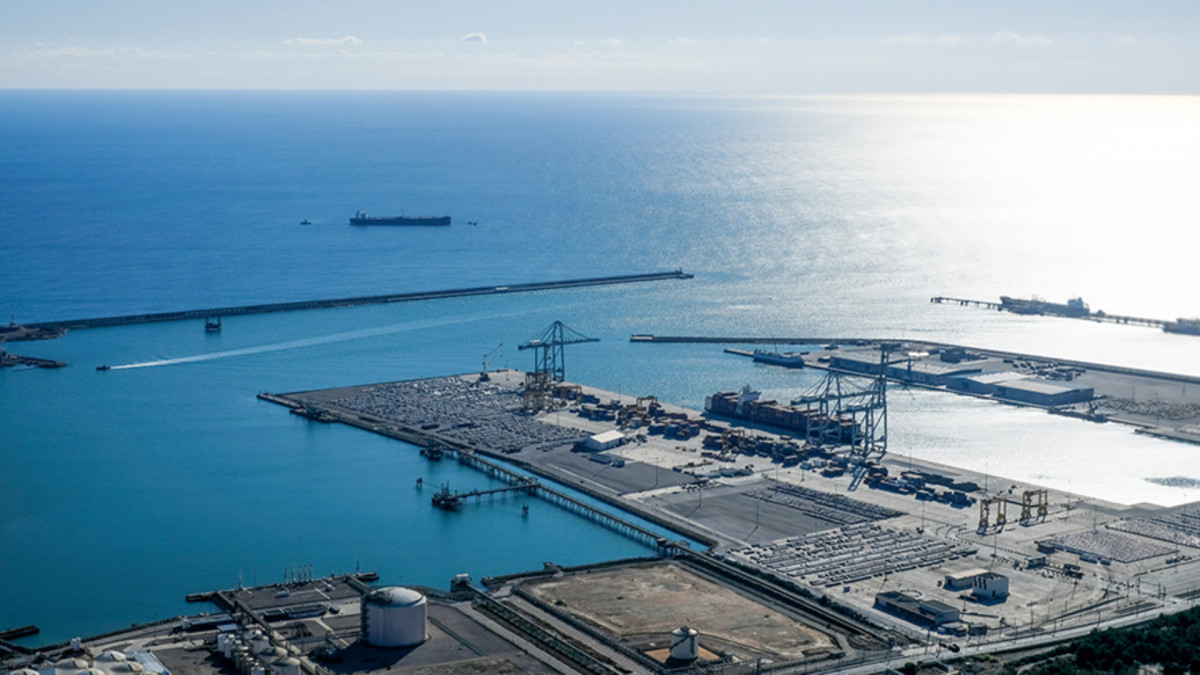
On May 28, the Tarragona Port Authority awarded to a consortium formed by the Chinese state-owned shipping company COSCO (51%) and the Argentine group PTP (49%) the 50-year concession for Moll d’Andalusia, with a net investment of €116.8 million for a multipurpose terminal capable of handling the equivalent of 680,000 TEU (the unit for a 20-foot container). The concession covers Moll d’Andalusia (where DP World operated containers until the concession reverted to the port in 2023) and the La Boella rail terminal, on a total area of 510,586 m². It will be managed by a company 51% owned by Rapport Investment Ltd, the vehicle that groups COSCO Shipping Ports and COSCO Shipping Bulk, and 49% by PTP Ibérica, the Spanish subsidiary of the Argentine group. The committed net investment is €116.8 million (about €144.6 million with taxes and interest included), a figure that, since it surpasses the bidding documents’ €60 million threshold, justifies the maximum concession period of 50 years.
The terminal will have capacity equivalent to 680,000 TEU (a mix of containers and conventional general cargo), compared with a minimum traffic commitment of 360,000 TEU from 2031, of which 200,000 TEU must correspond to containers. Work will be carried out between 2027 and 2028, with full operation expected by late 2028 and about 150 direct initial jobs, rising to 180 when fully operational. The project includes three ship-to-shore cranes, electrified machinery and a semi-automated model with digital twin technology already tested by COSCO at other terminals.
PTP (standing for “ports, terminals and platforms”) is an Argentine logistics holding founded and led by Guillermo Misiano, with more than a dozen terminals across South America and two concessions at the Port of Cádiz Bay (one for bulk solids and another for refrigerated cargo) in operation since September 2024. Tarragona is its second bet in Spain and a milestone in its transatlantic expansion.
“The logic Misiano defends, the alliance’s spokesperson, is to use Tarragona as a pivot between Asia, South America, North Africa and central Europe”
COSCO contributes its global network of terminals, its regular shipping lines and the fleet of multipurpose vessels of COSCO Shipping Bulk, the world’s largest in bulk solids with more than five hundred ships, which the group is converting to also carry containers, vehicles and general cargo to monetize round trips. PTP brings its specialization in refrigerated and agri-food cargo (a strong segment in Catalonia, with meat exports to Asia) and its port positions in South America.
The logic Misiano defends, using Tarragona as a hub between Asia, South America, North Africa and central Europe via rail, takes advantage of the opening window created by the EU-Mercosur agreement. The parties present the operation as the first European port platform of joint Sino-South American control. It is telling that Misiano frames Tarragona as a complement, not a rival, to the neighboring big ports: he insists they do not wish to compete with Valencia or Barcelona as a full-container terminal, but rather to capture niche markets and project cargo (batteries, photovoltaics, Chinese automotive) supported by rail connectivity.
COSCO already owns the largest footprint of Chinese port presence in Europe: it controls 67% of the Piraeus Port Authority, 51% of the Valencia terminals and almost 40% of Bilbao (both acquired in 2017 with the purchase of 51% of Noatum Port Holdings for €203.5 million, which also included Madrid and Zaragoza dry ports), in addition to stakes in Rotterdam (Euromax), Antwerp, Zeebrugge, Vado Ligure and 24.9% of Hamburg’s Tollerort terminal. Tarragona fits into the Maritime Silk Road as a node of the western Mediterranean connecting Asia with Europe, Africa and the Americas.
The interest comes after years of friction: the forced reduction of COSCO’s stake in Hamburg (from an initial 35% to 24.9% after 13 months of review and the intervention of Chancellor Scholz), investment lapses at Piraeus and increasing European scrutiny. Tarragona represents, in words of Lloyd’s List, the first meaningful Chinese investment in a European port in more than three years, making it a test of how far Chinese port capital can continue to expand within the EU.
Spain is already the main entry point for COSCO in Europe, and Tarragona reinforces that position. For the Catalan port, it means, in the words of its mayor, “jogging up a level,” without really threatening the Spanish hierarchy: Valencia closed 2025 with a record of 5,662,661 TEU (+3.41%), followed by Algeciras (4.73 million, +0.5%), Barcelona (3.72 million, -4.1%) and Las Palmas (1.54 million, +16.1%); Tarragona, with residual container traffic since 2023, does not even appear in that ranking. Its versatile, ferroport-based niche complements the larger ports.
The agreement is one link in a broader chain. According to the AidData report Anchoring Global Ambitions and its CPORTS 2.0 database, from 2000 to 2025 China financed a total of 168 ports in 90 countries through 363 loan and grant projects worth USD 23.9 billion as of 2025; the largest disbursements were in Hambantota, Sri Lanka (USD 1.970 billion), Newcastle, Australia (USD 1.320 billion), and Kribi, Cameroon (USD 1.170 billion). The study notes that nearly half of that financing goes to high-income economies.
“Ports are, by nature, dual-use infrastructure and nodes of strategic dependence.”
The underlying tension, however, is real: ports are inherently dual-use infrastructures and nodes of strategic dependence. The EU’s new Port Strategy, adopted on March 4, 2026 alongside the Maritime Industry Strategy, states that the Commission “will develop criteria and guidelines on foreign ownership and control, focused on ports identified as dual-use strategic infrastructure”, with guidance to Member States expected by 2028 and supported by the EU’s Investment Screening Regulation and foreign subsidies regulation. The European Parliament has been more forceful and has noted that China holds stakes in more than twenty European ports.
It is prudent to calibrate risk without overreacting or downplaying it. A substantial portion of academic literature concludes that the probability of direct coercion over a foreign terminal is low due to reputational and commercial costs such action would incur for Beijing, and that Chinese capital has rebalance traffic toward Mediterranean and Atlantic ports to benefit Southern European economies. Nonetheless, ignoring it is not prudent either, especially in a context of gradual de-dollarization of Chinese trade with Latin America and increasing use of the yuan, which makes ports not only physical nodes but links in alternative trade and financial chains.
