
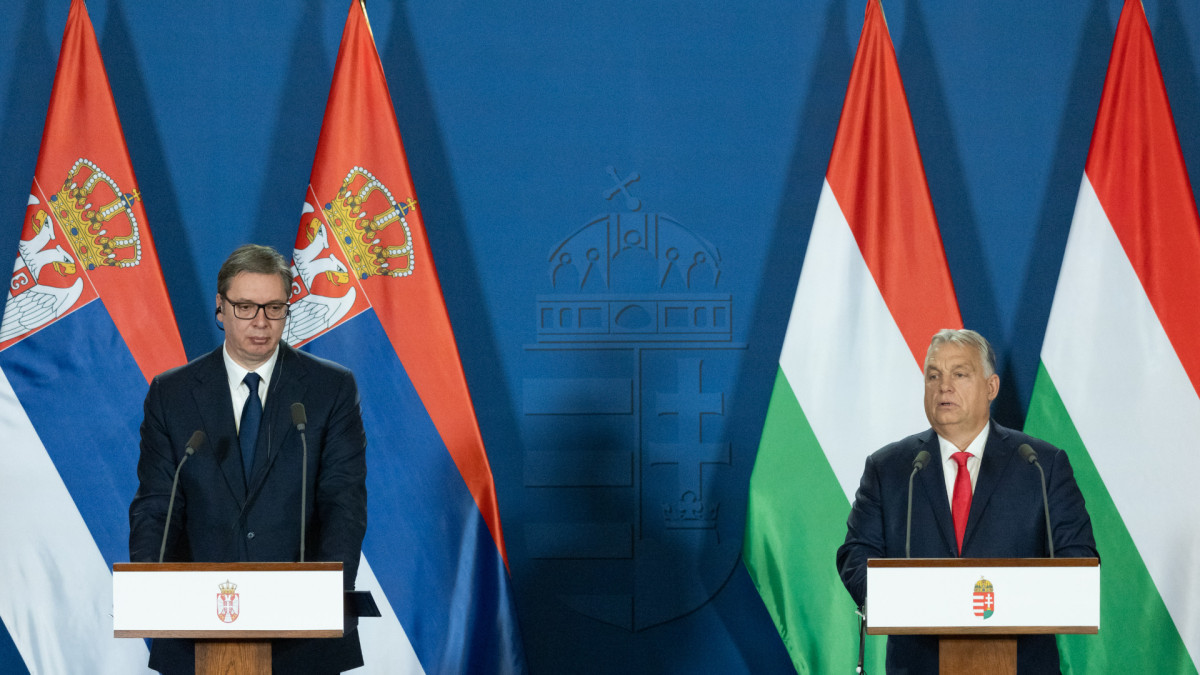
In barely six months, two of the leaders who had best embodied Europe’s illiberal and authoritarian drift have been defeated at the polls. Viktor Orbán, after sixteen years governing Hungary, and Aleksandar Vučić, after more than a decade dominating Serbian politics, have had to acknowledge that their respective political projects no longer enjoy the broad backing of their societies. Two countries, two different trajectories, and one same conclusion. The regimes that seemed to have perfected the mechanisms to perpetuate themselves in power can also be defeated electorally. And, perhaps more importantly, they can be defeated without needing to reproduce their methods or to build a wholly opposed ideological alternative.
“The regimes that seemed to have perfected the mechanisms to perpetuate themselves in power can also be defeated electorally”
For years, Hungary and Serbia became the European political enfants terribles. Orbán made illiberal democracy an explicit political proposition, constructing a system in which electoral pluralism coexisted with the capture of institutions, media concentration, and the weakening of democratic checks and balances. Vučić, for his part, consolidated in Serbia a model of stabilocracy that blended domestic authoritarianism, clientelism, and calculated geopolitical ambiguity. Both managed to present themselves before their societies as guarantors of stability and before international interlocutors as indispensable partners.
Traditional oppositions in both countries sought to unseat them through electoral alliances, coalitions between parties, and programmatic agreements that, in the end, were unable to break the rulers’ hegemony. Hungary’s 2022 experience, when a broad opposition coalition was defeated by Orbán, stands as probably the clearest example of the limits of that strategy: the sum of parties proved insufficient to build an alternative social majority.
In 2026 something different happened. In both countries, though through very different processes, alternation became possible when traditional party structures ceased to occupy the opposition’s center. In Hungary, Péter Magyar, coming from within the same Fidesz political milieu, built around Tisza a platform capable of drawing in ideologically heterogeneous sectors. In Serbia, the student movement that emerged in the wake of the Novi Sad tragedy managed to transform a social mobilization against corruption into an electoral candidacy that overwhelmed the existing parties. The aim was to construct a political actor distinct from the coalitions of discredited organizations.
“The objective was to build a political actor different, outside coalitions of discredited organizations”
This distinction is fundamental. Traditional coalitions are forged through negotiations among party elites, seat distribution, and policy commitments. The new democratic fronts operated under a different logic. The priority was to articulate a shared objective capable of crossing existing ideological divides, rather than negotiating an exhaustive governing program. Reclaiming the institutions, fighting corruption, restoring democratic guarantees, and ending the patrimonial appropriation of the state. That is the key to understanding how Orbán’s and Vučić’s defeats occurred.
We are not, therefore, witnessing left-wing victories over the right. Nor is there necessarily a shift in the ideological compass of Hungarian and Serbian societies toward more progressive positions. Magyar represents a center-right conservatism that maintains restrictive migration policies and shares certain nationalist premises with his predecessor. In Serbia, the Student List gathers very diverse sensibilities, ranging from liberal and pro-European stances to conservative and nationalist sectors. Beyond their economic and social differences, they are united by the rejection of a political system perceived as corrupt and authoritarian.
The European-reading of both results also requires nuance. It is true that Magyar has promoted a normalization of Hungary’s relations with Brussels and that the restoration of the rule of law is an indispensable condition for rebuilding that relationship. But his project retains part of Hungary’s earlier positions on issues such as immigration and European enlargement. In Serbia, the ambiguities are even greater. The student movement has deliberately avoided taking a clear stance on divisive issues such as Kosovo, Russia, or European integration. Democratic regeneration, therefore, may advance without a deep geopolitical pivot.
“Democratic regeneration, therefore, can advance without a deep geopolitical pivot”
Here emerges one of the most interesting paradoxes of the European moment. While a large swath of the continent experiences the advance of reactionary, nationalist forces that openly oppose some fundamental principles of liberal democracy, two of the countries that for years symbolized that drift have chosen alternation. Change comes from the belief of broad segments of the citizenry that the continuity of those governments impeded the normal functioning of their democracies, beyond their ideological preferences.
It is also noteworthy how the defeated leaders acknowledged the electoral result, in contrast to what happened in Brazil or the United States, where the challenger’s contestation has called into question the democratic system itself. Thus, Orbán accepted his defeat in April and Vučić did the same this October, although in Serbia the final tally remains to be definitively confirmed. After years of institutional erosion, power concentration, and the weakening of political competition, alternation has ended up occurring through the existing electoral mechanisms. Of course, this does not mean that those systems operated under fully equitable conditions, nor that the power structures built over years disappear overnight. But it shows that even in deeply deteriorated democracies there can be openings for change when there is sufficiently broad social mobilization.
The Serbian experience adds a singular element: the evolution of the student movement into an electoral alternative. A concrete protest against corruption and political accountability after the Novi Sad covered market’s collapse ended up turning into a political option thanks to its ability to spread territorially, sustain mobilization for months, and connect with very different social sectors. Serbian civil society has shifted from pressing institutions to directly contesting power with those who controlled them.
“Serbian civil society has moved from pressuring institutions to directly contesting power with those who controlled them”
In any case, it is important to exercise caution, for it would be premature to confuse the defeat of Orbán and Vučić with the disappearance of Orbanism or the political system built by the SNS. The patronage networks, economic interests, and institutional structures that sustained both projects do not vanish after a single election night. Nor is it evident that social coalitions built mainly around opposition to a rival can preserve their cohesion when faced with distributive decisions, territorial disputes, or international dilemmas.
That is precisely where the challenge for these new governments lies. Winning elections against an illiberal regime requires building a sufficiently broad negative majority. Governing afterward requires transforming that majority into a durable institutional project, capable of managing disagreements and rebuilding democratic mechanisms without reproducing the practices of those who were defeated.
Hungary and Serbia thus offer a relevant lesson for a Europe that seems resigned to the advance of reactionary forces. The response to authoritarianism can be articulated outside the major party coalitions and without a symmetric ideological confrontation. It can emerge from a citizenry demanding something seemingly more elemental: that institutions belong to everyone again, not just to those who govern. But they also pose a warning. Democratic regeneration can be a necessary condition for political change, though it does not in itself guarantee a societal transformation or a more progressive orientation.
“Democratic regeneration can be a necessary condition for political change, although it does not by itself guarantee a societal transformation or a more progressive orientation”
The enfants terribles of Europe have fallen at the polls; in the day after, one will have to wait to see whether their successors will be capable of dismantling the systems they inherited or merely managing them differently. Defeating authoritarianism electorally is an indisputable democratic victory, but turning that victory into a sturdier democracy is a far more difficult task.
