
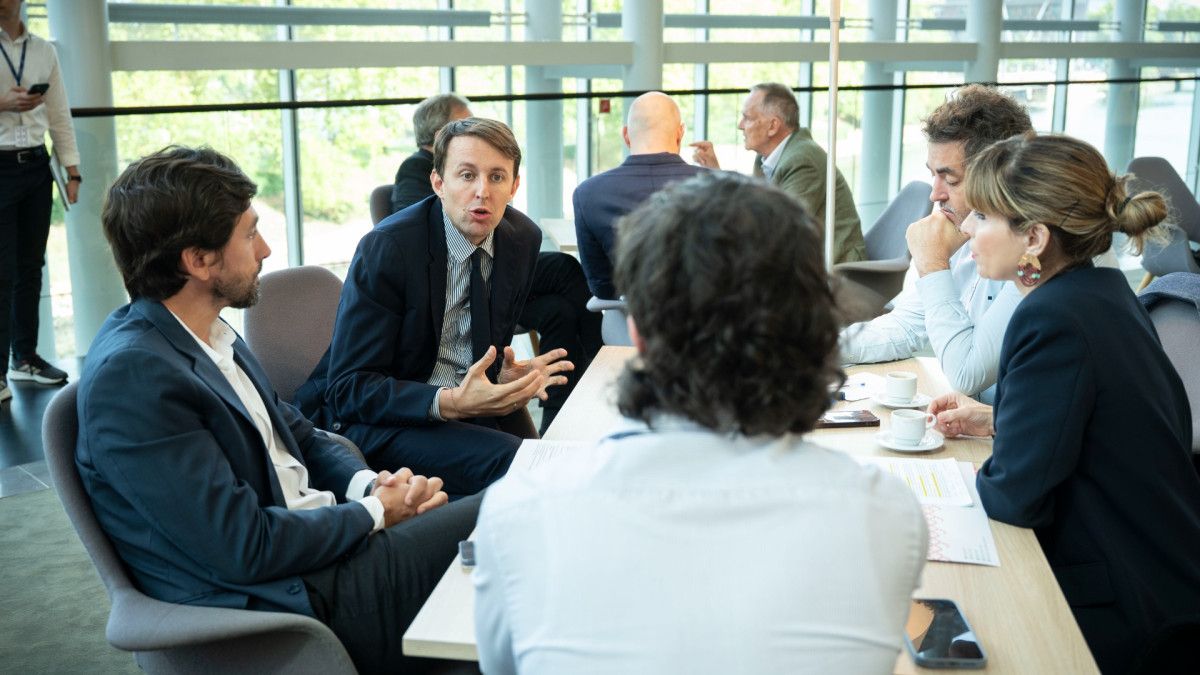
Positive in the face of uncertainty. That was the mood among the four Spanish MEPs on Wednesday following Ursula von der Leyen’s address in the State of the Union debate. With the Canadian prime minister in attendance, Adrián Vázquez, Jonás Fernández, Javi López and Hana Jalloul spoke to Agenda Pública in Strasbourg about the state of Europe and what lies ahead in the remainder of the parliamentary term.
Although they see a lack of ambition in some areas, they are also aware that commitments must be adapted both to the political realities of Parliament and to the resources available. As representatives of the two political families that have shaped European Parliament majorities for decades, they find common ground when they believe it is necessary, but do not conceal their differences over the budget, migration or the response to the Ceuta crisis.
The four MEPs discuss European affairs with Agenda Pública at Strasbourg’s European Parliament. Photo: Agenda Pública / Dorothée Parent
How were you feeling going into this week and Ursula von der Leyen’s speech? There seems to be a somewhat pessimistic mood.
Hana Jalloul (H. J.): We must maintain an optimistic stance, especially given everything swirling around us. The speech itself felt rather broad and lacked many concrete steps. We would have preferred clearer specifics on certain topics. For instance, on Israel and Palestine, addressing the Houthis as a terrorist organisation should have been part of the discourse. We have been pushing for this within S&D, and there is already movement in the Council. That was the impression we got yesterday from High Representative Kaja Kallas. Considering the Houthis’ activity in Bab el-Mandeb and what that implies for terrorism, it seemed an essential point to tackle.
“The speech was too general and did not contain many concrete measures. We would have liked more specificity on certain issues”
It is important that she highlighted critical raw materials and the need for a durable plan in this area, even though no funding has been allocated yet. We certainly cannot allow ourselves to drown in pessimism. Her remarks about Canada were very positive as well.
I also found her take on China to be highly meaningful. It matters in a Parliament that sometimes leans toward a confrontational posture toward Beijing, because she advocated for dialogue. She also highlighted one of our major achievements: the array of trade policies and the trade agreements we have secured. She enumerated them one by one, including the India agreement, one of the largest in scope.
She closed the speech by voicing wholehearted support for Spain in the Ceuta crisis.
Adrián Vázquez (A. V.): We are already halfway through the parliamentary term. This is a speech where nothing can be concealed any longer, since we now understand how the legislative process operates and that a sudden fix with a new regulatory framework is rarely feasible. I am more optimistic today than yesterday, yet I still feel the speech lacked ambition. Not necessarily because she cannot propose more direct ideas, but because the institutional structure and the member states’ realities place hard limits on what can be achieved. Still, she tackled the principal challenges ahead and was specific on a couple of matters that I would regard as a strong starting point. On security, she laid out a concrete plan: something we in the People’s Party have been advocating for years—a European Security Council. She was also explicit about Ukraine, a stance we must not abandon.
“She is going to launch something we in the People’s Party have been calling for for years, this new European Security Council”
The presence of the Canadian prime minister and the idea of Canada becoming an associate member still require additional work and need to gain approvals from the Member States, which, to my understanding, has not yet happened. I support this. On protecting minors in the digital sphere, with this package for the protection of minors, I think she was very precise and that the new proposals were the right ones. We will then have to scrutinize them in detail. On migration, which is arguably one of the topics exerting the greatest influence on our societies today, I am waiting for a clearer European emergency response framework. I believe there is still something missing there.
I would emphasise two other points. I welcome the focus on electrification, but the real issue is more about infrastructure than production; we will see how we handle that. And then there is competitiveness, which she did address. The omnibus packages are advancing and will yield savings of nearly €17 billion annually. Ultimately, she touched on a bit of everything. I would have liked more ambition, but, as I started with, I am more optimistic today than yesterday.
Jonás Fernández (J. F.): I do not think the right adjective is pessimism so much as uncertainty. None of the challenges we faced last year has been resolved, and there are more and more obstacles where, broadly speaking, there is a general sense of direction, but those policies never quite come to fruition. As for the speech, it read more like a lecture than a political address one would expect in a State of the Union debate. We have heard several versions of this, as Adrián noted, and perhaps after repeatedly promising plans that never materialise or deliverables that are very limited, today’s remarks felt more reflective than concrete policy answers.
“None of the challenges we faced last year has been resolved, and there are more and more challenges”
There is little to challenge in the measures she did announce: they are reasonably sound, though we’ll have to see what they actually amount to. Some of them leave me somewhat skeptical. What exactly is the corporation she proposed for ensuring supplies of critical raw materials? Many other proposals stem from an underlying problem she rightly pointed to: with the current budget, there isn’t a lot more we can do. The Hanseatic League is pushing for deeper cuts, while the debate on own resources remains unresolved. Everyone in this House keeps bringing it up; [Manfred] Weber raised it in his speech, and of course Iratxe [García] did too. But the question remains unresolved. Without a clearer overarching framework that empowers the Commission to do its job, we find ourselves again in a cycle of announcements whose outcomes are unclear.
Javi López (J. L.): This moment is one of profound uncertainty. Everyone recognizes that this could be Europe’s most precarious moment for the integration project since its inception. We face external risks from a geopolitically hostile environment toward the Union: a direct threat from Russia, a shift in transatlantic relations, and a geopolitical and economic climate that runs counter to our interests. Internally, the situation is equally fragile, notably due to gains by the far right, which undermine the European project as we have known it. That is the backdrop against which today’s uncertainty and risks permeate every discussion about Europe’s future.
“This is probably the most dangerous moment for Europe and European integration since the project began”
Von der Leyen’s analysis, diagnosis and the vision she lays out are accurate. I am satisfied with the overall direction she presents; broadly, it aligns with the diagnosis shared by pro-European forces. The problem lies in the absence of accompanying measures, resources, and decisions needed to translate that vision into real action, and in the lack of ambition required to make it a reality. It probably stems from the internal balance of power, because this speech is not issued in a vacuum: it is delivered in a Union where governments in Berlin and Paris are currently quite weak for different reasons, and which is also approaching a major electoral cycle in Europe in 2027.
I agree with the issues and the vision—European strategic autonomy, European sovereignty, taking full responsibility for our own security, the industrialization and reindustrialization of Europe, climate action, diversifying our alliances and forming partnerships with democracies, electrification and the regulation of artificial intelligence. I share that agenda, but it clashes with forging majorities with those who want to divide or weaken the Union. That remains another major challenge to address.
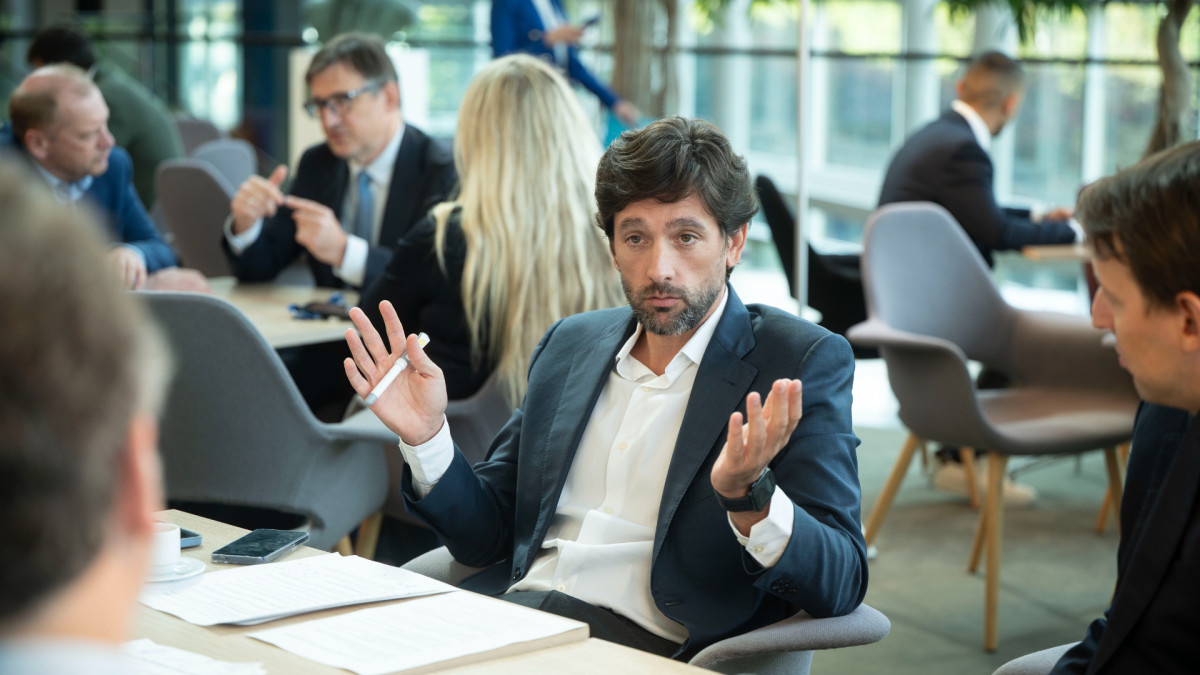
The MEPs discuss pro-European majorities and the political direction of the second half of the parliamentary term. Photo: Agenda Pública / Dorothée Parent
What is the relationship between the European People’s Party and the Progressive Alliance of Socialists and Democrats like at the moment? The mid-term reshuffle of positions is still pending, and there are just over two and a half years left in the parliamentary term.
H. J.: Those negotiations are led more by the group leaders and by those within our political families who barter specific posts—vice-presidencies, committee slots and the like. It is essential that there is negotiation and that everyone can advocate for what best serves their group. But I also think there is a need to distinguish between the objectives we pursue in Parliament and some personal agendas. We have made major commitments. We have Javi here, for example, who is our vice-president, and we are delighted. He is dependable and skilled at building consensus.
Our leader delivered a strong speech, and the principal pro-European forces that have contributed to building this Parliament since 1948 must reach agreement. I do not see a fundamental problem. Everything will be fine.
A. V.: What matters to European and Spanish citizens is not who holds which position in this debate. Our job is to deliver solutions, within our powers, to the demands and challenges facing society, irrespective of who occupies each post. Democracy functions as it does and majorities are formed as they are formed. You must work to ensure your political agenda becomes laws and legislative proposals.
This Parliament pushes legislators to confront political realities, especially for those of us coming from countries where party lists or majorities are constructed differently. Here, in the end, you must reach agreements and sit across the table with people who think differently in order to discover common ground. That requires fewer red lines. What we must do is assemble majorities capable of meeting these challenges. And, if you ask me, those of us who carry Europe in our minds and hearts should strive to do so with pro-European forces.
“In the European Parliament, you have to reach agreements and sit around the table, as we are doing today, with people who think differently in order to find common ground”
But we should not delude ourselves either: there are issues we deem vital for Europe’s continued survival, such as competitiveness and maintaining a productive base, that can be extremely difficult to advance alongside other pro-European forces. From that point onward, flexibility is essential.
J. L.: The mid-term moment should serve as an opportunity to rethink Europe’s overall political direction. This is not about assigning blame or positions, but about deciding which majorities will shape Europe and what political course it will follow in the second half of the term. It represents a chance to energize a pro-European majority that is currently more fragile than at the outset. If the discussion, reflection, and negotiations around the mid-term point help rejuvenate that pro-European camp and provide continuity to the European Commission’s mandate, then it is welcome, because that is the only sure way to safeguard institutional stability for the remainder of the term.
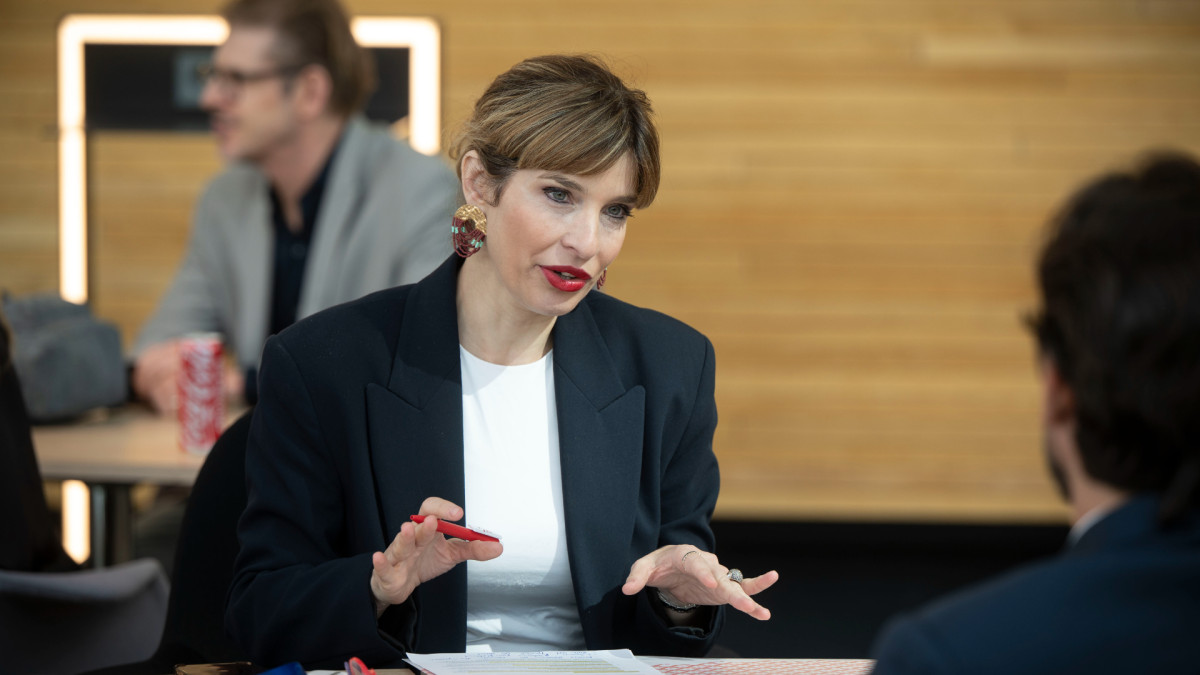
The discussion addresses the need to back crucial European priorities with political will and adequate resources. Photo: Agenda Pública / Dorothée Parent
Each of you specialises in different areas. Within those fields, what are your priorities?
H. J.: First and foremost, commitments must be honoured. Today, the Commission president once again underscored commitments, albeit not as forcefully as in her previous address, even though the goals remain unmet. I am thinking of Israel and Palestine, for instance.
She signalled to the major groups in the House that consensus is indispensable because failing to agree on issues like the Middle East solves nothing. We have struggled to reach agreement on central questions, especially Parliament’s stance on Israel and Palestine. That was a clear message. Yet last year she spoke of sanctions and the EU-Israel Association Agreement, while this time she did not utter a single word on them. If at the start of the term or in last year’s speech she laid out commitments and failed to fulfil them, the first responsibility is to deliver on what was promised.
Then comes political will. For instance, there is a proposal to establish a European body tasked with securing supplies and building strategic stockpiles of critical raw materials. You can announce a body that has already been proposed and is meant to kick off before year’s end, but without a budget, it will be very hard to move forward.
The same goes for electrification. It is a topic on which there should be broad agreement. We also need to address electricity grids and recall what unfolded in France. Spain has enacted substantial national regulation, unlike some peers, but European-level regulation must be assessed as well. If that happens, we will back it. This Commission needs greater political will and more funding for many of the projects on the table. The overall speech was solid, but it must be backed by money and political resolve.
J. F.: Returning to the budget and own resources, one structural problem in these debates—and in Brussels discussions more broadly—has been that plans demanding funding are framed around policies, yet the money does not exist to back them. In many cases, promises become strategies that could be sound but are not implemented by the European Commission. Each member state applies them differently, and their financial capacities vary widely. This fragmentation in the single market worsens the problem. I therefore distance myself from repeated rhetoric about a wide array of sectoral policies, not because I oppose the aims, but because I anticipate the Commission will struggle to translate them into concrete action, even if a plan is designed.
The budget negotiations for 2028 are proving difficult. A large bloc of countries, led by Germany, is pushing for further cuts to a budget that, in nominal terms, is similar to the current term but with €750 billion fewer because NextGeneration EU funds have expired. The Union’s overall financial capacity, including Next Generation, is nearly 40% lower than in the term ending in 2027. Simultaneously, there is a flood of proposals justified by urgency and necessity, yet lacking funding to implement them. Calls to trim the budget come amid struggles to create own resources, which are also needed to service Next Generation debt.
“The Union’s overall financial capacity, including Next Generation, is almost 40% lower than in the period ending in 2027”
Until someone takes this seriously —and I think they are, though we have not yet seen results— progress remains elusive. I would like to commend António Costa for his summer and recent efforts visiting capitals to broker an agreement. He is making a significant push from the European Council presidency. Until this is settled, we can discuss many strategies and plans; I fear many proposals tied to real needs will lack financial backing.
A. V.: While I partly agree with him, any transfer of sovereignty must be accompanied by budgetary resources. I do not think now is the moment to reopen the debate on own resources for one simple reason: we could derail the entire agreement, and a year from now, the budget might be negotiated by Bardella or Alternative for Germany. We must secure at least a minimum budget agreement as soon as possible. I agree that we cannot implement many Commission proposals, but if we push too hard and drag out or complicate negotiations, next year could be far worse.
J. F.: I’m not talking about demands so much as acknowledging reality. The Commission’s financial framework proposal is roughly the same as during the previous term, amounting to a near 40% cut once Next Generation is removed. And we still must begin repaying Next Generation debt. If the budget remains nearly the same while we owe debt, some debates should wait. We owe the public practical responses, and in many cases we will not be able to deliver. It’s better not to promise what we cannot meet.
J. L.: The budget is the instrument Europe has to act. If we want Europe to shoulder its own security and pursue a genuine industrial policy, a lean budget won’t suffice. If we tailor our ambitions to current resources, we risk dismantling the Common Agricultural Policy and the cohesion policy. That would be politically damaging, given how sensitive those areas are. If we wish to safeguard them, we must drop plans for new resources for other priorities we share—industrial policy and security. It was stated today: you cannot achieve more with less. Europe faces greater needs and more threats, yet is asked to act with fewer resources. That recipe breeds frustration and internal conflict.
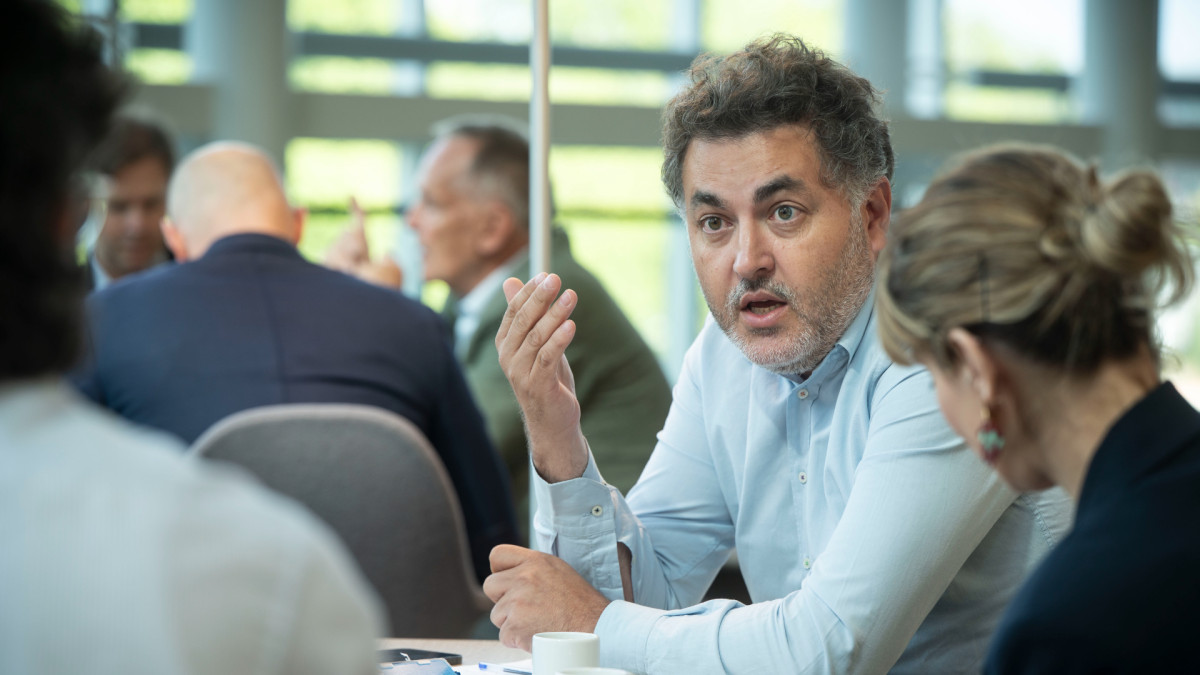
The debate over the European budget pits the Union’s new ambitions against resources that the MEPs consider insufficient. Photo: Agenda Pública / Dorothée Parent
To what extent has the Ceuta crisis affected the European agenda? It touches on many sensitive issues: immigration, hybrid threats, foreign relations, minors…
H. J.: We faced a crisis that affected our sovereignty. Around seventy thousand people entered, with roughly 95% returned to Morocco within seventy-two hours. This outcome hinges on a solid relationship with Morocco. We have readmission agreements with Morocco that function well, along with cooperation in other areas not always mentioned, such as counterterrorism and crime. Additionally, irregular migration dropped by 42% between 2024 and 2025. The event happened, but a large share of those who entered returned to Morocco rapidly.
The prime minister has been clear: there is no conclusive evidence that Morocco masterminded all of this. Police reports suggest that, before July 30 and the mass arrival of migrants in Spain, about 180,000 people used social networks to coordinate. That does not prove Morocco’s complicity beyond doubt. We must maintain a good relationship with Morocco, while both sides strengthen their borders. Otherwise, Commissioner Brunner would have taken that same stance yesterday, nor would the Commission president have stated today that more resources are needed, which is a longstanding demand. Ceuta represents the Union’s southern border, it affects migration and asylum, and it is a European challenge. That does not mean individual actors didn’t gain from the events. We’ve seen messages from Donald Trump and Elon Musk. But for us, Morocco remains a neighbour we must partner with, and that relationship must be preserved.
“Ceuta is the Union’s southern border, it affects migration and asylum, and it is a European problem”
We have endured other crises, such as those of 2020 and 2021, and we resolved them. Our cooperation extends beyond migration policy to security, intelligence, and counterterrorism. Morocco faces migratory pressures and helps to contain them toward the rest of Europe. Our objective is economic cooperation and acknowledging that externalising borders is not a solution; migration cannot be stopped entirely. It must be managed through a comprehensive policy. We also need legal, safe and orderly migration, and we must work with countries of origin and transit. Many players will try to instrumentalise migration. We already observed that in Belarus. It is part of hybrid warfare and one of the principal challenges we confront.
A. V.: Generally speaking, when someone digs a hole and refuses to climb out, I tend to warn them. After that, individuals may act as they wish. I just came from a debate with Laura Ballarín on disinformation. We agreed that combating misinformation online is essential, but those who address the public must not themselves spread misinformation.
All the information is clear. I have here, in chronological order, the messages circulated and the police reports. We’ve just heard a claim that is untrue about where the WhatsApp groups involving 180,000 people were organised. If someone wants to peddle a tale that Morocco played no part, be my guest, but people are not naïve. Moreover, while polls do not determine truth, 89% of Spaniards, according to 40dB, believe Morocco was behind this.
Morocco represents more than a migration matter. Ceuta was a security issue, a hybrid confrontation designed to exert pressure for some gain, though I am not sure what. It is a European issue. Frontex could have been present from the outset upon the Member State’s request. The European Commissioner for Home Affairs could have arrived in August, but no minister accompanied him, so he could not go. A much more immediate response would have been provided by deploying the army, but that option was rejected. I do not understand why, but it is clear that the handling left room for improvement. This should not be treated as solely a domestic matter, but as a European issue. Belarus did something similar in the early stages of Russia’s aggression against Ukraine.
“I do not think we should treat this as a national issue, but as a European one”
The fact that the debate has spiralled into a broader political fight within Spain risks making Europeans view it as a purely Spanish issue, when in security terms it is undeniably European and affects us all.
We still do not know what will happen to the thousands of Moroccan minors remaining in Ceuta. Today in Congress, Mr. Sánchez was asked as he left the chamber about the fate of these minors and replied, “Ask Mr. Vivas.”
H. J.: I completely disagree. As for the prime minister’s remarks, the issue of the minors’ legal representation has been raised. For many of them, stay in Spain is due to the ongoing process to identify them and determine whether they can be reunited with their families; they must first be identified and provided with legal representation. That is the basis for the prime minister’s response. I have no problem with Mr. Vivas; we’ve always had a cordial relationship. I was secretary of State for Migration, I handled two crises, and the relations were always courteous. He is a very polite man.
J. L.: Beyond Ceuta this summer, for Spain, the Morocco relationship is more than a foreign policy matter: it is a national security partnership. It stems from how we manage our borders and migration, and because it touches our sovereignty and intersects with the fight against terrorism. It is a fundamental connection that must be grounded in cooperation, but also in firmness.
Secondly, that relationship operates within a European framework. We should pay close attention to the signals from other capitals and European institutions. During this plenary and in recent weeks, national capitals—sensitive about migration—and European institutions have reminded Spain of the importance of maintaining a Morocco relationship based on cooperation and firmness.
“For Spain, the relationship with Morocco is more than foreign policy: it is a national security relationship”
If you listen to what Brussels and the capitals have said, it’s clear we must manage a border that is both Spanish and European. I sincerely hope our partners won’t back any confrontational approach. We should be explicit about that. And if we want their support and help in facing something that touches our sovereignty, it would be wise to build a broad domestic consensus, so we can mount an organized and effective response to specific incidents.
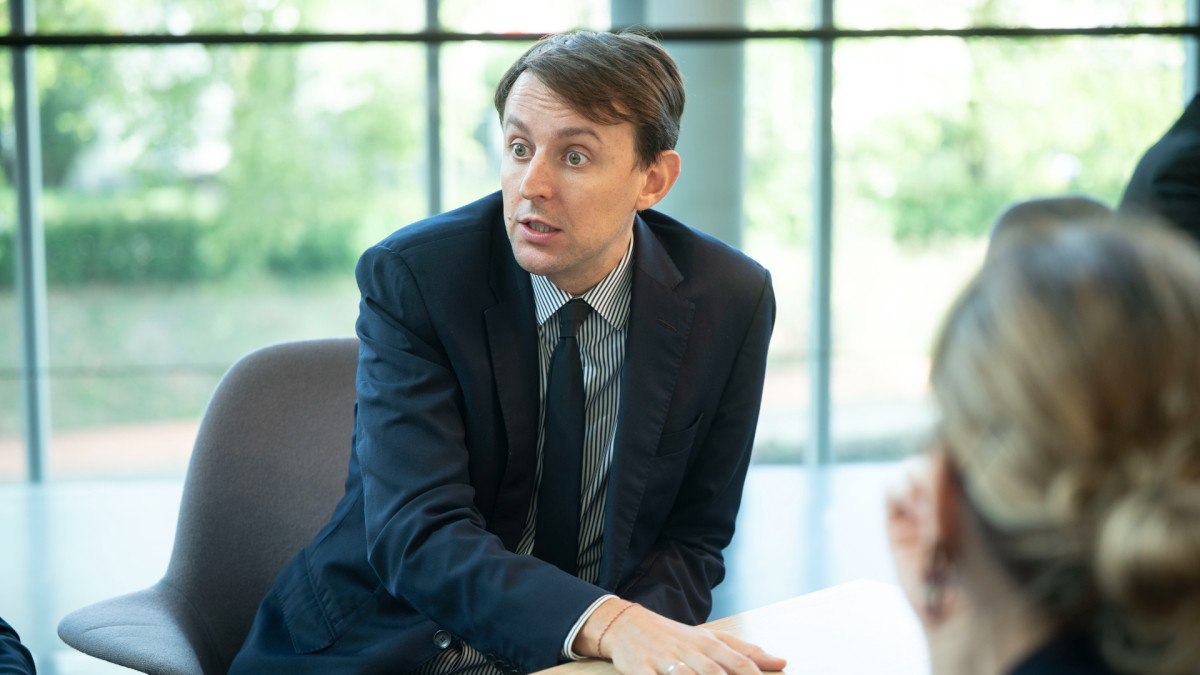
The MEPs analyse the Ceuta crisis as a challenge that combines migration, security, and relations with Morocco. Photo: Agenda Pública / Dorothée Parent
In light of today’s State of the Union debate, I would like each of you to identify one development you would like to see before the end of the parliamentary term and one risk that particularly concerns you.
A. V.: I want to focus a bit on my own domain: the minors protection package. Von der Leyen laid out a concrete and highly specific proposal that almost all groups have been calling for throughout the term, something we expected before the summer, and at last it shows that the European Union is taking the protection of minors seriously. It also serves as a counterweight to major tech and digital firms that monetise addictive features targeted at children and adults alike, because this affects all of us. I don’t merely believe it will pass—I’m confident it will. I expect broad support in this House, and I deem it absolutely essential for our society.
“The European Union is finally taking the protection of minors seriously”
Regarding my concerns, I found the point raised by Jonás about expectations and budget particularly insightful. The problem we’ve been facing is that we promise more than the EU can actually deliver. I try to limit expectations. The national governments bear much responsibility here: they often use the institutions as a scapegoat and, when those institutions succeed, they take the credit. It is a natural, human tendency. But I worry we may set expectations too high and then be unable to fulfill them due to resource or authority limitations. It’s a perennial issue. Apologies, and thank you.
H. J.: For us, and especially in my view, the European critical raw materials corporation matters and must come with a budget. We also need to keep investing in trade agreements. At the core of all this lies strategic autonomy, which means delivering what has already been announced in defence and trade.
What worries me is the possibility that we could drift away from international law and maritime law. I am concerned that we could lose momentum on international law and related maritime issues. I am thinking of the Gaza situation, the two-state solution, Israel and Palestine, the events in Lebanon, and Houthi terrorism. We must keep working on all of these issues because we want to be a force for peace and exert political influence. If we want that influence, we need to continue investing in our diplomacy.
There was little discussion of the European External Action Service either. We strongly support it. It was not mentioned today, and I think we should bring it back to the table. I am disappointed that it was not included, because sustaining investment there is part of what we need to continue funding. I also worry that this might not occur.
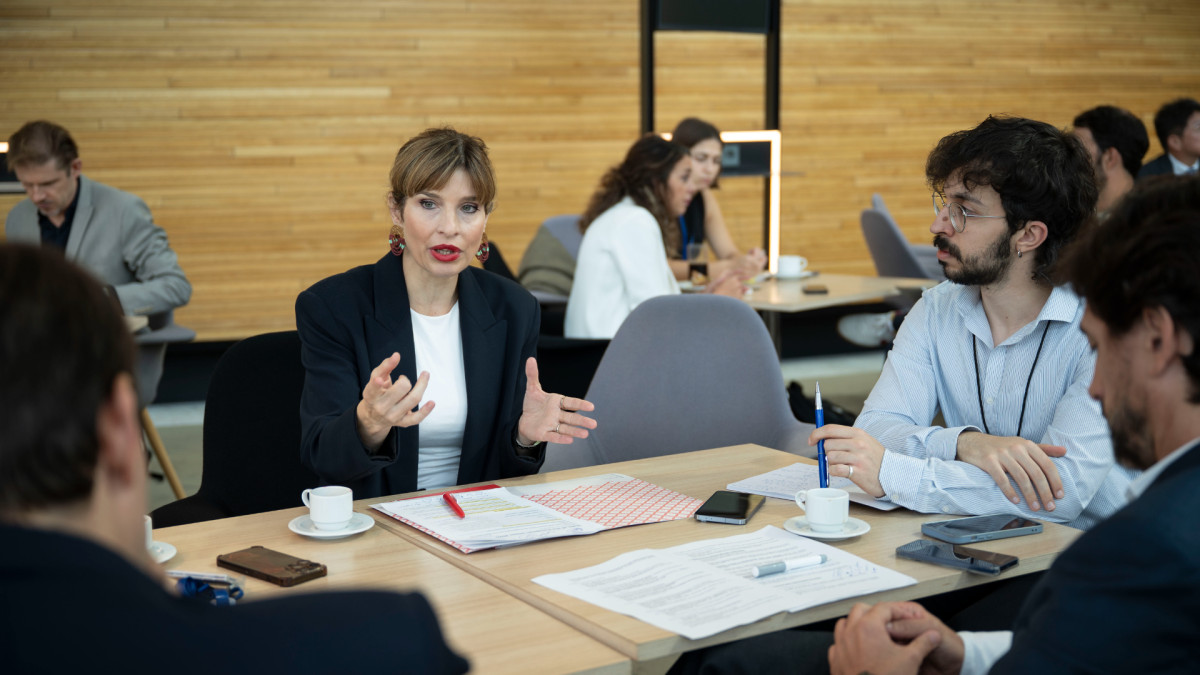
The final part of the conversation focuses on strategic autonomy, foreign policy, housing and the single market. Photo: Agenda Pública / Dorothée Parent
France and Germany have also put forward proposals to reform the European External Action Service.
H. J.: Our ambassadors abroad are our eyes on the ground and they do excellent work. You cannot expect to influence global affairs if you are not present, because the on-the-ground reality differs. We already have enough trouble with MEPs who vote on issues they haven’t seen or studied. How could we even discuss the Global Gateway in Africa without a real presence through our embassies and without verifying that projects are actually being carried out?
J. L.: My expectation is to see progress in the Canada partnership as a sign of renewed momentum in our relations with democracies and with middle powers facing the likes of Trump and Putin. That in itself would be emblematic.
And I worry that our housing policy might fall short. A housing package has been announced to tackle one of Europeans’ greatest concerns. We need bold and effective actions: regulating tourist accommodation, curbing property speculation, and facilitating and funding housing initiatives by public authorities. This is a necessity for Europe.
J. F.: I share their hopes. We are starting to see movement toward implementing the One Europe, One Market plan, because the single market runs into serious problems. The IMF and ECB last year published reports estimating costs from internal trade frictions. They quantify hidden tariffs of 40% to 60% for goods and 100% to 110% for services. Those numbers are unacceptable. When we criticise tariffs negotiated with the United States, we must remember European companies face far higher internal costs than when they sell outside the Union.
That means implementing Letta’s ideas and much of Draghi’s guidance on the single market—telecommunications, digital, energy, banking, and finance. These markets remain highly fragmented, and there is no path to restoring competitiveness unless we advance that agenda.
“How are we going to talk, for example, about the Global Gateway in Africa without being present through our embassies and without checking whether its projects are actually being implemented?”
What I would not want to see, consistent with my earlier remarks, is Europe, its institutions, or its political majorities—depending on next year’s elections—to settle on an immigration approach I consider inhumane and misguided. We witnessed a controversial vote on the Return Regulation this spring, when the People’s Party and the far right secured a majority. I hope that kind of reckless approach to migration policy does not lead us into scenarios we can already begin to anticipate.
Thank you very much, everyone.

Natalie Foster
I’m a political writer focused on making complex issues clear, accessible, and worth engaging with. From local dynamics to national debates, I aim to connect facts with context so readers can form their own informed views. I believe strong journalism should challenge, question, and open space for thoughtful discussion rather than amplify noise.