
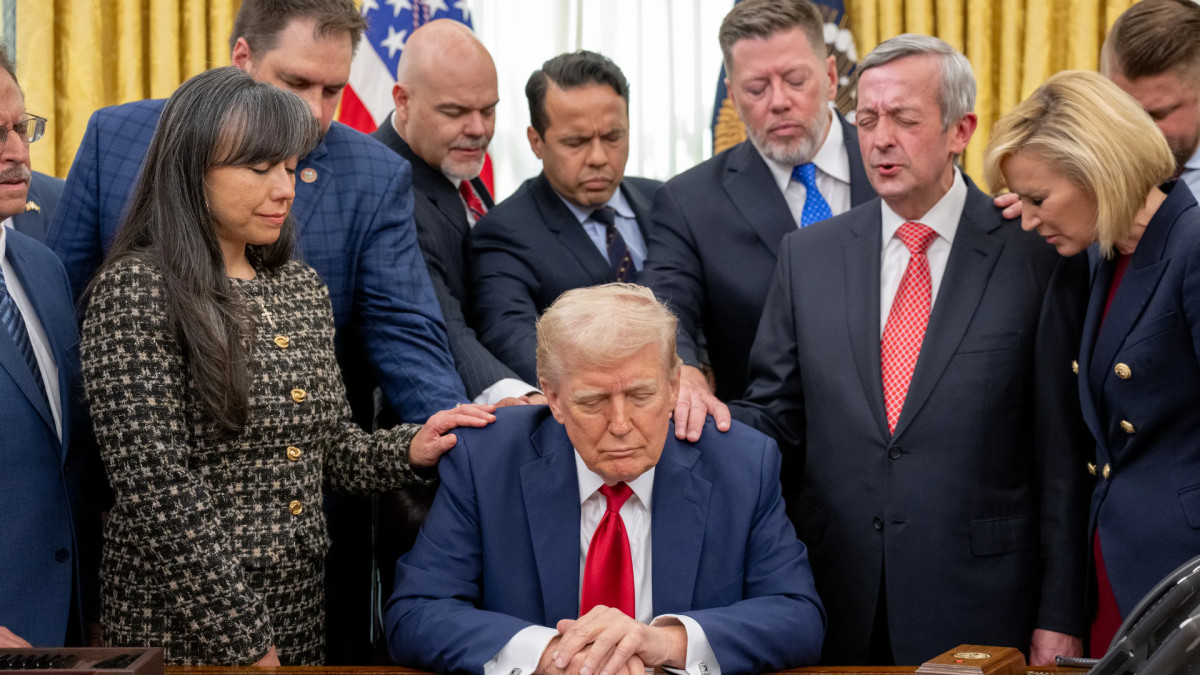
On March 6, less than a week after the offensive against Iran began, twenty religious leaders visited Donald Trump in the Oval Office to pray around him. They laid hands on him and asked God to grant him wisdom, strength, and to protect him and American troops.
Neither is this the first time the MAGA movement has promoted such an image. Since Trump returned to the presidency, he has shared several days of prayer with leaders from various Christian churches. All of them duly recorded or photographed. Even, he created the White House Faith Office, which is led by Paula White, a televangelist who has accumulated more than five million followers across all her social networks.
“For the first time, and despite that photograph of Trump, the White House did not have total control over faith in the United States”
But last week there was a novelty. For the first time, and despite that photograph of Trump, the White House did not have total control over faith in the United States. In Texas, a young Democrat challenged the frame and established himself as an emerging talent. This is James Talarico, a seminary student with a Master of Divinity and a close ally of the Presbyterian Church, who won the nomination for the Senate in the largest southern state of the United States.
The rise of Talarico makes the progressive party once again have a chance to win in Texas a state election for the first time in decades. During the primaries, he did not hide his faith; rather, he leveraged it. He drew a very clear contrast with the religious stance defended by the MAGA movement. He defined them as “Christian nationalists” who forget and distort Christ’s teachings, and therefore every Christian has a duty to rebel and oppose.
Last summer, the governor of California, Gavin Newsom, hit the mark to dispute Trump’s hold on voters on social media. Months later, Zohran Mamdani shared a recipe to reconnect with the working class in New York. Now, Talarico takes a step further and shows a path to reach moderate believers. Little by little, new forms and ideas are emerging within the Democratic Party that give hope for the future.
Is the importance of faith being renewed?
In the United States, more than six out of ten citizens identify as Christians, according to the latest study from the Pew Research Center. The figure, which has remained stable over recent decades, is even more striking when compared with other beliefs: less than half of that share say they have no religion and fewer than one in ten claim to follow another faith.
Not all Christians like the current president, but almost all of his most devoted followers are practitioners, according to a study published earlier this year that included 18,000 interviews. The research defines them as “fiercely loyal, deeply religious, and driven by a sense that the United States is in an existential struggle between good and evil, with God firmly on their side”. It is not surprising, then, that the Republican campaign sold Bibles in 2024 to raise funds.
This is why Trump is so strong in conservative states, in which the share of believers sits above the national average. And these same territories, mostly located in the South, are also the ones that are growing fastest in population, which will boost their weight in the Electoral College that selects the president and in the nation’s Congress in the coming years. That is well understood by Vice President J. D. Vance, who is the leading figure of the MAGA movement’s Christian wing hoping to succeed Trump.
“When Charlie Kirk was murdered, the vice president was one of the main drivers of his televised funeral, an event in which religion played a leading role”
Vance further emphasizes the religion behind Trump. For example, when Charlie Kirk was killed, the vice president was one of the principal proponents of his televised funeral, an event in which religion played a leading role. Later, in December of last year, he was the keynote speaker at a Turning Point event, the organization Kirk founded in life. He asserted that “Christianity is the creed of the United States” and that the country has always been and always will be Christian.
Turning Point has not weakened by the disappearance of its leader. His widow, Erika Kirk, has taken the reins of the organization and has intensified the emphasis on Christianity. The Super Bowl’s side-show in February, for example, was organized by them and in the songs they included messages about the importance of practicing faith.
The radical right knows that, to keep political allegiance active through religion, it is essential that young people do not lose faith. For that reason, these kinds of organizations, which are present not only in the United States, have growing importance and claim the mission of reclaiming the share of adherents to Christianity, after two decades in which it has waned in various parts of the world, especially among the newer generations.
And they have had some success. Although the Millennials and Gen Z remain the groups with the lowest religiosity, in recent years there are signs of a revival of religiosity, especially among the younger members of Generation Z. And beyond percentages, the topic of faith has returned to the center of the cultural debate. The film Los Domingos has just swept the Goya Awards; pop music is being heavily influenced by Christianity, and even Rosalía explores themes of faith in her latest album. Religion may not have the same share of adherents as a few decades ago, but those who practice it do so with even greater intensity.
“Pope Leo XIV has expressed his distress that in countries like Spain extremist parties are taking advantage of the instrumentalization of faith to win followers”
As with Trump, not all practitioners are on the far right. Even Pope Leo XIV has voiced his concern that, in countries like Spain, extremist parties are taking advantage of faith instrumentalization to gain adherents. But until a week ago, only the far-right and conservatives were paying attention to this electorate.
Talarico has changed the odds. In the United States, but also sending a message to the world. Why grant radical-right or conservative evangelical groups the monopoly on faith? Progressivism must not leave its supporters who also hold religious beliefs or who practice faith to fend for themselves. It is possible to chart a path to unite both. Their political options need it. Democracy, too.
