
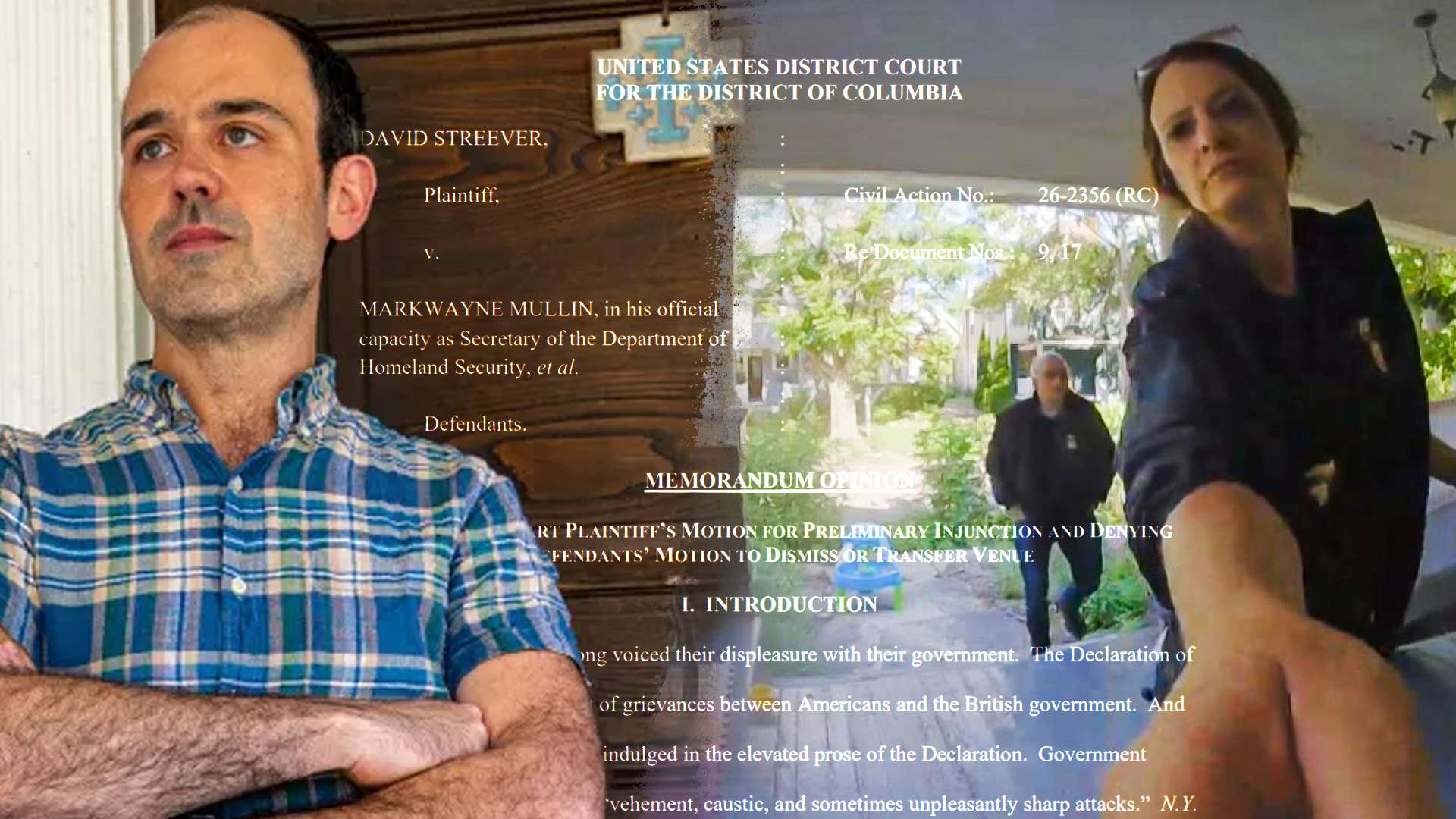
After David Streever launched a vitriolic email at ICE’s acting director, investigators handed him a so-called “warning notice” asserting that he “may be in violation of federal law.”
On January 26, two days after Department of Homeland Security (DHS) personnel fatally shot Minneapolis protester Alex Pretti, Streever fired off an angry missive to Todd Lyons, who was then serving as the head of Immigration and Customs Enforcement (ICE). In that message, Streever attacks Lyons as “a monstrous human being,” compares him to the genocidal Nazi official Reinhard Heydrich, and forecasts that Lyons would live with the burden of “shame at your own pathetic weakness” for defending the Pretti shooting “until your last day on Earth.”
That email was certainly heated and insulting, but it was not illegal. By contrast, a federal judge ruled on Tuesday that the DHS response—a “WARNING NOTICE” delivered to Streever’s Rochester, New York home by two ICE investigators five months later—likely violated the First Amendment by threatening him for engaging in constitutionally protected speech.
U.S. District Judge Rudolph Contreras issued a preliminary injunction prohibiting the DHS from taking any action against Streever based on that notice and from “issuing similar warnings” that “suggest he cannot engage in non-threatening criticism of the government.” The order remains in place while the case, Streever v. Mullin, proceeds in the U.S. District Court for the District of Columbia.
“ICE knowingly pursued an American citizen for criticizing his government—speech that sits at the core of the First Amendment,” said Adam Steinbaugh, a senior attorney at the Foundation for Individual Rights and Expression, which represents Streever in his lawsuit against the DHS. “Ominous letters warning people that their speech might land them in prison are designed to coerce silence, and that is not how the First Amendment works.”
Although the government conceded that Streever’s email was protected by the First Amendment, it argued that the ICE notice was merely an advisory that caused him no real harm. Contreras, a former Obama appointee, rejected this claim, noting the threatening implications embedded in the document’s language.
“YOU MAY BE IN VIOLATION OF FEDERAL LAW,” the notice proclaimed, which ICE investigators Abbi Henry and David Brodie left with Streever’s wife on June 23 because he was traveling in Europe at the time. It cited two statutes—one addressing threats of violence against federal officials, the other criminalizing the disclosure of “restricted personal information” about them with the intent to intimidate or incite violence.
Streever had not violated either statute. Yet the notice stated that ICE had “reason to believe” his email to Lyons “may constitute a violation of Title 18 of the United States Code,” which encompasses more than 1,500 offenses.
The document asked Streever to “promptly remove and/or discontinue the aforementioned behavior.” It added that “receipt of this Notice will be taken into consideration, should you continue to be involved in any criminal activities described above.”
Because the notice referenced Streever’s email, the ICE “request” can be read as a demand that he refrain from criticizing Acting Director Lyons, Contreras writes. “The notice also warns Mr. Streever of the potential for prosecution….If that were not enough, the letter closes by telling Mr. Streever that ‘[r]eceipt of this Notice will be taken into consideration, should you continue to be involved in any criminal activities described above. The use of ‘continue’ implies that Mr. Streever’s email already exposed him to criminal liability and, critically, that any similar speech by Mr. Streever in the future will be viewed the same way.’
Since “political speech is not a crime,” the notice “is hardly a reminder to follow the law,” Contreras contends. “And because the Warning Notice speaks of ‘discontinu[ing] Mr. Streever’s political speech and threatens consequences if he ‘continue[s]’ to speak out, it represents a continuing, rather than a past, injury.”
Streever’s injury is “the loss of his freedom to engage in political speech now because the threat of such an investigation or prosecution looms over him like the sword of Damocles, and he is forced to self-censor under that threat,” Contreras writes. “The Warning Notice works because Mr. Streever is too intimidated by the threat of future government action that he will not test whether the government will follow through on its threat.”
ICE has used the same tactic against other critics. On the same day that Henry and Brodie visited his home, they confronted a Syracuse resident, Paigelynne Gonyea, at a polling place where she was volunteering and handed her a warning notice. Gonyea’s alleged infraction was similar to Streever’s—“The ICE agent who shot and killed Renee Good in broad daylight has been identified as Jonathan Ross by the Minnesota Star Tribune,” she had written on Instagram. “I think today is a great day for Jonathan to be indicted!”
ICE has also attempted to unmask anonymous critics who vent their criticisms of the agency on social media. The Wall Street Journal reports that ICE “has deployed a round-the-clock digital dragnet” to monitor online speech in order to identify more targets.
“I am deeply relieved that the court upheld what I always believed: that I am free to speak my mind in the United States, including when I critique government officials,” Streever said. “While I wish this ordeal hadn’t occurred, I hope this ruling serves as a reminder that the First Amendment protects us all.”
