
Good morning. I am very glad to see you and to convey to you our best wishes —from the Queen and me— for the year that begins. This annual conference is a valuable occasion for fellow ambassadors of Spain, both women and men, to exchange views and information at a crucial moment.
Felipe VI Defends Liberal Democracy: International Law Is Not Naivety, But a Moral Beacon
August 31, 2026
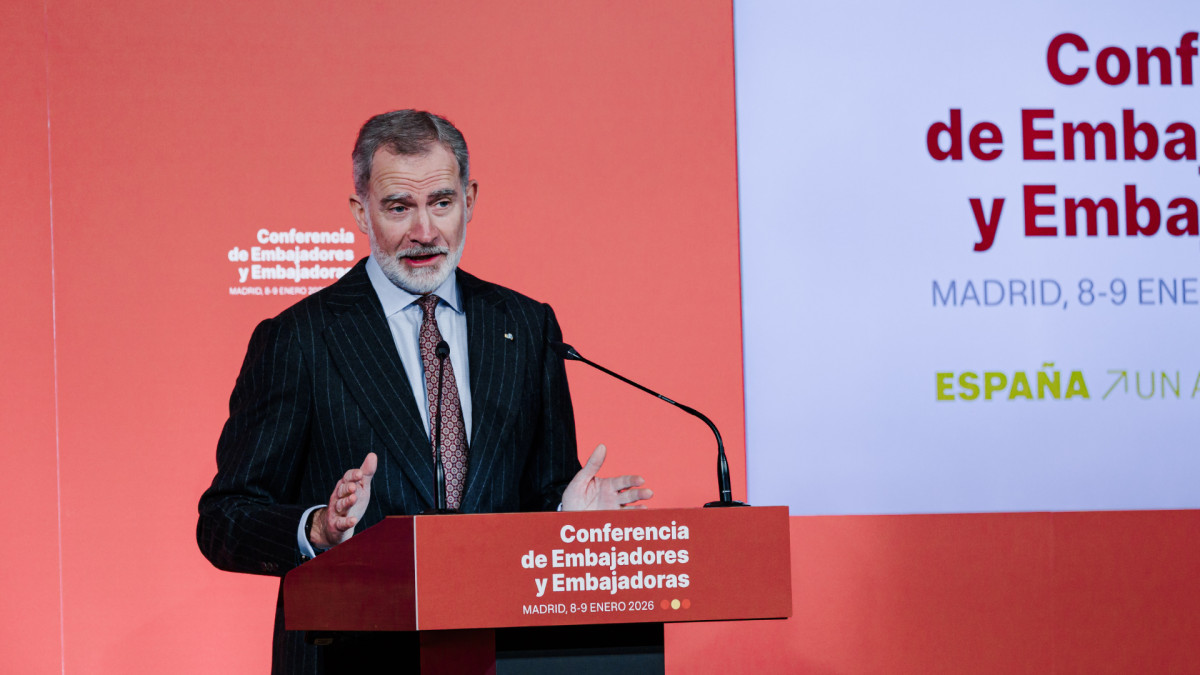
I had planned to lay out, in my remarks, the main axes of the Presidency’s foreign policy agenda for 2025, which—by no other course could it be—will be the pillars of our external policy: defending multilateralism and a rules-based international order; a stronger Europe; the promotion of security and defence (both our own and collective); the importance of the transatlantic bond (beyond short-term conjunctures); our fraternity with Ibero-America, and our Mediterranean identity; attention to Bilateral Relations, particularly with the countries in our surroundings; international development cooperation or the promotion of the Spanish language, to name just a few.
I will address all of these matters without extending myself too far later on, but some events of recent days compel me to share with you a few reflections on Venezuela. I want to underline two fundamental ideas:
The first: our closeness to the people of Venezuela, that brotherly people with whom we share so many historical and deeply affectionate ties within the Ibero‑American space. This closeness leads us to hold on to hope and to want to contribute, as much as possible, so that, with guarantees and as soon as possible, a genuine democratic transition opens—peaceful, inclusive, and respectful of the sovereign, free and independent will of the Venezuelan people; they must therefore be the only protagonists of their own destiny. In this sense, all of us should be glad about the release of five compatriots and of other citizens who were also being held. It marks a necessary step in the direction we long for and that the Venezuelan people deserve, which cannot be different from the full restoration of freedoms.
The second idea: it is fundamental, beyond the specific Venezuelan case, that we offer firm and unequivocal support for respect for International Law. We cannot—neither in word nor in silence—accept its systematic violation; and that is what we too often see today. It represents a step back of more than a century: a time of normative vacuum that, compounded by today’s technology, poses unsettling future scenarios.
It is undeniable that the states that have done most to build that normative and institutional architecture are the democracies, and within them lies a special ethical responsibility to preserve that world based on norms — that is, on reason — against the other based on the unlimited exercise of force and driven by interests that are often exclusive or incompatible.
Remember that—however imperfect it may be—a world founded on the law, open to cooperation and dialogue, will always come closer to the goal of peace, stability and development than any other.
Ambassadors,
The events we have just witnessed—in the framework of an increasingly complex international society—reaffirm to me a thought that may seem paradoxical: this era we live in is the time of diplomats. I say this from the experience of my travels and conversations, from observing and analysing the geopolitical situation, and from the many years of work with you and with your teams, for which I am deeply grateful.
The events we have just witnessed—in the framework of an increasingly complex international society—reaffirm to me a thought that may seem paradoxical: this era we live in is the time of diplomats. I say this from the experience of my travels and conversations, from observing and analysing the geopolitical situation, and from the many years of work with you and with your teams, for which I am deeply grateful.
The diplomat is a translator of worlds. And never before have we needed to read well, to understand the keys and the underlying motivations behind everything that happens. For global security—as we have seen in Palestine, in Ukraine, in so many conflicts in Africa or Asia, and this very week in Venezuela—**it is endangered from its very foundations.** We also see it in the arms race and the cracks in the non‑proliferation architecture, in the persistence of terrorism and hybrid threats; or in the hesitations to confront so many global challenges, where zero-sum games spell defeat for all.
Spain possesses solid credentials grounded in a security policy that makes us loyal and reliable allies, as evidenced by our participation in NATO missions on the Eastern Flank and our contributions to peacekeeping missions. We have a development cooperation policy fully committed to the Sustainable Development Goals set by the United Nations and humanitarian action (a good example is the deployment of the START team in Jamaica) and we carry out geographic policies focused on building alliances and seeking synergies in the face of common challenges. I think of the Euro‑Mediterranean space and Sub‑Saharan Africa, to name two examples.
The Spanish diplomats have a prestige based on listening, deep knowledge and the capacity to achieve consensus; a prestige that, very often, I hear echoed by authorities and other interlocutors abroad.
You are needed, first and foremost, in defending multilateralism. There is no better way to defend multilateralism than through coherence and effectiveness. The Fourth International Conference on Financing for Development of the United Nations has been one of those tangible results. The Seville Commitment—where your masterful hand in forging consensus was evident—represents a robust boost to the Sustainable Development agenda.
We need to continue asserting international law, as you do. Talking about international law is not an act of naivety; it is a mandatory reminder of the ethical beacon the international community has endowed itself with to ensure peaceful and prosperous coexistence. Therefore, I ask you, in line with a sentiment deeply rooted in our citizenship, to demand its respect and to work to have effective instruments to enforce it.
Great doses of skill and diplomatic courage are required, at this moment, to preserve the transatlantic bond: that indispensable frame of reference for Europe and for America, which also arose from the ashes of World War II. A framework that has fostered the flourishing of our democracies, brought us stability and growth, and contributed—decisively—to the genesis and development of multilateralism.
Preserving the transatlantic bond is a shared responsibility: it demands mutual loyalty, reciprocal trust, a forward-looking vision and respect —permit me to repeat—that regard for those “rules of the game” that—though always improvable—are the fundamental norms of international law. The erosion of that bond would leave us all worse off. And I do not want to dwell here on what the hypothesis of its total dismantling would mean—for everyone.
Ambassadors,
You are also greatly needed in Europe. In the year just ended I had numerous occasions to speak about European matters—in Yuste, Bruges, Coimbra, Aachen—and in a couple of weeks I will return to address the European Parliament. I will speak of Europe’s transformative power in our country, now that we mark forty years since our accession; and I will also discuss our contribution to the integration process, in areas of citizenship, justice and home affairs, cohesion, and equality, to name just a few. And I will insist on the call for “more Europe.”
You are also greatly needed in Europe. In the year just ended I had numerous occasions to speak about European matters—in Yuste, Bruges, Coimbra, Aachen—and in a couple of weeks I will return to address the European Parliament. I will speak of Europe’s transformative power in our country, now that we mark forty years since our accession; and I will also discuss our contribution to the integration process, in areas of citizenship, justice and home affairs, cohesion, and equality, to name just a few. And I will insist on the call for “more Europe.”
Because, in the times we live in, deepening integration is, for a united Europe, an existential necessity. As you have heard me say on many occasions, it is not about defending what we have, but about defending what we are.
We must prevent at all costs that the future of the world be written outside Europe. Let us not be mistaken: this is about increasing our weight in the world and our capacity to act thanks to Europe, thanks to our belonging to the European Union. And Spain can take a step forward by building consensus, by participating in reinforced cooperation, by proposing measures to increase strategic autonomy, productivity, innovation and the attraction of talent; or by developing to its full potential the Mercosur agreement, which is so important for the Union, and, of course, for our country.
Your work is also essential in the Iberian‑American space. I reaffirm this now, fully aware of the uncertainty hovering over the region, but with even greater conviction: at the XXX Iberian American Summit, which we will hold in Madrid, let us advance in what unites us—in social, digital and environmental areas. Let us give a new impulse to the Summit system. May the voice of Ibero‑America be heard clearly in international forums, may it be strengthened in dialogue and cooperation with Europe, and may it, known for a shared past, speak to the world, above all, about the future.
A major link in that Ibero‑American space is the Spanish language. At the recent CILE, in Arequipa, there was consensus on the importance of continuing to secure the future for Spanish. Let us keep working so that our language — with its more than 600 million speakers — occupies the space it deserves, also in the realm of technology, innovation, and Artificial Intelligence.
But where the social impact of your work is most visible, it is undoubtedly in the consular field. Last year you advanced the digitisation of the network of consulates, streamlining processes and becoming more effective in serving our citizens abroad. I also want to recognise the broad effort of the entire consular service to attend to the numerous requests for Spanish nationality, especially in Ibero‑America.
Ambassadors,
Much of the Queen’s and my agenda is focused—as noted at the outset—on developing the lines of foreign policy I have just set out. This has been the case in defending multilateralism, with our participation in the Seville Conference and my address to the United Nations General Assembly on the occasion of its 80th anniversary; or the Queen’s address on the 80th anniversary of FAO. It has also encompassed European matters, with the events and conferences already mentioned; and in Ibero‑America, with trips to the region and the ongoing preparations for the Madrid Summit. Or in cooperation, with the Queen’s trip to Cape Verde.
I have visited our troops deployed in Romania and Slovakia. I have spoken about transatlantic relations in Coimbra, at the Spain–U.S. Forum and at the La Toja Forum. I have upheld the memory against totalitarianisms in Auschwitz and Mauthausen; as well as in Guernica, accompanying the German Federal President. I highlight State Visits to Egypt and to China; State Visits to our country by the Sultan of Oman, and by President Steinmeier of the Federal Republic of Germany; not to mention meetings with other Heads of State on various occasions.
I am aware of the intense workload these international agendas and commitments place on you this year as well, and I reiterate my gratitude. You will permit me to highlight this year the Office of the Ambassador Introducer—as well as the team he leads—upon the four-hundredth anniversary of the creation of this very important figure.
In short, ambassadors and ambassadors, for all these reasons, this must be—more than any other—the time of diplomats: your time. In the face of ever more troubling dissonances, never cease seeking harmony and coherence, in accordance with our constitutional values, for, as ambassadors of Spain, you are also ambassadors of our democracy and our framework of coexistence; in short, of the ideas that unite us and that have brought us to the five decades of greatest growth, stability and prosperity in recent history.
I want to express the gratitude and pride of the society you represent and serve—and of the society we all serve and represent—and my full confidence that, in this time of great complexity, you will rise to adversity and shine, as you have always done, with your own light.
Thank you very much.

Natalie Foster
I’m a political writer focused on making complex issues clear, accessible, and worth engaging with. From local dynamics to national debates, I aim to connect facts with context so readers can form their own informed views. I believe strong journalism should challenge, question, and open space for thoughtful discussion rather than amplify noise.