
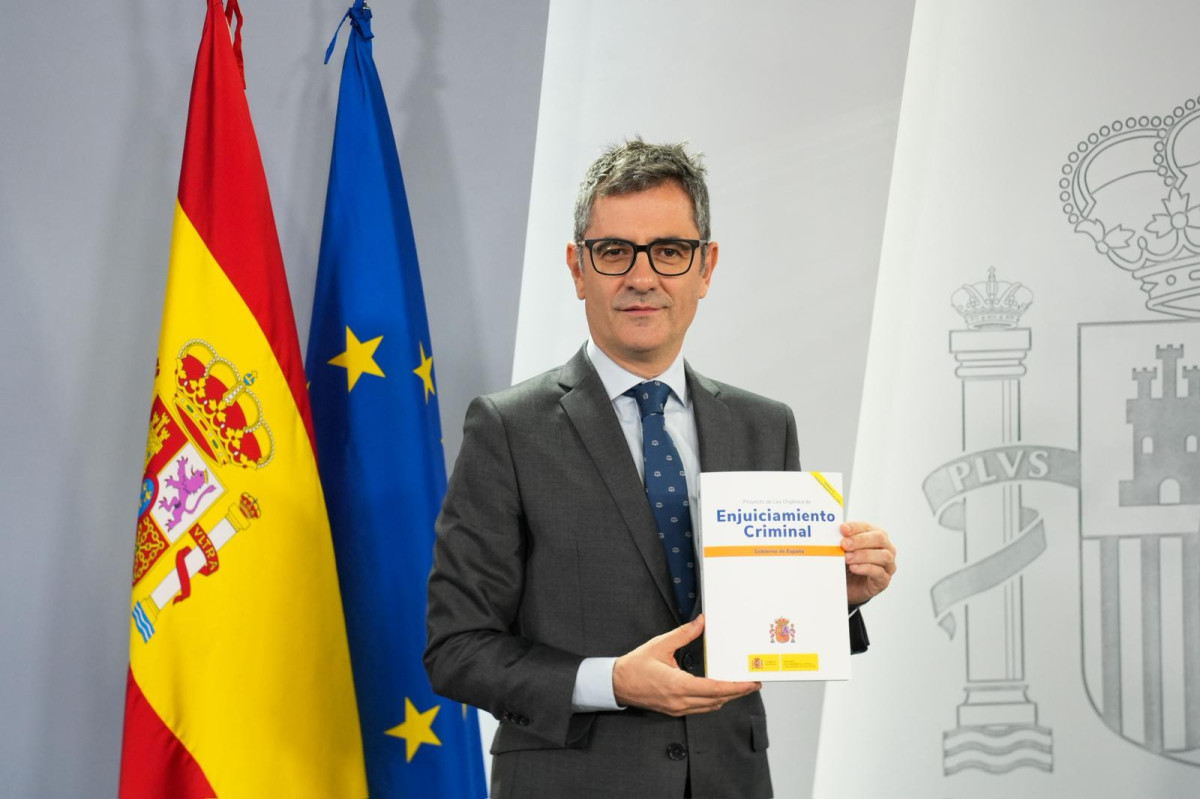
The Council of Ministers has approved this Tuesday the new Organic Law on Criminal Procedure. As Minister Bolaños announced on Agenda Pública, this project is another pillar of the “the greatest transformation of justice in decades” that the Government is proposing. Agenda Pública, this project is another pillar of the “the greatest transformation of justice in decades” that the Government is proposing.
“La principal novedad que trae esta ley es que el Ministerio Fiscal será el encargado de dirigir la investigación penal, en un papel que hasta ahora recaía en el juez de instrucción”
The main novelty this law brings, which will renew the current legislation dating from 1882, is that the Public Prosecutor’s Office will be responsible for directing the criminal investigation. This role, until now, fell to the investigative judge, but the Government intends to bring Spain’s standard in line with the rest of European countries. “Throughout Europe, in all Western and developed world, prosecutors conduct investigations,” argued Bolaños. Other reputable voices in the legal field pointed in the same direction. The former Attorney General, Dolores Delgado, in this same outlet, stated that “we need legislative reforms in the realm of justice. We have a criminal procedure law from 1882. It has undergone many partial reforms, yes, but we are an anomaly in Europe because of our own law”.
In the new framework, the prosecutors will direct the investigation and the judicial police will functionally depend on them, while a new actor, the Judge of Guarantees, will oversee respect for fundamental rights and validate the more intrusive decisions, such as search warrants or preventive detention. “The Judge of Guarantees will decide whether the prosecutor’s decisions are correct or not,” were the minister’s words in this outlet.
The rule, which would not come into effect until 2027, incorporates a set of measures independent of the role of the Prosecutor’s Office. It updates investigative procedures to incorporate digital, biometric, or DNA evidence; revisits the procedural rights of victims and accused; and limits popular accusation, which may only be exercised by individuals or entities with a legitimate interest, excluding political parties and unions. It also includes a specific regime for cases with juries and regulates restorative justice for the first time.
A politicized scenario
The political context is very important: the approval of this law comes after a prolonged period of tension between the Executive and the judiciary. Partial strikes by judges and prosecutors add to the criticisms from some associations, which interpret this reform as government interference. Nevertheless, the central axis of the reform regarding the role of the prosecutors is a stance shared by earlier reports. Beyond the favorable ruling of the General Council of the Judiciary and the State Council, as far back as 2012 a commission proposed by the PP and chaired by Judge Manuel Marchena suggested the need to place the investigation in the hands of the Public Prosecutor’s Office.
“La reforma contempla un reforzamiento de la independencia del FGE, condicionando su cese a un informe del CGPJ y prolongando a cinco años su mandato, dejando de coincidir con las legislaturas”
Another point likely to generate significant controversy is the strengthening of the Attorney General of the State (FGE). The text approved by the Council of Ministers provides that he can only be dismissed after the issuance of a report by the CGPJ detailing a serious or repeated breach of his obligations. Moreover, his position will become “independent from the political cycle,” with a five-year term. In this way, he will no longer coincide with the legislatures in an attempt to promote greater independence of this figure, according to sources close to the development of this project. However, despite this reinforcement of the FGE’s position, a limit on his powers is added: if the Board of Prosecutors of the Chamber, by a three-fifths majority, has a view different from that of the attorney general, the chamber’s opinion will prevail. In any case, it should be noted that the change will not come with the current attorney general, Álvaro García Ortiz, as with the current arrangement he will complete the two terms set by law.
Effective date for 2028
All the changes anticipated in this new LOECrim will come into effect in a little over two years. With this approach, beyond developing the necessary adjustments for proper functioning with the new system, it avoids altering ongoing processes.
As explained by the Minister of the Presidency, Justice and Relations with the Cortes, “in 2028 [the current processes] will be resolved, one way or another, and, furthermore, because there will be a transitional regime that obviously will not affect matters coming from behind“.
