
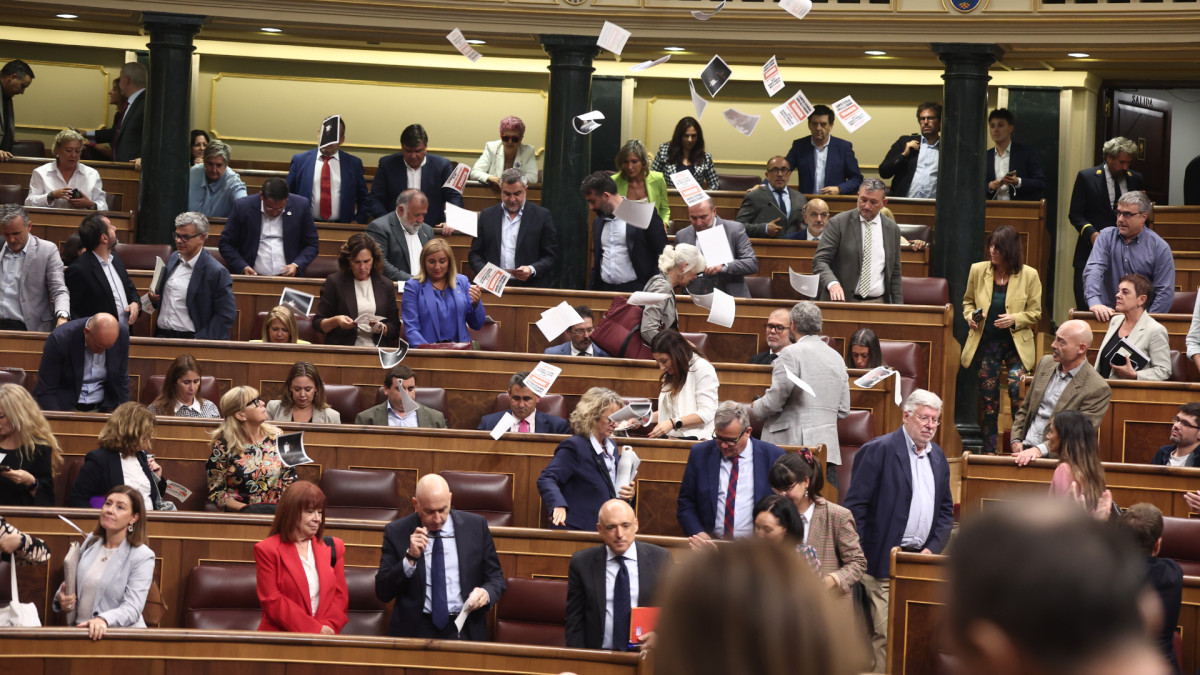
The call for general elections on November 29 invites us to take stock of a legislature that has unfolded in a brusque and hostile political climate. In these years, cross attacks ad hominem have predominated over a genuine confrontation of ideas, proposals, and policies. In historical perspective, legislature XV combines the lowest legislative output with one of the lowest levels of agreement among rivals in democracy.
They have approved 34 laws (13 organic and 21 ordinary). It is the lowest legislative output in the history of democracy. In the previous one, 118 were approved, and the average number of laws enacted per legislature is 148. This may have been helped by the political climate and the variable geometry of voting: faced with the evident impossibility of obtaining the votes necessary to pass certain parliamentary initiatives, the groups or the Government may decide not to present them or wait for better times. Budget laws are an example (though there is also a tradition of incorporating the opposition there), although it is difficult to know which initiatives are not presented for this reason, with the exception of budgets whose submission to Parliament is constitutionally mandatory (Article 134). The variable geometry may explain part of the decline, although it is present in other legislatures without a reduction in legislative output.
The limited legislative output has another explanation. The Government has frequently resorted to decree law. According to the balance published by Demócrata, 60 royal decrees-laws were issued, of which 43 were ratified and 13 repealed by the Congress. The number of repeals illustrates the fragility of the parliamentary majority underpinning the Government.
“During these years cross ad hominem attacks have predominated over a genuine confrontation of ideas”
The second distinctive feature is the low level of agreement reached by the representatives. To measure it we use the inclusion index, also called the agreement or incorporation index, which measures the proportion of affirmative votes and abstentions that a law receives from deputies belonging to groups other than the Government. Naturally, studying the final vote on a law implies assuming that it is the result of a negotiation among rivals that typically unfolds in the less visible part of politics.
The index ranges from zero, when only the representatives of the groups backing the Government (in this legislature, PSOE and Sumar) support the law, to one, when all their deputies vote in favor or abstain, regardless of their party. As expected, the index varies from legislature to legislature, as seen in Figure 1. The causes of the variability are analyzed in this article, which includes the regional chambers.
With an index of 0.68, the agreement in Legislature XV is low and far from the historical average per legislature (0.80): there have been agreements, but they have occurred less frequently than in other periods. As the chart shows, only Legislature XIV (0.67) and Legislature X (0.59) show lower values.
“With an index of 0.68, the agreement in Legislature XV is low and far from the historical average per legislature (0.80): there have been agreements, but they have occurred less frequently than in other periods”
Which laws did their lordships manage to agree on? Of the 34 laws passed, the maximum agreement was reached on nine of them: five laws aimed at specific groups (forest firefighters, people with ALS, living organ donors, forest agents, workers with permanent disability), two on the transposition of European law or the ratification of treaty amendments, one related to mutuals as an alternative to Social Security, and another on the right of defense. In these cases, their lordships have either coincided or agreed irrespective of the party to which they belong. Notably, in six of the laws with the most agreement, the initiative originated from the Sánchez government (bills), obtaining the support of rivals. In this legislature, ordinary laws show a higher agreement index (0.73) than organic laws (0.62), which require absolute majorities.
A grouped view by legislatures provides a historical perspective. The UCD records the greatest ability to attract the opposition across the entire series: alongside the need to build a new model and look to the future, with a relative majority it had to bargain to pass laws. With the early Socialist governments, the index remained high (between 0.82 and 0.86), even with an absolute majority, signaling that this does not exclude dialogue and negotiation and nuances the idea that absolute majorities reduce agreement. Note legislatures II, III, IV, VII, and X.
Thereafter, some wear becomes evident. The first government of José María Aznar, in a minority, maintains the level; the second, with an absolute majority, drops to 0.75, which reinforces the idea that absolute majorities make agreement less necessary; the decline continues with the first of José Luis Rodríguez Zapatero. With his second term (Legislature IX), however, the index shoots up to 0.87, one of the highest values in democracy. With Mariano Rajoy and amid the economic crisis the minimum is reached (0.59). There is some recovery afterward, especially after the no-confidence motion: Pedro Sánchez governed with 84 seats, but with broad parliamentary agreement (0.88). Finally, the two legislatures of Sánchez’s coalition government rank among the least inclusive in democracy (0.67 and 0.68).
“The two legislatures of Sánchez’s coalition government rank among the least inclusive in democracy (0.67 and 0.68)”
It is worth explaining what happens behind the values of the agreement index. It is easy to sense that a government backed by a parliamentary minority (whether in solo or in coalition) will mechanically generate a higher degree of agreement, since it is not arithmetically possible to pass a measure if the government party or parties do not reach accords with rivals. Without agreement, the measure falls through (we have seen this several times in this legislature) and it is not counted in the index. This makes comparing index values between legislatures with majority governments and those with minority governments not entirely fair.
It is more illustrative to compare what happens across different minority-government legislatures. Here we have two possible scenarios. In the first, the government party or parties establish broad agreements with other political groups, so that legislative production is maintained and laws are passed with the support of a broader representation of society. This is the case for Constituent legislatures I, V, VI, VIII and IX (see Figure 1). In the second scenario, illustrated by the XIV and XV legislatures, the government and the opposition parties are less capable of agreeing, and this leads to less agreement on the laws passed and to a downturn in legislative output because some initiatives are not presented due to lack of parliamentary support to push them through (although it is not known how many, except for the budgets).
Thus, comparing the value of the agreement index for this legislature with those of earlier ones does not fully reflect the blunt effect of block politics on the dynamics of parliamentary agreement. A large part of the (lower) agreement reflected in the index is explained by the occasional support from the parties of the so-called investiture bloc for legislative initiatives, but very little by support from the rest of the parties (PP and Vox). This gives us a clearer sense of the drastic drop in the ability to reach agreements among parties of different ideological blocs that has occurred in the last two legislatures. In other words, little legislation is enacted and it is only possible through bargaining within the ideological bloc itself.
Given the course that Spanish politics is taking, it does not seem likely that this trend toward “blockism” will moderate in the short term, not even in scenarios where emergencies or natural disasters (DANA, COVID, volcanic eruptions) would foresee a “closing of ranks,” even if temporary. The media ecosystem does not help either. And this has consequences: comparative literature shows that broader agreements increase the stability of policies, generating future certainty. In the United States it has been shown that laws passed by narrow majorities are more likely to be subsequently changed: they remain more exposed to a future majority modifying them with few continuity elements, which reduces predictability and can generate uncertainty among the citizenry.
“Given the course that Spanish politics is taking, it does not seem likely that this tendency toward “blockism” will moderate in the short term”
This leads to a final reflection. Every democracy rests on the pluralism of ideologies and of solutions to common problems that compete in the political market. In other words, democracy carries within it the seed of conflict. In fact, it is the offspring of social conflict. But historical experience suggests that few democracies endure a permanent political conflict between rivals who decide not to cooperate institutionally feeding the flames of pernicious polarization. Juan J. Linz told us this in The Breakdown of Democracies and more recently Steven Levitsky and Daniel Ziblatt in How Democracies Die.
