
The prospective Supreme Court nominee maintains his longstanding position that the U.S.-born children of unauthorized immigrants are citizens under the Fourteenth Amendment.
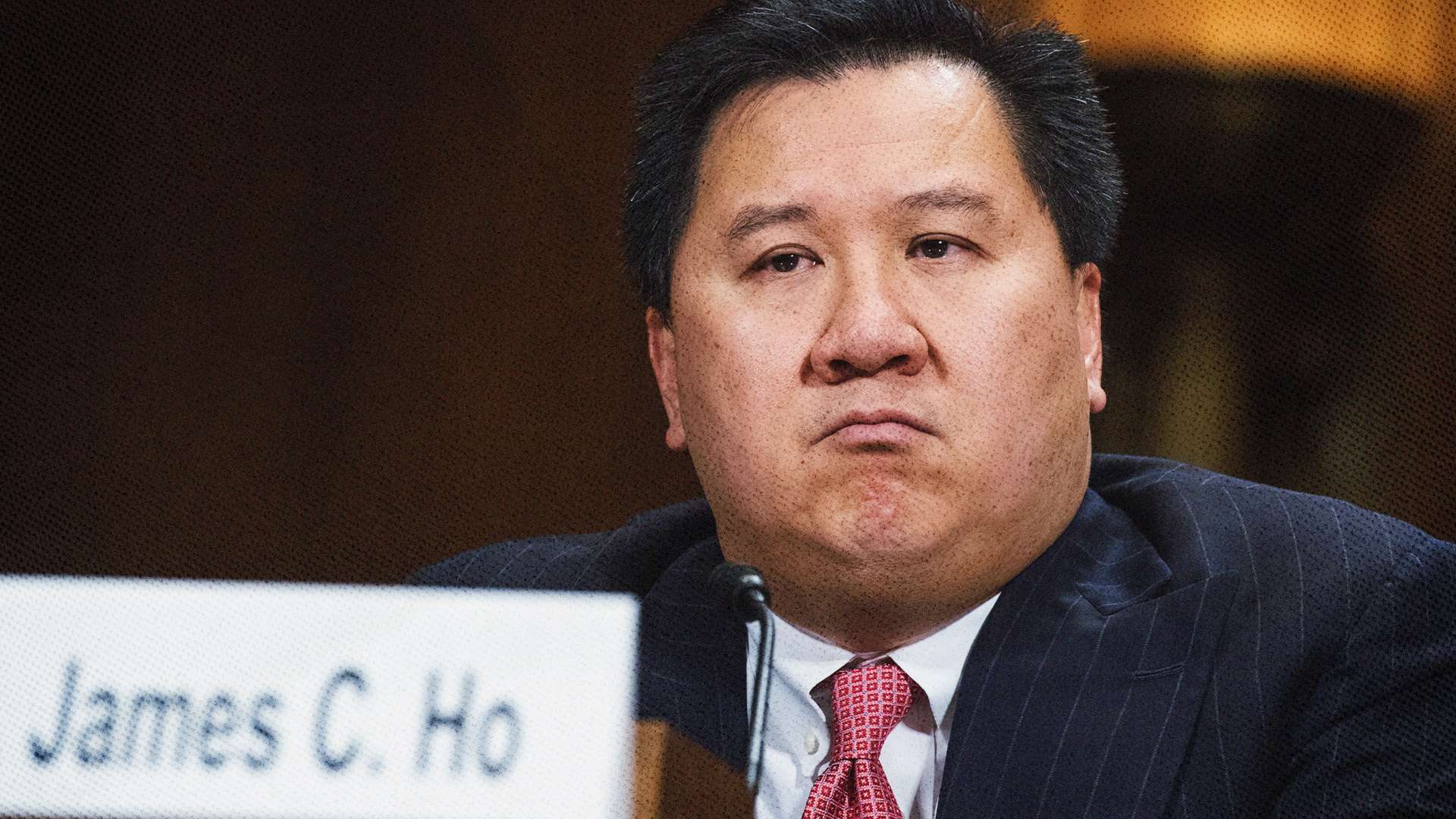
James Ho, whom President Donald Trump appointed to the U.S. Court of Appeals for the Fifth Circuit in 2017 and long considered a potential Supreme Court pick, recently criticized Trump v. Barbara, the June 2026 ruling that rejected the administration’s bid to curb birthright citizenship. His remarks, delivered on October 5 to a gathering of Christian activists at the Museum of the Bible in Washington, D.C., are notable because they appear to run counter to his enduring belief that children born in the United States to unauthorized immigrants are citizens under the 14th Amendment.
The New York Times portrays Ho’s speech as evidence that he hopes Trump will nominate him to the Supreme Court if a vacancy arises in the next couple of years. However one interprets that, Ho’s stance on Trump v. Barbara clashes with what he has repeatedly said about the scope of the Citizenship Clause.
“Birthright citizenship is guaranteed by the Fourteenth Amendment,” Ho stated in a 2006 law-review article. “That birthright applies with the same force to the children of undocumented individuals as it does to descendants of Mayflower passengers.”
Ho reaffirmed that view in a 2011 essay for The Wall Street Journal. “Opponents of illegal immigration cannot claim to defend the rule of law while simultaneously endorsing policies that violate our Constitution,” he wrote.
The first sentence of the 14th Amendment states that “all persons born or naturalized in the United States, and subject to the jurisdiction thereof, are citizens of the United States.” Ho argued that the language’s “plain meaning” is unambiguous. “A foreign national living here is ‘subject to the jurisdiction thereof’ because he is legally obligated to obey U.S. law.” He added that historical evidence shows that “both supporters and opponents of the citizenship clause agreed” it would extend birthright citizenship to the U.S.-born children of Chinese laborers and other noncitizens.
So why does Ho contend that the Supreme Court reached the wrong result in Trump v. Barbara? “Foreign governments weaponize illegal immigration to damage other nations,” he said at the Museum of the Bible conference, organized by the Judicial Action Group. “For decades, administrations of both parties have warned about using illegal immigration as a weapon of war, and judges are supposed to defer to presidential proclamations about a state of invasion. Therefore, the Supreme Court should have upheld the president’s birthright citizenship order in full based on that invasion proclamation.”
Ho had hinted at this line of thinking in a November 2024 interview with Josh Blackman, a professor at South Texas College of Law, who shares Ho’s belief that the Citizenship Clause covers U.S.-born children of unauthorized residents. Blackman had noted, in July 2024’s United States v. Abbott, that Ho had written a dissent arguing that illegal immigration could qualify as an “invasion” under Article I, Section 10, Clause 3 of the Constitution, which prohibits states from engaging in war unless actually invaded or faced with imminent danger.
Blackman pressed Ho to respond to criticism of that view. Ho replied that there is a direct link between birthright citizenship and invasion in his prior writings. “Birthright citizenship has support from various Supreme Court opinions, including cases involving Justices Scalia, Thomas, Alito, and others. But birthright citizenship clearly does not apply in situations of war or invasion. To my knowledge, no one has ever argued that the children of invading aliens deserve birthright citizenship. And I can’t imagine what the legal argument for that would be.”
The problem with Ho’s qualification is that it empowers the president to override birthright citizenship—long understood to be guaranteed by the 14th Amendment—simply by declaring that illegal immigration constitutes an “invasion.” It isn’t hard to see why that stance would appeal to Trump, since it would allow the president to redefine citizenship unilaterally.
Does that mean Ho is currying favor with Trump in hopes of replacing any justice who might retire before the end of the president’s term? That is the view advanced by The Times columnist Mattathias Schwartz. Schwartz concedes that Ho—like most of the potential Supreme Court nominees Trump listed during his first term—belongs to the camp of “traditional conservatives with strong ties to the Federalist Society.” Yet Schwartz argues that some observers view Ho’s remarks as an attempt to signal alignment with Mr. Trump’s worldview.
What basis does he have for that claim? Schwartz notes that Ho’s speech echoed frustrations shared by Mr. Trump and his base—that the Supreme Court’s conservative six-justice bloc, including three of Trump’s appointees, has not uniformly advanced his agenda. Despite notable conservative successes on abortion, gun rights, and-redistricting, there is a perception among Trump-aligned conservatives that Justices Brett M. Kavanaugh, Amy Coney Barrett, and Neil M. Gorsuch are turning into unreliable centrist swing votes—hints of the Kennedy/Souter dynamic they supposedly resemble.
That framing implies that supporting Trump’s program is a matter of conservative principle. Yet Trump himself has shown little coherent ideology, and his authoritarian impulses frequently clash with core conservative tenets such as originalism, the rule of law, and the separation of powers. Describing justices who occasionally dissent from Trump as “centrist” only makes sense if one accepts his views as the standard by which judicial performance should be measured.
In any case, Schwartz suggests Ho is casting himself as a judge friendly to Trump who, unlike Kavanaugh, Barrett, and Gorsuch, could be counted on to side with the president. But the evidence Schwartz cites to back that interpretation is slender.
As Schwartz acknowledges, it isn’t even clear that Ho desires the seat for which he would be auditioning. His wife, Allyson N. Ho, works for a firm that frequently handles Supreme Court cases, and Ho has suggested that his joining the Court would jeopardize her career. “I can’t imagine Allyson’s firm would want to be categorically recused from the highest court in the land,” Ho said in a recent interview. “To tell every client they could only seek cert from an eight-member Court would effectively end her career and the practice she has spent decades building.”
Undeterred by that complication, Schwartz points to passages in Ho’s speech that he believes signal a desire to please the president. “Judge Ho lamented the values of ‘this fallen world,’ ” Schwartz writes. “He urged the judiciary to resist ‘cultural elites who control the national discourse.’ He also bluntly criticized the Supreme Court for legalizing same-sex marriage, argued that the court’s majority was wrong not to block the distribution of an abortion drug, and said it was wrong again when it rejected Trump’s attempt to limit birthright citizenship.”
Those remarks likely resonated with the Christian conservatives in attendance. Yet with the exception of Ho’s stance on Trump v. Barbara, nothing else seems tailored to ingratiate Ho with a president who is not notably religious and shows little interest in revisiting same-sex marriage or overriding state abortion policies.
While opposition to “cultural elites” aligns with Trump’s populist instincts, the context makes clear that Ho was defending originalism against results-driven jurisprudence. “We know that originalism may be permissible in polite company,” Ho said, “but only if it does not yield outcomes that are detested by the cultural elites who control the national discourse and who confer the prestige and status sought by many judges.”
Although Ho’s remarks included Christian rhetoric, he stressed that originalism does not require interpreting the law through religious lenses. “Being an originalist means adhering to the text and the original understanding of the law regardless of the outcome, regardless of how it affects a judge’s standing or reputation,” he said. “If that is truly the approach, there should be no Christian interpretation of the text or atheist interpretation of the text—only a faithful, dutiful interpretation of the text.”
If you thought Trump genuinely cared about judicial methodology, about a faithful reading of the text, or about sticking to an original understanding of the Constitution, you have not been paying attention to his criticisms of judges, which almost always hinge on their disagreement with him. Michael Fragoso, former top aide to Sen. Mitch McConnell (R–Ky.), who oversaw Trump’s nominations of Kavanaugh, Gorsuch, and Barrett, expressed that sentiment in an interview with Schwartz.
“One thing the activist class hasn’t realized is that the president doesn’t really care about those substantive questions,” Fragoso said. “He regards this as a loyalty issue.”
Given that frame, you might expect a judge signaling alignment with Trump to weigh in on tariffs, Trump’s hallmark policy. Yet Ho’s critique of recent Supreme Court rulings did not extend to the February decision in Learning Resources v. Trump, which rejected Trump’s claim to sweeping tariff powers under the International Emergency Economic Powers Act.
Among Trump’s courtroom defeats during his term, that ruling may have been the loudest, especially because Justices Gorsuch and Barrett joined the majority. Yet Ho, who the speech was meant to project as channeling Trump’s exasperation with dissenters, did not mention that case. Nor did he address the Court’s ruling against the deployment of the National Guard or its ruling curbing the use of the Alien Enemies Act, both significant blows to the administration.
Those omissions are puzzling if Ho was primarily aiming to improve his odds for a Supreme Court appointment. They are less troubling if he was simply voicing his sincere opinions.
