“FarmaIndustria is the leading business association of the innovative pharmaceutical industry in Spain. It represents the companies that research, develop and produce medicines for human use,” recalls Fina Lladós, who since the end of 2024 has served as president of the association.
A licensed pharmacist from the University of Barcelona, Lladós has built her entire career in multinational pharmaceutical companies, and especially in Amgen Iberia, where she is also chief executive. In this American company, a benchmark in biotechnology, she has worked for the last twenty-five years, first in R&D and later in medical and commercial roles.
Catalan, with a dialogical temperament and a strong technical profile, Lladós is recognized for her ability to bridge between industry, the public administration and the academic research ecosystem. “Medicines should be seen not as a cost, but as an investment in health and a stake in our economy,” she argues during the conversation in Illa da Toxa, convinced that public-private collaboration is the key to reinforcing Spain’s strategic role on the European pharmaceutical map.
Fina Lladós is characterized by a pragmatic yet optimistic view of science’s ability to transform society. She is firm in defending Europe’s strategic autonomy in health and with a leadership style that mixes professional rigor with social sensitivity, aware that medicine is not just an economic product, but a tool that can change patients’ lives.
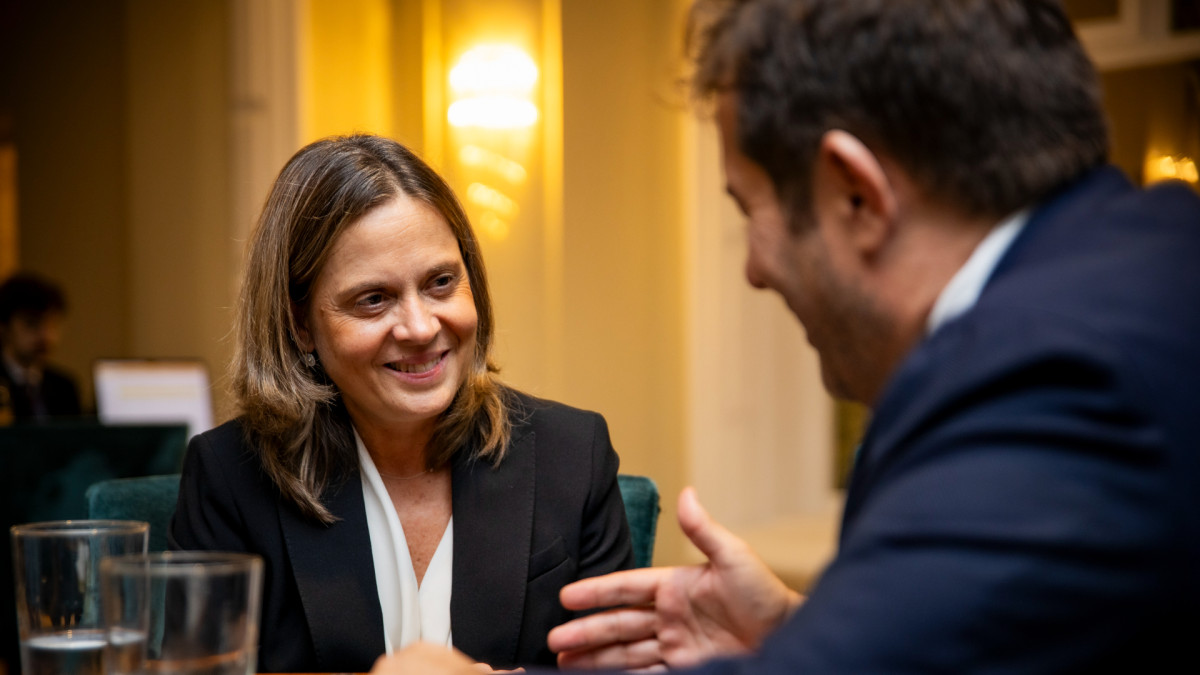
Fina Lladós responds about the relevance of Barcelona in the pharmaceutical context. Photo: Agenda Pública / Yanka Soto
Why is the pharmaceutical industry, despite its growing importance in Spain’s economic development—especially in Catalonia—appearing absent from the public debate?
There can be several reasons. One is our health system: our main client is the public sector. We research and develop drugs so they reach patients, but the challenge lies in how innovation is incorporated. When the discourse is limited to health care, it is perceived only as a cost.
In contrast, if the perspective is broadened, it must be understood as an investment in health and in the economy: every euro invested in medicines yields four back to the country as a whole. Additionally, we generate young and qualified employment and support innovation in diseases without solutions, many times arising from academia, which can take up to twelve years to reach the patient. This requires viewing the sector as a generator of value, employment and research, in collaboration with high-quality public centers.
What importance does public capital have? Mariana Mazzucato reminds us that the iPhone would not exist without public investment in defense.
It is fundamental, because it sets the strategic priorities of a country. The United States, for example, decided that R&D in health sciences was key: it invested in universities, attracted talent and created clusters around academia. That public commitment is what makes a country competitive.
How are we doing in Spain?
The Pharmaceutical Industry Strategy 2024-2028, published at the end of last year by the Government, is a statement of intent that acknowledges our sector as strategic for the country. And it is good news that it now must be materialized with more real investment and a mindset shift that creates an effective framework.
“Spain should bet on sectors where it has experience such as pharmaceuticals, and boost knowledge transfer between academia and industry”
Tthere are still barriers between the public and private sectors; as long as we speak in those terms, the separation remains. Spain must clearly commit to sectors where it already has experience like the pharmaceutical sector, and boost knowledge transfer between academia and industry to create new companies.

Lladós deepens the idea of strategic autonomy. Photo: Agenda Pública / Yanka Soto
Why have Barcelona and Catalonia become such an important pharmaceutical hub?
Because for years there has been a deliberate effort to create an ecosystem: the first Spanish pharmaceutical companies were born with an entrepreneurial vision, accompanied by institutions and funds that took risks in health and innovation. Universities, research centers, leading hospitals and the role of institutions such as Biocat were decisive. In this way, an environment was created where innovation attracted more innovation and investment attracted more investment.
Who do we compete with at the European level?
Mainly Lombardy, which is the leading region in Europe; Barcelona and its surroundings rank second. The big future competition will be who leads the incorporation of artificial intelligence in health. Barcelona has already taken important steps with the arrival of technology centers and the Barcelona Supercomputing Center. The key is specialization: if Europe tries to have every country and region do everything, it will fail.
In the EU there is talk of strategic autonomy. How dependent are we in the pharmaceutical sector?
The pandemic showed it: Europe and Spain were relatively resilient thanks to the presence of local factories. But we must preserve this industrial fabric and develop areas where we are still dependent. The value chain must be complete: research, discovery, protection of intellectual property, manufacturing and marketing. The geopolitical situation obliges us to strengthen our autonomy, because science can become a tool of global power.

Marc López Plana asks Fina Lladós about the development of the public debate on pharmaceutical policy. Photo: Agenda Pública / Yanka Soto
Who do we depend on more?
Primarily on the United States, with whom we share more. With China less, although its influence is growing. Europe has excellent research, but it needs to turn it into productive reality. The challenge is not so much that others do not share science, but that Europe is not prepared to harness it with strategic autonomy.
Draghi and Letta have noted that many European startups end up moving to the United States due to a lack of financing. How can this be avoided in the case of pharmaceuticals?
From FarmaIndustria we promote forums for contact between startups and companies, but the underlying problem is the lack of venture capital culture in Europe. Here, investment is lower and mistakes are penalized more. While a startup is in the preclinical phase, it can be funded with small rounds, but when it progresses to clinical research it requires very high and high-risk capital.
“Europe has capital, but it lacks an investing mindset and infrastructures to channel it. It also needs regulatory certainty.”
The United States has a more ready ecosystem to take on the risk. Europe has capital, but it lacks an investing mindset and infrastructures to channel it. In addition, it must offer regulatory certainty: in the U.S., inventors know their investment will be protected, ensuring a return. In Europe, not yet.
Europe is aging. How should the pharmaceutical sector respond?
It is both a challenge and an opportunity. There will be higher demand for health, more chronic diseases, and longer life expectancy. States must prioritize health investment as wealth and well-being. Research has already adapted: where once all tumors were treated with chemotherapy, today the focus is on the tumor’s pathophysiology to design drugs that target specific cells.
The innovation demands qualitative leaps, combination therapies, and incremental improvements that ensure therapeutic adherence. Current research is far more sophisticated and must respond to the needs of the present and the future.
Thank you very much, Fina.
In partnership with