
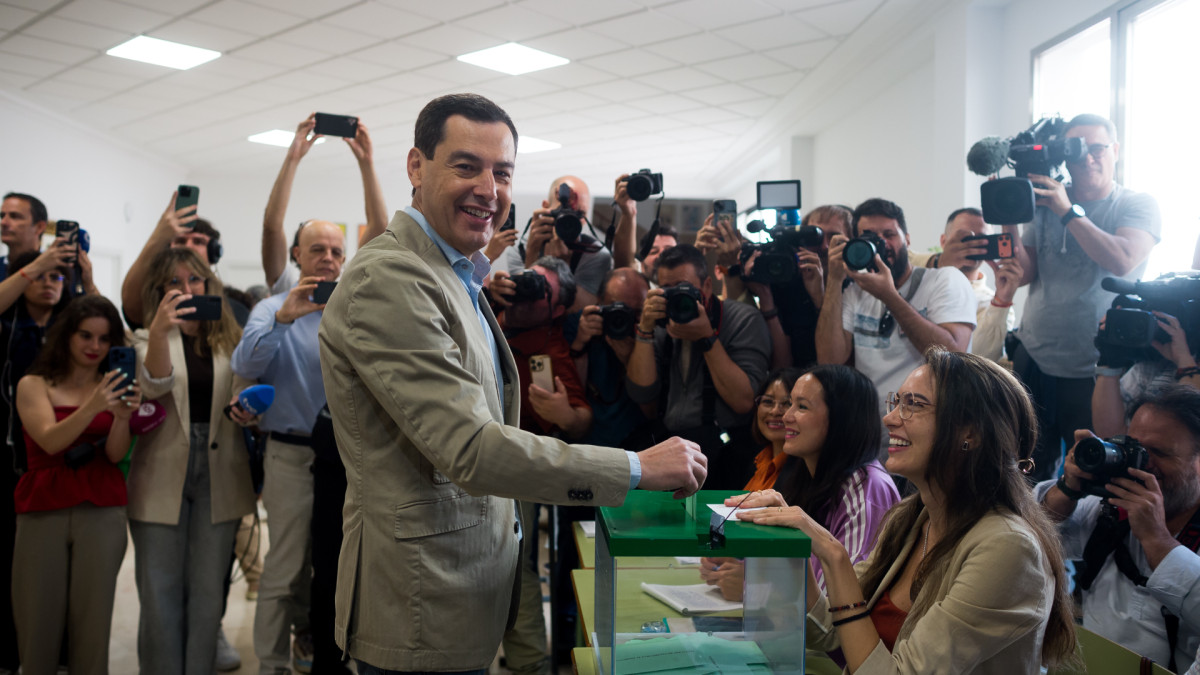
Juanma Moreno wins the Andalusian elections but loses the absolute majority. That is the headline for a call that closes the autonomous electoral cycle designed by the PP. The conservatives drop to 53 seats, five fewer than in 2022, and they remain two seats short of the threshold that would have allowed them to govern alone. Vox rises to fifteen, a modest gain (one seat more) that hints at the exhaustion of its expansive phase. María Jesús Montero registers the PSOE’s worst result in Andalusia’s democratic history with twenty-eight seats, yet avoids the more catastrophic scenarios sketched by some polls. And Adelante Andalucía, the list led by José Antonio García, quadruples its representation to eight seats, surpassing Por Andalucía, which stays at five. All this with a turnout of 63.50%, more than seven points above 2022, a mobilization that has not translated into the scenario most forecasts had drawn. Five keys to decode the day.
1. The absolute majority slips away by two seats
The PP drops from 58 to 53 seats. The loss is not marginal. It totals five seats and, above all, the end of guaranteed single-party governance. Moreno Bonilla will begin a legislature conditioned by the need to choose between governing in a minority with parliamentary support from Vox or opening the doors of the Junta of Andalusia to the radical right in the form of a coalition. The crossroads is historic and goes beyond the Andalusian framework. The model of “administrative Andalusianism” that the PP displayed is formally deactivated in the most populous community in Spain. Until tonight, Moreno Bonilla was the only PP leader able to display a legitimacy of his own against Vox and Madrid, differentiated under the banner of moderation.
“The territorial reference to which the party looked as proof of viability without the radical right appears tonight dependent on it”
It is a poor result for Moreno Bonilla, which reveals significant wear and tear, and also for Alberto Núñez Feijóo, because it closes an autonomous electoral cycle without the epic that the PP hoped for. The territorial benchmark the party looked to as proof of viability without the radical right appears tonight dependent on it or trapped in a precarious legislature. The dilemma facing the conservatives was whether Moreno Bonilla’s model could be reproduced or whether it was more an anomaly. Five fewer seats suggest that the anomaly is starting to return to the mean. As for Vox, Santiago Abascal’s party is no longer the crutch of weak barons: it is now the crutch of the strongest as well.
2. Montero signs the PSOE’s worst historical result in Andalusia, but saves face
The PSOE obtains 28 seats, two fewer than in 2022. The figure is significant: Andalusian socialism records its worst result in democracy in the territory that for forty years was its hegemonic stronghold. Yet the political reading sits alongside the historical.
“Andalusian socialism is now only able to win dwindling battles, to manage defeats rather than compete for majorities”
Sigma Dos had placed it between twenty-six and twenty-nine deputies, and Montero has landed within that range, which helps avoid the worst omens. The apparent contradiction precisely defines the state of Andalusian socialism: capable now only of winning dwindling battles, of managing defeats rather than contending for majorities.
3. Vox grows by one seat and its expansion cycle hits a ceiling
Vox rises from fourteen to fifteen seats. The improvement is real, but very modest, and breaks with the explosive growth trajectory the party had shown in Aragon and Extremadura. In Andalusia it stands at 13.9%, barely half a point above the 2022 share. The conclusion is twofold. On one hand, Vox confirms that it remains in broad and significant vote shares. On the other, the pace has clearly slowed. The radical-right expansion cycle, which seemed unstoppable six months ago, finds in Andalusia its first clear ceiling.
There is an additional factor that nuances the result: SALF, Alvise Pérez’s formation, obtains 2.54% of the vote. It does not enter the Parliament of Andalusia, but competes with Vox for adjacent voters and drains a bloc of votes that, under other circumstances, would have added to its total. In other words, Vox not only encounters a ceiling on the upside — the PP’s useful vote — but also on its own flank, where there is an extracurricular competition that affects it.
“Vox hardly grew in votes, but multiplied its capacity to influence”
Nevertheless, the qualitative highlight of the night for Vox is not its seats, but its position. In 2022, Vox’s fourteen deputies were irrelevant for forming a government: Moreno Bonilla governed with an absolute majority and could afford to keep the Abascal party at a distance. In 2026, with fifteen deputies, Vox becomes the key to the legislature. The same parliamentary group, but a radically different political stance. Vox has barely grown in votes, but has multiplied its capacity to influence. In short, that is the news: it has gone from being a bystander to an arbiter without needing to gain a single additional point.
4. Adelante Andalucía completes the overtaking of Por Andalucía and reorders the left’s space
The night’s big phenomenon is Adelante Andalucía. The list led by José Antonio García climbs from two to eight seats and quadruples its representation, reaching 9.6% of the vote. Por Andalucía, the IU and Sumar brand, to which Podemos had joined, repeats the five seats of 2022, but loses more than one percentage point and 22,000 votes. The five seats help salvage its own parliamentary group, but leave the political future of IU’s federal coordinator Antonio Maíllo damaged.
The overtaking confirms a trend that the electoral cycle has been hinting at for years: the left-wing electorate withdraws to non-state-based candidacies when Madrid-based brands lose mobilization capacity. We saw this with the BNG in Galicia or EH Bildu in Euskadi at different moments, or recently with the Chunta Aragonesista in Aragon. We now see it with Adelante Andalucía. It is not identity politics in the classic nationalist sense: it is the search for a territorial anchor perceived as authentic against state brands, and the assertion of a less institutionalized left and, above all, less governing.
“There exists an alternative left with its own territorial anchor, detached from the Madrid bubble dynamics”
The reading has two main levels. The first, Andalusian: Adelante Andalucía has capitalized on the progressive vote discontent with the PSOE and with Sumar’s subordination, and has also managed to attract voters less inclined to participate in elections. The second, structural: there exists an alternative left with its own territorial anchor, detached from the Madrid bubble dynamics and capable of growing when state brands deflate.
5. Moreno’s crossroads: minority governance or a coalition with Vox
Moreno Bonilla will have to confront in the coming weeks the most delicate dilemma of his political career. Governing in a minority with 53 seats obliges him to negotiate every budget, every law, every decree. It will be a legislature of slow wear, with no certainties, as the opposition sets the agenda at every vote and institutional stability remains permanently at stake.
The alternative is to forge a coalition with Vox and hand portfolios to the radical right. It is the option that guarantees a stable parliamentary majority, but it formally ends the model that has made the Andalusian president a statewide reference for the PP. Moreno Bonilla had built a distinct brand and bets everything on the decision he makes.
In short, it has become clear that these Andalusian elections were not just any elections. The PP wins, but loses the model. The PSOE loses, but saves face. Vox improves, but less than it hoped and with the doubt of whether its expansion cycle is ending. And Adelante Andalucía, which arrived at night as a footnote, emerges as the protagonist of the left’s reordering.
