
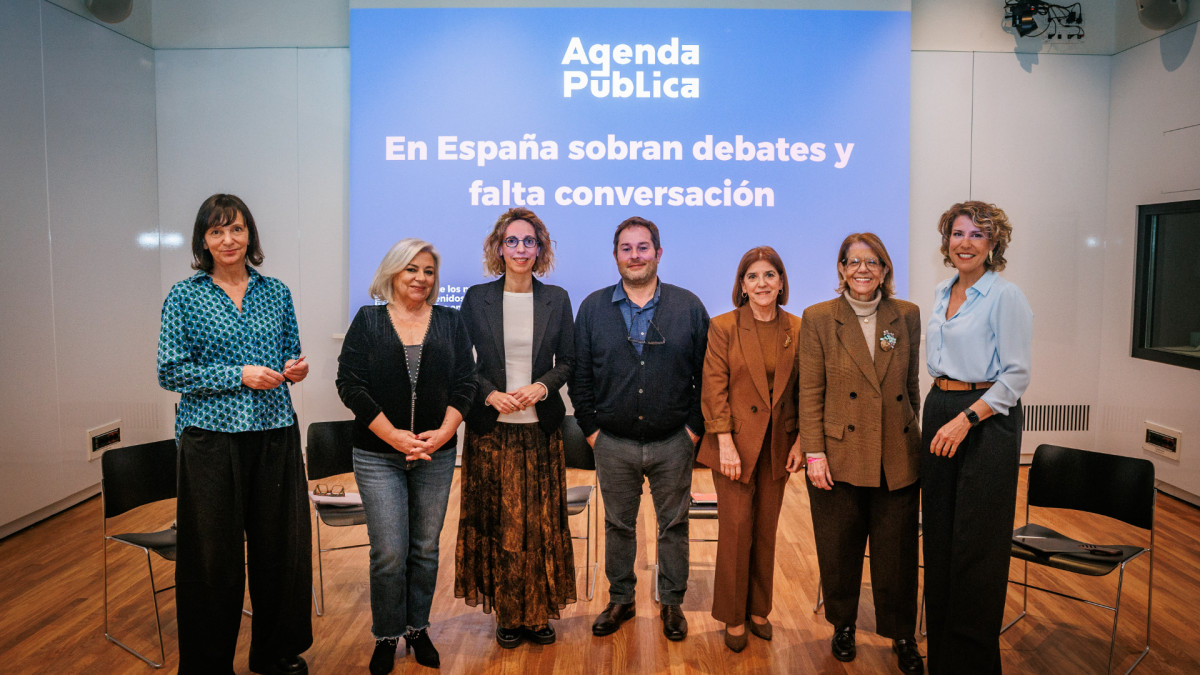
For much of their political careers, the five women had championed projects that faced off against one another. One was the PSOE’s number two. Another helped found Podemos, the party that challenged socialist hegemony on the left. A third served in a conservative government and headed the National Securities Market Commission. The other two came from nationalist traditions, Basque and Catalan, accustomed both to negotiating with the major Spanish parties and to confronting them. On Friday, November 20, however, none of them seemed particularly eager to defeat the others.
A Cross-cutting Dialogue in a Diverse Spain
Agenda Pública brought them together in Madrid. They were Elena Valenciano, former deputy secretary-general of the PSOE and former vice president of the Socialist group in the European Parliament; Carolina Bescansa, sociologist, cofounder of Podemos, and former deputy; Elvira Rodríguez, former Environment Minister under José María Aznar and former president of the CNMV and of the Madrid Assembly; Izaskun Bilbao, former president of the Basque Parliament and fifteen-year MEP for the PNV; and Àngels Chacón, former regional minister for Enterprise and Knowledge of the Generalitat de Catalunya and former secretary general of the PDeCAT. Over more than two hours they spoke about polarization, the crisis of representation, and the problems Spain has been unable to solve for years. Nine days remained before the general elections, and the parties in which they had built their careers were preparing for another clash at the ballot box.
“In this country there are too many debates and too few conversations,” said at the outset the political scientist Verónica Fumanal, a counselor at Agenda Pública, former president of the Association of Political Communication (ACOP) and former communications director for various national leaders. As she explained, during the campaign more than sixty debates of various kinds had been scheduled. The Madrid meeting aimed at something different: for people with differing positions to listen to one another, to disagree, and to try to understand each other. All five agreed that Spanish politics carried deep-seated problems. There was, however, no shared answer on their causes or on how to resolve them. That was, in large part, the interest of the gathering.
Verónica Fumanal, political scientist and Agenda Pública adviser, opened the conversation calling for more listening and less political confrontation. Photo: Agenda Pública / Tania Sieira.
A Polarization That Starts from Above
“La polarización viene más de arriba abajo que de abajo arriba,” Valenciano asserted. In her view, a good portion of the Spanish confrontation stems from a strategy by the party leaderships to keep their voters cohesive. As society grows more complex, political organizations become more closed, tolerate dissenting voices less, and lose their capacity to act as intermediaries. From that contradiction she drew a distinction that reappeared throughout the session: going to the polls does not necessarily mean feeling represented. A party may mobilize millions of people and, at the same time, move away from their everyday concerns.
“A party can mobilize millions of people and, at the same time, move away from their daily concerns.”
For Bescansa, the explanation goes beyond party strategies. The Podemos cofounder led the discussion toward the transformation of Western democracies and their public discourse. She placed Silvio Berlusconi’s entry into Italian politics among the episodes that shifted attention from policies to people. Then came the fight for audience figures, the precarization of journalism, and the growing weight of digital platforms. “One of the things we are witnessing is the replacement of politics by political communication,” she warned. The media also participates in the dynamic, she added: competition among news organizations for attention favors speed and immediate reactions, often at the expense of discussing public issues.
Àngels Chacón found a frame for that mood: Spanish politics increasingly resembles a Roman amphitheater more than an Agora. Citizens attend the confrontations as spectators, and parties seem more interested in defeating the opponent than in convincing them. The analogy left an uncomfortable question: if this style of politics impoverishes the debate, why does it endure? Because what works to win elections does not always help to govern. Portraying the rival as a threat mobilizes one’s own side; acknowledging later that they have valid arguments, or that one might have to accommodate them, is far more difficult.
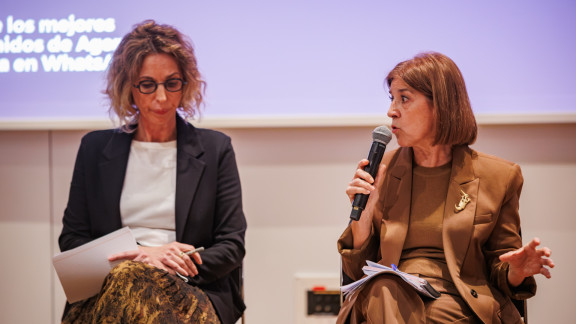
Àngels Chacón (left) and Izaskun Bilbao during the meeting, where the participants debated how to address polarization without renouncing their differences. Photo: Agenda Pública / Tania Sieira.
Politics Can’t Be Merely Reactive
Elvira Rodríguez stressed the importance of the time politics spends thinking. “There is too much short-termism, too much immediacy,” lamented the former minister. She had been the first to respond to Fumanal’s question about why it is so hard to listen to one another, and her answer went beyond manners: politics spends too little time understanding problems before answering them. Listening is not simply waiting for the other to finish speaking; it means reflecting on what is said. For Rodríguez, public leaders must regain the ability to set long-term objectives, even in difficult moments. Otherwise, urgencies end up replacing any strategy. Not exactly the same reading as Bescansa’s. If she pointed to the structural changes in the media, the attention economy, and the rise of platforms, Rodríguez called for responsibility of leaders not to let themselves be carried away by them. She spoke of transparency, but also of generosity. Negotiating, she reminded, does not have to equal losing: agreements can yield benefits for all sides. Governing, from that perspective, requires placing some collective goals above immediate political advantage.
“Elvira Rodríguez noted that public officials must recover the ability to set long-term goals, even in difficult moments.”
The disagreement was visible. Bescansa saw a problem too deep to be solved solely by better individual attitudes; Rodríguez resisted embracing resignation in the face of momentary complexity. Would a change in leaders’ behavior suffice? Or should political, media, and economic incentives that feed confrontation be modified? The meeting did not settle the question, but it did allow discussion without reducing it to a volley of blame.
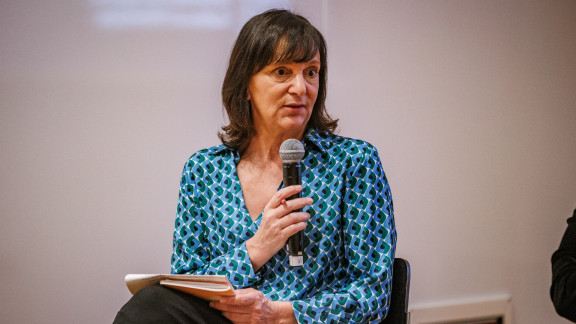
Carolina Bescansa, sociologist and Podemos cofounder, warned of the growing weight of political communication and digital platforms in public debate. Photo: Agenda Pública / Tania Sieira.
Agreements Do Not Erase Differences
Izaskun Bilbao’s experience in Brussels provided a counterpoint. In the European Parliament, she recalled, representatives from different political families regularly negotiate to advance legislative initiatives. “People do care about politics; they don’t like how we do it,” insisted the former PNV MEP. To illustrate, she recounted a scene from her years in the European Parliament: during a debate on agriculture, a deputy held up a cucumber and monopolized media attention. She had spent eight months negotiating a report that she defended in that session. It received little coverage. A flashy gesture had drawn more attention than eight months of negotiation.
“A flashy gesture had received more attention than eight months of negotiation.”
Hence her defense of parties that are more open to participation, capable of explaining their decisions, and aware of their role as public service. Bilbao also questioned whether an agreement with a government of a different stripe must be framed as a defeat for the opposition. Bescansa added a pertinent caution: democracy does not require unanimity. There are conflicting interests and, when agreement is not possible, majorities must be able to decide. Consensus cannot become an obligation that erases differences.
And there were differences. Rodríguez emphasized budget discipline and the economic sustainability of public policies; Valenciano focused on representation and social cohesion. Bilbao and Chacón called for respect for different territorial realities, while Bescansa pressed for structural responses to inequalities and the power of the large platforms. No one renounced their positions to keep the conversation going. What mattered was that they could confront them without turning the disagreement into a personal affront.
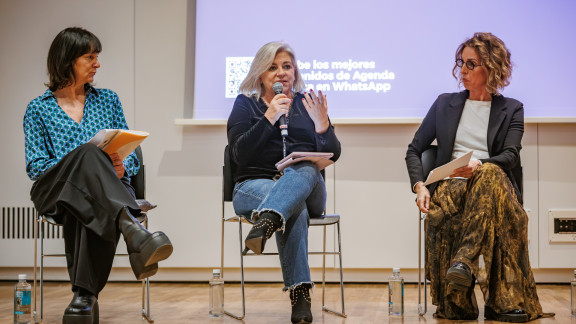
With the microphone, Àngels Chacón, contributing her perspective in a conversation about the causes of political confrontation and the need for lasting agreements. Photo: Agenda Pública / Tania Sieira.
The Problems That Await After the Elections
The dialogue moved from the rules of politics to the tasks awaiting them when Fumanal asked what major agreements Spain would need in the next legislature. The responses pointed to problems that are hardly solvable in four years. Rodríguez called for cleaning up public accounts and rigorously discussing the financing of services and investments. The former minister, who had also been Secretary of State for Budgets and Expenditures, urged keeping in mind the economic consequences of every decision: merely announcing objectives is not enough if one does not explain with what resources they will be met. For Chacón, priorities included education, productivity, and reindustrialization. Bilbao added the need to tie industrial policy to professional training and to address immigration and its integration into the productive model.
Valenciano steered the discussion toward the generations that will live longest with today’s decisions. She proposed an intergenerational pact given the widening gap between the living conditions of older people and the difficulties faced by young people to become independent, obtain housing, or imagine a better future. They are fewer in number and have less electoral weight, she noted, even though they will bear the consequences of current policies for longer. Housing then made tangible one of the representation gaps that had emerged at the start of the meeting: tenants’ organizations have helped bring the problem to the agenda, sometimes before traditional parties responded to those demands.
“Elena Valenciano proposed an intergenerational pact given the widening gap between the living conditions of older people and the difficulties of the young.”
Another pending issue, according to Bescansa, is the privatization of the public conversation. The big tech platforms control a large portion of the spaces where political opinions are formed, and artificial intelligence further blurs the line between true and false information. The former deputy called for substantive answers, not superficial tweaks. With different recipes, the participants kept bumping into the same difficulty:
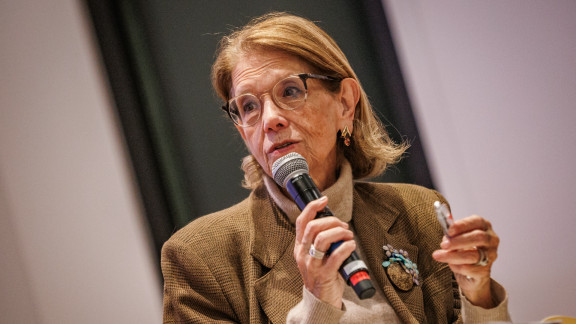
Elvira Rodríguez, former minister and former CNMV president, urged setting long-term objectives and accounting for the economic sustainability of public policies. Photo: Agenda Pública / Tania Sieira.
A Europe That Cannot Afford to Waste Time Either
The discussion about timelines and priorities did not end in Spain. When addressing the future of the European Union, the five agreed on the need to take decisions in an international arena dominated by competition among great powers, though they disagreed about which should come first. Rodríguez opened the European economy debate with a question: how to finance the investments necessary to recover European competitiveness? She referred to the needs outlined in the Draghi report and doubted that the solution could be found merely by increasing public debt. She also criticized the EU institutions’ faith in regulation. “Problems are solved by doing, not by prohibiting and regulating,” she stated. Her argument was that Europe needs resources, companies, and productive capacity to sustain the values it wants to defend.
Valenciano was more concerned with the weakening of the political consensus on which the Union was built. She warned about the rising influence of the far right and the willingness of some conservative parties to lean on forces that question fundamental principles of the European project. From her experience in the European Parliament, Bilbao urged completing the single market, strengthening diplomacy, and restoring multilateralism. Chacón returned to the loss of competitiveness relative to the United States and China. Bescansa, for her part, warned of the return of military power to the center of international relations and the need to preserve the European model of equality and social protection.
They were not debating only instruments. Rodríguez placed the problem in investment and regulatory limits; Valenciano in the erosion of community consensus; Bescansa in the concentration of economic and technological power. Bilbao and Chacón added to this map. Europe needs long-range decisions, precisely when political fragmentation makes them harder to adopt. It was, at European scale, a difficulty similar to the one they had described for Spain.
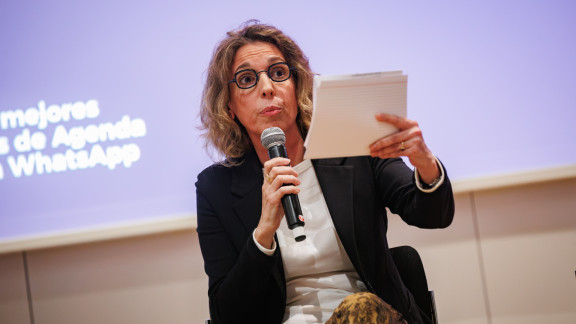
Àngels Chacón, former Minister of Enterprise and Knowledge of the Generalitat de Catalunya, addressed Europe’s loss of competitiveness against the U.S. and China. Photo: Agenda Pública / Tania Sieira.
The Freedom of Those Who No Longer Need to Win
Before closing, Fumanal asked each participant to name one pending conversation for Spain. Valenciano chose the very way politics is conducted; Bescansa selected the major social transformation projects; Bilbao the public service and recognition of differing territorial realities; Chacón the obligations of the parties toward future generations. Rodríguez recalled a television program from her childhood, La unión hace la fuerza, to insist on something more concrete than a call for harmony: identify problems, set priorities, and accept that no collective project can advance without work and effort.
There was no shared program nor any late-life conversion. The disagreements over taxes, territorial competences, regulation, and public spending remained intact. Nor did it seem that any of them had changed their mind substantially. What they had achieved was to discuss without needing to discredit the person across from them. It may not be an extraordinary feat, but the participants themselves acknowledged how difficult today’s Spanish politics is.
The five had held positions of responsibility, and none were now under the daily discipline of electoral competition. That distance could give them room to acknowledge an argument even if it did not receive immediate endorsement from party leadership or former voters. It does not necessarily make former leaders more reasonable. It changes incentives. Someone seeking to win elections may interpret a concession to the opponent as a sign of weakness. Who no longer needs to contend for power has more freedom to listen.
“Who seeks to win elections may understand a concession to the adversary as a sign of weakness.”
In closing, Fumanal thanked the exercise and noted that probably none would receive applause for having spoken without trying to overpower the others. Nine days before the general elections, that sentence took on a particular meaning. Five women who had devoted a large part of their careers to political competition had managed to understand each other well enough to disagree. Meanwhile, those still aiming to govern Spain continue to face powerful incentives to clash.
Perhaps the problem is not that Spanish politicians have forgotten how to agree. Perhaps it is that they have learned that, in order to win elections, it is often more profitable not to.
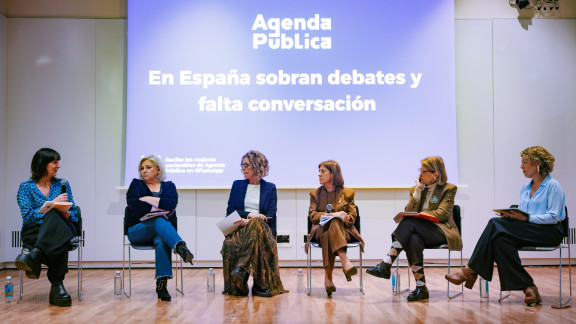
From left to right, Carolina Bescansa, Elena Valenciano, Àngels Chacón, Izaskun Bilbao, Elvira Rodríguez, and Verónica Fumanal, at the Agenda Pública event in Madrid. Photo: Agenda Pública / Tania Sieira.
