
John McTernan surveys the malaise engulfing the British Labour Party with a rigorously unsparing lens. Once at the helm of Tony Blair’s political operation, he believes Labour’s recent electoral defeats stem not only from the typical fatigue that comes with governing but from “doing very, very un-Labour things for two years.” In a discussion with Agenda Pública, McTernan contends that the principal danger facing the British centre-left does not come from Reform UK’s radical right. Instead, he argues that a sizable slice of voters could drift to the Greens, to the Liberal Democrats, to nationalist candidates, or to Gaza-connected independents. Regarding the nation’s electoral trajectory, he notes that in a system that is increasingly fragmented, the right can prevail with only a portion of the vote if the centre-left fractures.
In essence, the former Labour adviser outlines the party’s future, the threat posed by Nigel Farage, the UK’s stance toward Europe, defence, energy, immigration and housing, before proposing an alternative: Labour must reclaim a recognisably Labour identity, renounce the mistakes of the Starmer era, and offer a positive reason to vote Labour beyond merely stopping Reform. Because, as he frames it, the next election could become a contest between “socialism and barbarism”.
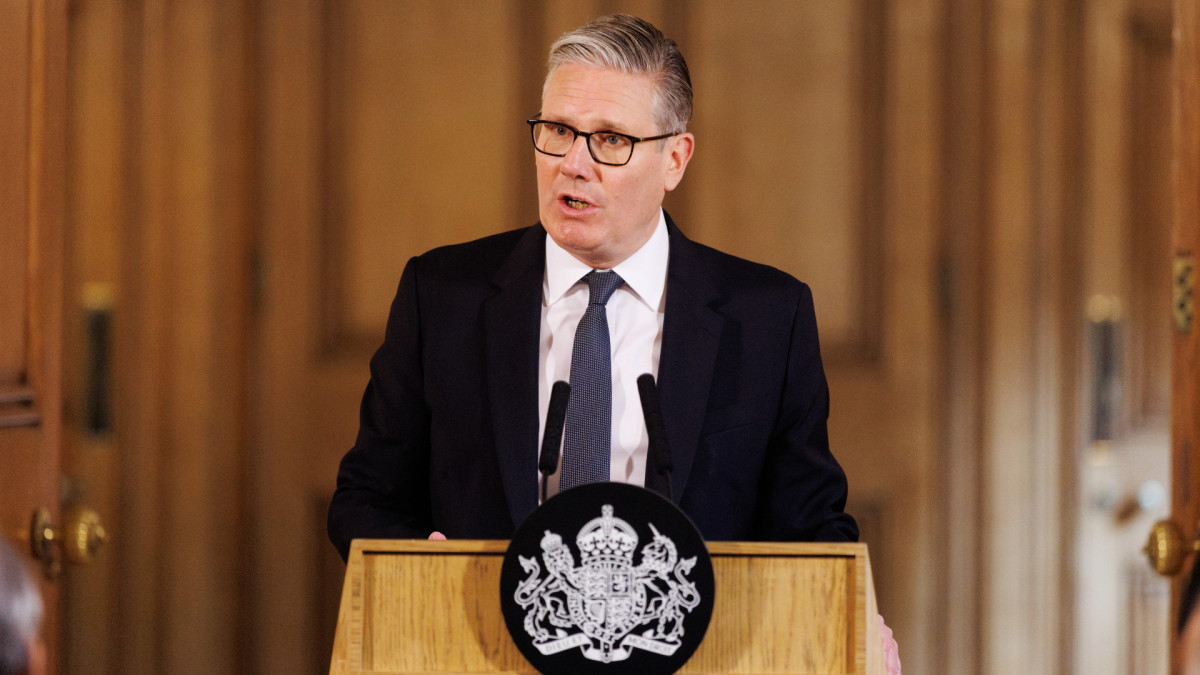
Photo: John McTernan. Image adjusted.
The pressure on Keir Starmer has intensified after recent electoral setbacks for the Labour Party. Do you see this as a situational backlash, or as a deeper, more structural problem within the party?
It is both. These are the worst electoral results Labour has faced in more than a hundred years, and it is only about a century since Labour began governing. So it isn’t surprising that the response has been negative.
What is being debated by those calling for a leadership challenge, or for one more broadly, is a set of arguments about why the government’s programme has gone wrong. This isn’t a matter of messaging. It’s about policy content.
“It was a historic defeat in the local elections, and it was clearly caused by the actions of this government”
This was not a run-of-the-mill defeat. It marked a historic local-election defeat, clearly traceable to the government’s actions. It isn’t about midterm unpopularity or anything of that kind. It stems from doing very, very un-Labour things for two years and then expecting Labour voters to turn up for you.
You have argued that Labour should be more worried about the Greens than about Reform UK. Why do you see the Green Party as the greater challenge?
Reform UK poses a threat to the Conservative Party, and it has carried out that threat. It has fractured the Tory Party. Reform is a right-wing, indeed far-right, party, and it has supplanted Britain’s traditional right-wing establishment.
It isn’t a danger to Labour. It threatens the Tories. Only around 2% of Reform voters would ever contemplate voting Labour. Chasing them would be a fruitless endeavour. Even if there were a path to it, Reform remains a right-wing, far-right outfit. Its platform includes incarcerating and deporting 2 million people in Britain. Therefore, it must be defeated.
On the Labour side, the centre-left has long regarded Labour as the dominant force for a century. Yet Labour’s support now splits among the Greens, the Liberal Democrats, nationalist movements and Gaza-linked independents, typically including Gaza independents.
When the Greens perform well, they siphon votes away from Labour. Consequently, the right wins—even if it only attracts 27% of the total vote. In the United Kingdom’s first-past-the-post system, 27% can be sufficient to prevail in elections marked by five-party dynamics. And today we truly experience five-party politics.
“The more right-wing you become to get votes on the right, the more votes you lose on the centre-left”
Thus, in times of trouble, you must seek the votes where they lie. They are on the left, not on the right. The more you lean to the right to win over the right, the more votes you lose on the centre-left. This isn’t just a misreading; it is a self-defeating strategy.
The current UK polling landscape looks highly fragmented. Looking ahead, is this sustainable for the next election? Do you expect some parties to retreat while others gain?
The forthcoming election will hinge on a choice between socialism and barbarism. If you want to unite the left’s votes, you must alter your approach.
We cannot alter the electoral system. If fragmentation persists under the existing framework, Nigel Farage could become prime minister, and he would detain and deport 2 million people. That would redefine our country. In the UK, the prime minister’s powers, when backed by a landslide, are almost unchecked. So this election carries immense significance.
Labour stands as the sole party capable of defeating Farage. We hold around 400 seats and remain the dominant force. Therefore, if you want to vote for someone to thwart Farage, you should vote Labour, because in most places there is already a Labour MP.
Nevertheless, Labour requires a narrative, a justification, and a policy package that can resonate with Greens, nationalists, Gaza independents or Liberal Democrats. It must convey that Labour has grasped the nature of these challenges, that Keir Starmer has alienated certain voters, that Labour would replace Starmer, and that it has adopted a new set of policies.
“Each part of the coalition needs a positive reason to vote Labour, not just the negative reason of stopping Farage”
Those policies must offer each part of that coalition something constructive. A Green voter must be able to say: Labour does more than defeat Farage; it supports our adoption of electric vehicles, the decarbonisation of the grid, and a shift toward renewables. Each segment of the alliance needs a positive case for Labour, not only a negative one to hinder Farage.
That entails addressing housing, the environment, foreign policy and the Middle East.
I fail to understand why the UK government hasn’t established a Gaza reconstruction board. Set aside Trump’s Peace Board and actually take action. Convene an international donor conference and ask: what does Gaza require? Bring the Palestinian Authority into the process and design the reconstruction board. Priorities would include hospitals, infrastructure, schools, and universities. Outline the needs clearly and then marshal the funding.
The UK, as a permanent member of the United Nations Security Council, is a major player. Major powers should undertake major initiatives.
The same principle applies to rebuilding the global order. The rules-based order that existed has been dismantled by Trump. It was flawed, and we are not returning to it. So what should come next? That is a broad area for discussion.
Once again, the United Kingdom could lead on this, given its size. Diplomatically and militarily, we are significant. We could spearhead a new European defense alliance, potentially including a European army. You cannot have a European army without the UK, and you cannot truly have Europe without a European army.
Thus new debates on the progressive front must be opened. You need the kind of energy demonstrated by Pedro Sánchez at Barcelona’s great meeting of global progressives. But that kind of leadership is not possible with Keir Starmer. It is evident that he is incapable of delivering it. He did not even attend that gathering.
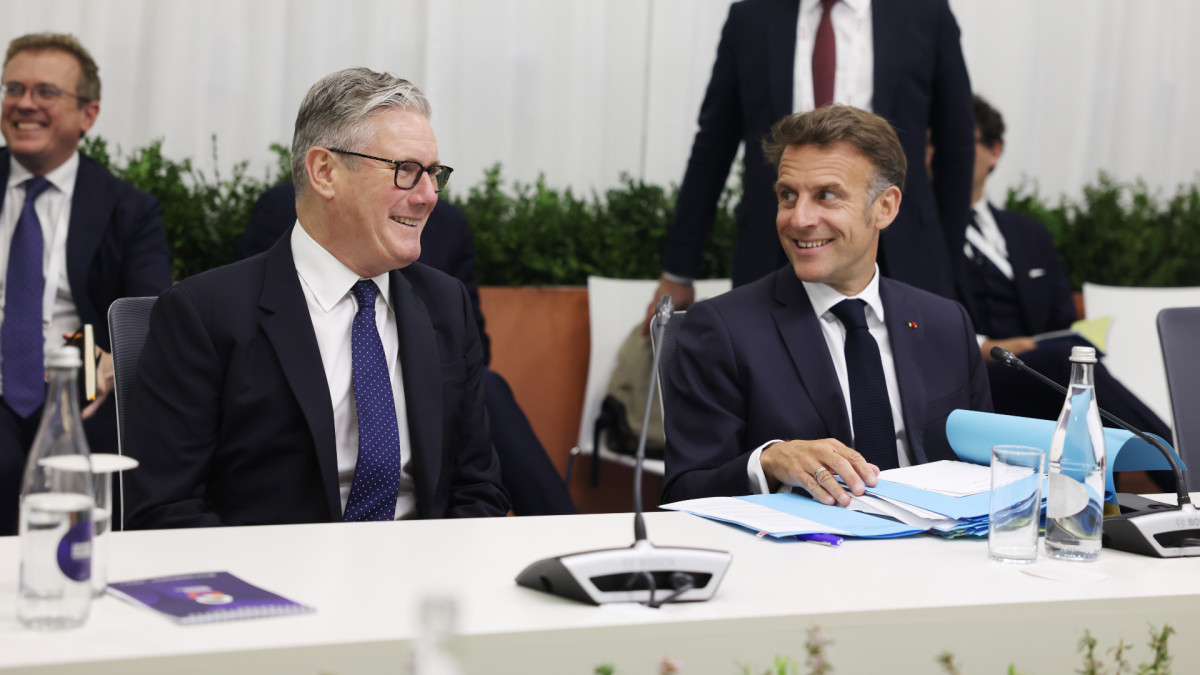
The UK prime minister with French President Emmanuel Macron. Photo: Office of Prime Minister Keir Starmer
Starmer has attempted to reset the UK’s relationship with the European Union. If he were to fall, would that EU reset be at risk?
Not at all. Everyone within Labour supports the reset. We probably need to advance further. It’s possible that a new leader would argue for rejoining the customs union.
And what if the Greens won the next election?
I think that scenario is unlikely. Yet should a Green government come to power, it would pose a substantial threat to Europe. The Greens reject NATO. What they would do to UK defence and security would not merely undermine Britain; it would destabilise Europe.
“If you destabilise the UK, which the Greens would do, you undermine European security”
The UK remains a crucial NATO member, especially in a post-Trump era where France and the UK are among the most dependable allies. If the Greens destabilised the UK—opposing defence spending, opposing the nuclear deterrent, and lacking a coherent defence strategy—you would undermine European security. Broadly, they question defence industries.
That represents one of the main risks. The second is that, although they are labeled the Greens, they also oppose housing and renewable-energy expansion. They reject the transmission lines, pylons, and grid infrastructure needed to deliver new renewables to markets where they are required.
On top of that, they remain anti-nuclear. They oppose both the deterrent and nuclear power. Nuclear energy, as Spain knows, is a vital component of the energy mix. Baseline power is essential, and so is nuclear; you also need renewables, but you require the corresponding transmission infrastructure for those energy sources.
The Greens would oppose all of these elements. The result would be an unbalanced, potentially dangerous situation. For these reasons, I doubt they would ever gain enough support in the UK, as these positions would be unacceptable to voters here.
Do you think Starmer has already forfeited authority? Is there a danger Labour will respond by inching toward Reform UK’s agenda on immigration and national identity, thus getting trapped in domestic culture wars rather than focusing on foreign policy, defence, energy or Europe?
No. There’s no chance Labour would choose a leader who seeks to become a touch more racist, or a touch more Reform-like. Labour MPs and members are exhausted by the government’s closeness to Reform.
“I would expect everyone to make some version of the argument that we should rejoin a European framework, even if only on immigration”
I would expect one of Keir Starmer’s steps before any leadership challenge to be to retract, or modify, some immigration reforms that would render our system far more punitive.
In a leadership contest, I would anticipate everyone to advocate rejoining a European framework of some form, even if only on immigration, so that we can be part of a single European immigration system.
Today, if someone seeks asylum in any European country and is rejected, they cannot apply elsewhere within that system. Yet they can attempt entry to the UK precisely because we are outside that framework. In effect, we have become an appeal court for the system. If you can’t gain entry via France, you come to Britain. If you can’t gain entry via Italy, you come to Britain. If you can’t gain entry via Germany, you come to Britain.
You must stop that. You need to join a Europe-wide arrangement. Everything the UK must do to tackle its challenges becomes easier if it acts with Europe, rather than clinging to the notion that Brexit was beneficial.
McTernan proposes that Labour adopt more left-wing public policies to emerge from the crisis. Photo: Office of Prime Minister Keir Starmer
You have written that Labour should be real Labour, not “Reform light.” In practice, after all that we have covered—defence, energy, Europe, immigration and the economy—what does it mean for the party to be real Labour?
It means discarding the racially charged immigration policies the government is proposing. It also means rejecting assaults on the welfare state. It means devolving authority from Westminster to the cities and regions of England.
It involves taking charge of the housebuilding effort that is needed: a social housing programme delivered by the government, not left to the market. It requires a clearer stance that the state plays a bigger role while markets are given less latitude, because social needs and economic realities are intertwined.
It also means being less generous toward pensioners (whose pensions are rising as a share of public spending) and more supportive toward young people who do not receive a fair deal. In other words, addressing intergenerational unfairness in a way that resonates with both older and younger generations.
There is a path to unite the country around a progressive agenda, but it demands an honest appraisal of the inequalities at stake.
Where this government has aligned with Labour’s manifesto, its steps have been acceptable. Where it has erred, it has pursued measures we never promised to implement.
You must also acknowledge the lack of judgment. Appointing Peter Mandelson as ambassador to the United States was a disastrous choice. No one has explained why it occurred. Why appoint a friend of a convicted sex offender [Jeffrey Epstein] as ambassador? A person who stayed at Epstein’s house while he was serving a sentence for trafficking girls for prostitution? And that was a negotiated deal. The charges were more serious than that.
A person who stayed at that man’s residence while he was serving a prison sentence—after he had completed the system, confessed and accepted the conviction—should never have held public office.
That is a failure of judgment. And judgment is fundamental to leadership. If you have poor judgment on this matter, you will have poor judgment in other areas as well.
If Keir Starmer wishes to continue leading, as he evidently does, he must be able to explain what prompted him to act, what convinced him, why he was wrong, and why he will never repeat those actions. At the very least.
“Taking responsibility means saying: this is what I did, this is why I did it, this is why I was wrong and this is why I will never do it again”
But simply saying “I take responsibility” and then stepping away does not constitute accountability. True accountability means detailing what you did, why you did it, why you were wrong, and why you will avoid repeating it.
There is a central gap in the argument. Labour has made these mistakes over two years and has effectively halved its vote. It cannot win an election by halving its support. It can only have a chance at resurgence if it carries a persuasive story. And the only credible story that signals a break with those mistakes is the replacement of the leader.
Thank you very much.
