
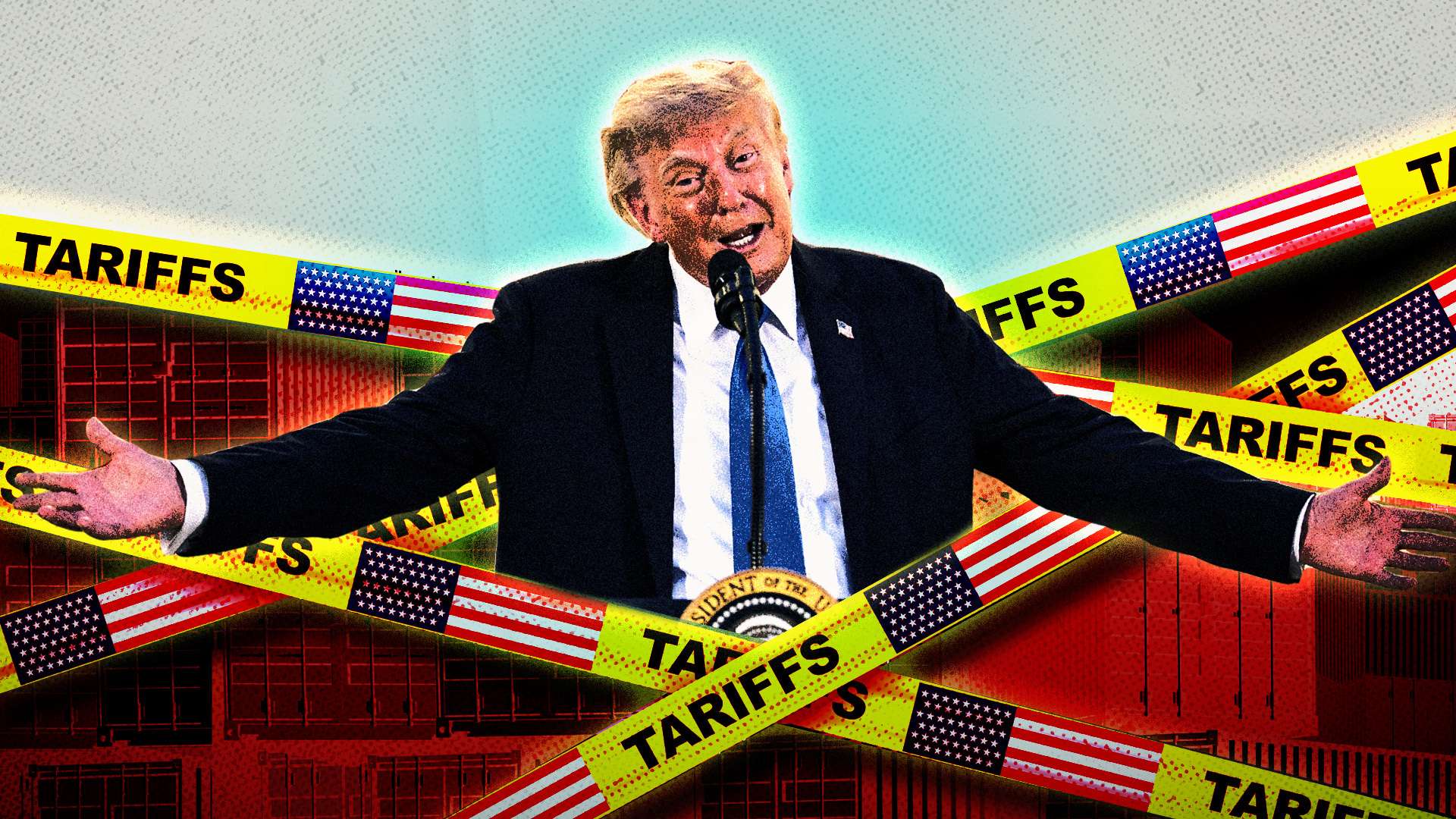
Their brief contends that the president is asserting “essentially boundless” authority to impose “economy-wide tariffs untethered from the statute Congress enacted.”
Three former trade officials warn in a filing submitted last week that President Donald Trump aims to transfer core tariff authority from Congress to the Executive Branch. If that objective sounds familiar, it is because he has attempted a similar maneuver on two prior occasions, only to be thwarted by the courts.
In this instance, the document notes, Trump leans on Section 301 of the 1974 Trade Act, claiming “a sweeping power to impose broad, economy-wide tariffs untethered from the statute Congress enacted.” That assertion is particularly notable because the authors of the brief—urging the Court of International Trade (CIT) to reject Trump’s expansion of power—were integrally involved in drafting and enforcing Section 301.
One of the signatories is Alan Wm. Wolff, who headed the Treasury Department’s Office of Multilateral Trade Negotiations and served as general counsel for what is now the Office of the U.S. Trade Representative (USTR) during the Nixon and Ford administrations. Wolff played a leading role in shaping the Trade Act and authored the original text of Section 301.
Joining Wolff are Carla Hills, who served as USTR under President George H.W. Bush, and Warren Maruyama, who worked as an USTR attorney during the Reagan era and later served as the office’s general counsel under the George W. Bush administration. Both bring extensive experience in implementing Section 301, which authorizes the USTR to impose tariffs in response to a foreign “act, policy, or practice” that is “unreasonable or discriminatory” and “burdens or restricts United States commerce.”
Section 301 “was enacted to address specific unfair trade practices by individual U.S. trading partners,” Wolff and the others observe. Yet the Trump administration treats the provision as a license to lay down sweeping duties on trading partners that represent nearly all U.S. imports, under the pretext that they have failed to “impose and effectively enforce a prohibition on the importation of goods produced with forced labor.”
Contrary to the statute’s prerequisites, the findings underpinning that determination do not spell out how each target has fallen short or how their alleged failures obstruct U.S. commerce. Nor has USTR Jamieson Greer explained why the targeted tariffs are expected to alleviate the problem he claims to be addressing.
The result of these “often sham ‘investigations,'” Wolff and colleagues note, is a tariff regime strikingly akin to the one Trump attempted to impose last year under the International Emergency Economic Powers Act (IEEPA), a 1977 law that does not reference import taxes and had never been used to impose them. In February, after the Supreme Court ruled that IEEPA does not authorize tariffs at all, Trump pivoted to Section 122 of the Trade Act, which the CIT said he had misapplied.
“The Section 301 tariffs appear to be a thinly disguised pretext for reimposing the President’s IEEPA tariffs under the guise of dealing with forced labor,” Wolff and his coauthors say. They contend that “nothing in the statute authorizes [the] USTR” to “justify tariffs of unprecedented breadth” by bundling “dozens of separate investigations” and establishing “a novel standard that foreign countries have not in the judgment of the USTR met.”
The Trade Act “imposed clear substantive and procedural limits on each tariff authority” it delegates. “It is not at all credible that Congress simultaneously conferred, by implication, an unlimited tariff power through Section 301, administered by a cabinet official, without any indication in the statute or legislative history that it intended to do so.”
By claiming “an effectively boundless Section 301 authority through the aggregation of numerous investigations,” Wolff and colleagues say, Greer “exceeds the limits established by Congress and upsets the constitutional allocation of trade powers.” But what do they know?
A cautionary note from the Liberty Justice Center, which brought one of the lawsuits challenging Trump’s tariffs, also appears: “The people who know Section 301 best,” it asserts, “are telling the Court that the administration is using the statute in a way Congress never designed it to be used.”
© Copyright 2026 by Creators Syndicate Inc.
