
Across Europe, extreme heat, wildfires, and air pollution are becoming an increasingly visible threat to human health. Heat waves are more frequent, more intense, and longer-lasting. Smoke from wildfires can travel hundreds or even thousands of kilometres, exposing populations far beyond the areas affected by the flames. In addition, burning fossil fuels contributes daily to air pollution, increasing the risk of cardiovascular and respiratory diseases, cancer, and premature death.
However, while governments and health services work to protect people from these threats, our streets, airports, transport systems, and public spaces continue to display advertising for products and activities that contribute to exacerbating these threats.
This raises a fundamental contradiction. We cannot warn the public about the dangers that climate change and air pollution pose to health while, at the same time, we use public space to promote greater fossil fuel consumption. Nor can we invest billions in adaptation measures for heat, floods, and rising sea levels while promoting behaviours and products that worsen those threats.
“We cannot warn the public about the health dangers posed by air pollution while promoting greater fossil fuel consumption”
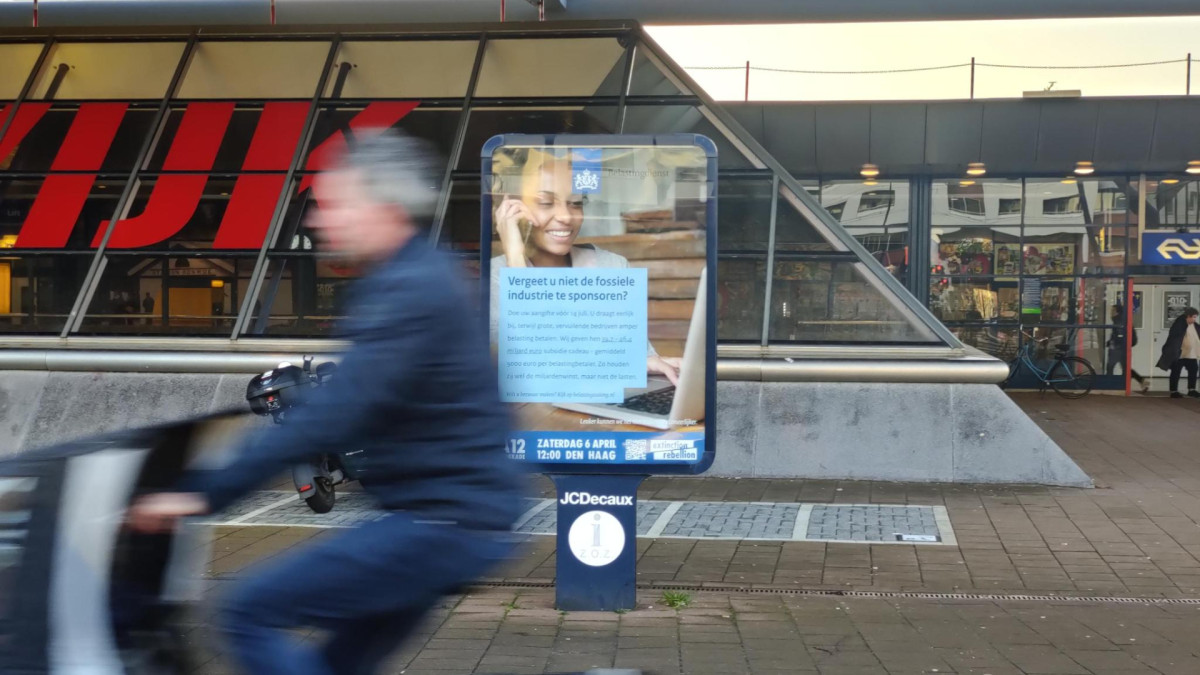
This was precisely the contradiction we faced in The Hague. Rising sea levels caused by global warming pose a serious threat to the Dutch coast, the city, and its inhabitants. It made little sense to plan multi-billion-euro sea-defense works while, at the same time, allowing advertising that encouraged people to engage in activities that contributed to the problem.
For this reason, The Hague became the first city in the world to legally ban fossil fuel advertising. We knew the measure could be challenged in the courts, but we also knew that protecting the health and safety of the public had to be the priority. When the tourism sector challenged the ban, the court ruled in the city’s favor, confirming the legitimacy of limiting commercial interests in favor of climate and public health goals.
That decision has implications that go far beyond a single city. Other governments and cities are moving in the same direction, including France, Edinburgh, and Sydney. What began as a relatively radical idea is now part of a much broader debate about what governments should and should not allow to be promoted in public spaces.
“The Hague became the first city in the world to legally ban fossil fuel advertising”
We have already faced a similar question. For decades, tobacco was marketed as glamorous, sophisticated, and even liberating, while the evidence of its devastating health consequences kept mounting. Over time, governments accepted a simple principle: if a product causes enormous harm to health, society does not have the obligation to help market it.
The comparison with fossil fuels is not exact, but the magnitude of their health effects is potentially even greater. Fossil fuels harm health through two interconnected pathways. Their use across their entire lifecycle poisons our environment and pollutes the air we breathe today, contributing to cardiovascular and respiratory diseases, cancer, and premature mortality. At the same time, their greenhouse gas emissions are destabilizing the climate, increasing exposure to extreme heat, fires, and floods, as well as food insecurity, risks of infectious diseases, and other health threats.
In other words, dependence on fossil fuels is not merely an environmental or climate problem. It is one of the major public health challenges of our time.
“Fossil fuel dependence is not merely an environmental or climate problem. It is one of the major public health challenges of our time”
Advertising is not neutral. Its purpose is to shape preferences, generate demand, and normalize consumption. Fossil fuel advertising can reinforce behaviours and infrastructures that trap societies in pollution for decades, while sophisticated corporate campaigns increasingly portray the companies as environmentally responsible by highlighting their comparatively small investments in cleaner energy, even as they continue to produce fossil fuels.
Meanwhile, governments encourage the public to make greater use of public transport, walk and cycle more, improve energy efficiency, breathe cleaner air, and transition toward healthier, lower-carbon economies.
It is hard to reconcile both messages. More than a decade after the Paris Agreement, the world remains far from a trajectory compatible with limiting warming to 1.5 °C. Governments continue to plan fossil fuel production levels higher than those compatible with international climate goals. The health consequences of this trajectory will not be abstract or distant. They will be measured in asthma crises, heart disease, cancer, heat-related deaths, disruptions to health services, and premature deaths.
As leaders in the health sector and as city authorities, our first responsibility is to prevent harm and protect the wellbeing of our communities. That responsibility must extend to the environments in which people live, including the informational and commercial messages they are exposed to every day.
The public space must promote the wellbeing of the population, not undermine it. Restrictions on fossil fuel advertising have a relatively low cost, can be implemented immediately, and can contribute to a much broader transition toward cleaner energy, healthier mobility, and more livable cities. They will not solve the climate crisis on their own. But tobacco advertising bans did not solve the tobacco epidemic by themselves either. They were part of a comprehensive public health strategy that changed social norms, reduced demand, and ultimately saved lives.
“Fossil fuel advertising restrictions have a relatively low cost, can be implemented immediately, and can contribute to a much broader transition”
The fossil fuel industry will undoubtedly oppose stricter restrictions, just as the tobacco industry did. But the history of public health teaches us something important: commercial freedom is not unlimited when the health of the population is at stake.
The transition away from fossil fuels should not be framed as a sacrifice. Cleaner energy means cleaner air. Cities designed for walking, cycling, and using public transport can cut pollution while increasing physical activity. More energy-efficient buildings can shield people from heat and cold while lowering energy costs. Benefits are both immediate and long-term.
This is the future we should be promoting. Banning fossil fuel advertising represents much more than a symbolic climate measure. It is a public health intervention and a statement about the kind of economy and society we want to build.
“Banning fossil fuel advertising represents far more than a symbolic climate measure”
The Hague has shown that cities can take action. And others are following suit. Now Europe has the opportunity to go one step further.
We stopped letting tobacco companies tell us that smoking represented freedom, success, and aspiration. We must ask ourselves why we still allow fossil fuel advertising to sell us another version of a future that harms our lungs, destabilizes our climate, and endangers our health.
We have the evidence. We know the health consequences. And, increasingly, we know the solutions. It is time for our public spaces and our public policies to reflect that reality.
