
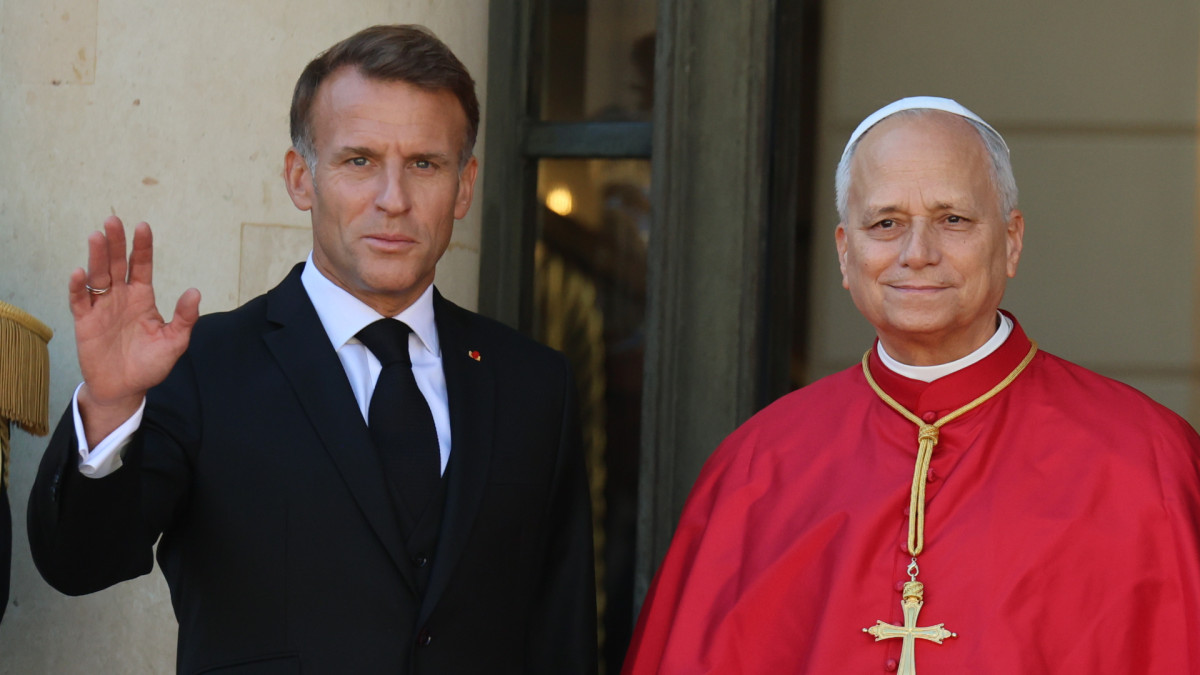
Only a hundred days after his visit to Spain, Leo XIV has unleashed in France the full artillery of Vatican diplomacy. And it is far from negligible.
From the salons of the Élysée and the UNESCO dais to the crowded mass gatherings foreseen in Lourdes or Metz, the Pope has decided to mirror the successful staging of his visit to our country. An institutional visit in the capital, a mass turnout, and dialogue with national politics and culture.
It is no coincidence. Both share a sociological backdrop that is nearly identical: a Catholic hegemony in clear decline (in France, church attendance has fallen from 68% in 1961 to the current 26%), governments cornered by the rise of the identitarian right, migratory tensions, and the open wound of sexual abuse. Yet it would be a mistake to reduce this weekend’s trip to a mere Spanish echo.
On one hand, the strict republican laïcité raises the institutional temperature, evident in Emmanuel Macron’s conspicuous abstention from all papal masses. On the other, the Gallic Church lives today with a vitality quite different from that of Spain, having responded to its social collapse with an identitarian withdrawal, reorganizing itself today as a leading, combative minority.
“France and Spain share a sociological backdrop: governments cornered by the rise of the identitarian right, migratory tensions and the open wound of sexual abuse”
In a climate of ferment, the Vatican sketched its global discursive line a few days ago. Its aim goes beyond confessional matters: to defend humanism against AI and the digital world, to propose an alternative view on bioethics, and to attempt to curb the growth of polarization in politics. These elements were already present in Magnifica Humanitas, but on this visit they are finding a more explicit expression.
Because France is, in both its grandeur and its decline, the mirror of the rest of Europe. And to anticipate the continental trajectory, or at least the vision that the Vatican has for it, it is worth focusing on these four strategic keys.
The Euthanasia Battle
The first major point to watch is dictated by the legislative calendar. On July 15, the French National Assembly approved, by 291 votes to 241, the “right to die with assistance.” This paved the way for practices akin to euthanasia and assisted suicide (a path that, incidentally, has recently faltered in the United Kingdom). In this context, the tour’s official banner, “That the world may have life,” the French refrain “Raise Your Eyes”, takes on immediate political significance.
As the Vatican’s Secretary of State, Pietro Parolin, stressed on the eve of the trip, the Pope’s message for France is that life must be welcomed, loved, and cared for, from conception to natural death, a reminder directed at “laws that do not respect this value” in a Europe “ravaged by a demographic winter.”
This was also made clear by Leo XIV during his recent visit to Madrid, before the Congress of Deputies. But in France, the Vatican’s strategy will also seek to leverage the power of imagery. Beyond doctrinal discourse, this Sunday the Pope will visit Lourdes, the largest “open-air hospital” in Europe. The imagery is unambiguous: to move among the elderly, the incurably ill, and people with severe disabilities to present a visual confrontation between two possible worlds.
“The imagery is clear: to move among the elderly, the incurably ill, and people with severe disabilities to present a visual clash between two possible worlds”
One could read this as a nudge to French lawmakers and to the world that dignity remains intact in vulnerability and dependence. Yet Leo XIV is playing on a different field. In the land of laïcité, the Church has been sidelined for more than a century at the margins of public moral debate. Its last significant social triumph in the streets was the Manif Pour Tous, against gay marriage, more than a decade ago, and it has not left a lasting imprint since then.
Therefore, the weekend’s key lies in measuring the strength of the papal machinery. Will it manage to rearm the opposition—politically and socially—against euthanasia?
The UNESCO Seat, or Europe and AI
The Pope has made artificial intelligence one of the major themes of his papacy. Thus he articulated this in his first encyclical, Magnifica Humanitas, focused on defending the dignity of the person in the digital era. Now, during his visit to UNESCO, the Vatican seeks to position itself as the global counterweight to the tech oligopoly. And Europe appears to be especially receptive to this message.
Caught in the race between China and the United States, the Old Continent is trying to position itself as the ethical-regulatory referee of AI. And it seems to view Leo XIV as a powerful ally. History, moreover, echoes.
In France, during the rise of 20th‑century totalitarianisms, papal intervention spurred many intellectuals to lay the foundations of personalism and Christian democracy. Pius XI’s 1926 condemnation of the far-right Action Française and the work of Charles Maurras indirectly fostered a body of thought that would become central to the creation of the European Union.
If back then Christian humanism served as a check against exclusionary nationalisms, today it seeks to safeguard the individual from the determinism of algorithmic technology.
Nevertheless, success is not guaranteed. This weekend will reveal whether the discursive alliance between European powers and the Vatican solidifies. Or whether, on the contrary, it proves to be little more than an elegant device to mask a new continental failure in the global technological race.
The Metz Speech, Immigration, and European Identity
Metz could well be the quintessential border city. Is it German? Is it French? What is France and what is Germany? Historically, the Alsace-Lorraine region stands as a living reminder of how far European fragmentation can go. There, under the symbolic protection of Robert Schuman, father of the EU, the Pope is expected to make a strong appeal for continental unity, extending the same multilateral tone he will echo at UNESCO.
But what if Leo XIV aims to go further? What if his objective is to revive a debate that John Paul II and Benedict XVI placed at the center of the board, one that François’s geopolitics of peripheries had muted? With French presidential elections approaching, the defense of Europe’s Christian roots becomes a controversial topic. The rhetorical challenge is significant. Can the Pope appeal to Europe’s religious heritage without breaching modern institutional secularism and without fueling nationalism?
The Pontiff will tread on a minefield. The identity debate in France burns with migratory tensions and the limits of inclusive laïcité. The delicate balance of the Muslim community and the sustained rise of the radical right will compel Leo XIV to measure every word, as if he were a tightrope walker.
“The identity debate in France burns between migratory tensions and the limits of inclusive laïcité”
On one side, Vatican diplomacy upholds universal hospitality and migrant integration. On the other, a large portion of the French Catholic base has embraced sovereigntist discourses, nourished by the specter of a demographic and cultural “great replacement.”
It is the same climate of civilizational anxiety that authors such as Michel Houellebecq have skillfully exploited in fiction. And these are the same dilemmas (and the same sensitivities, as Carlos Alsina once showed) that the Pontiff raised in Madrid. Or the ones Ratzinger sparked before the Bundestag. As the trip wraps up on Monday, Metz will stage a debate Europeans cannot pretend to have resolved.
Because if anything reminds us how unsettling it is to reflect on identity, it is this: we still do not have a definitive answer about what Europe exactly is. Nor about who belongs in it. Nor about what role the Church, if any, should play in its rebuilding.
The Open Wound of Sexual Abuse
As he did in Montserrat, the Pope will hold a private meeting with sexual abuse victims in Lourdes. A gathering intended to be healing, but which some critics describe as an attempt to paper over reality. And in at least one concrete case, they may be right.
In the weeks leading up to the visit, the Lourdes Sanctuary hurriedly concealed the mosaics adorning the façade of its basilica with a temporary canvas. The artist, the Jesuit Marko Rupnik, is known to have abused at least twenty women over his career, many of them nuns whom he had accompanied spiritually. The case has been public for years, just as his works continue to stand in Manresa, in La Almudena, and, as soon as the Pope departs, again in Lourdes.
The canvas over Rupnik’s mosaics is the perfect metaphor for a Church that still does not know how to manage its own monster. And if there is anything that prevents the Vatican from becoming the moral counterweight it aspires to be, it is the devastating institutional wound left by its abuses, laid bare in France in the Sauvé Report.
“The canvas over Rupnik’s mosaics is the perfect metaphor for a Church that still does not know how to manage its own monster”
Published in 2021, this independent report momentarily halted French society. It claimed, not without its critics, that about 330,000 minors suffered abuse at the hands of clergy or lay people connected to the Church over the last seventy years. Since then, the narrative of Catholic exemplary conduct has been scorched in many contexts.
From there arises the last great question of the trip, the same one left unresolved after Spain and the Montserrat meeting with victims. Can closed-door meetings, or the gestures of Leo XIV, restore the Church’s moral authority? Or, as the canvases covering Lourdes’ mosaics this weekend suggest, are they merely a temporary fix?
In any case, there is no doubt that the apostolic visit to France will be historic. The country has long served as a precursor for the rest of the continent. And today, its challenges are ours: a questioned political order, migratory, demographic, and technological pressures, and the climate of international conflict.
The main lines Leo XIV outlines over these days will lay the foundations of the Vatican’s strategy for Europe in the coming years. Will the Vatican promote a global discourse that rises above faith, or will it shelter in “creative minorities” and counter-cultural voices to push for a social amendment to the whole? Are these paths compatible or mutually exclusive?
Undoubtedly, these questions remain open. But they render this visit a global event to be watched closely.
