
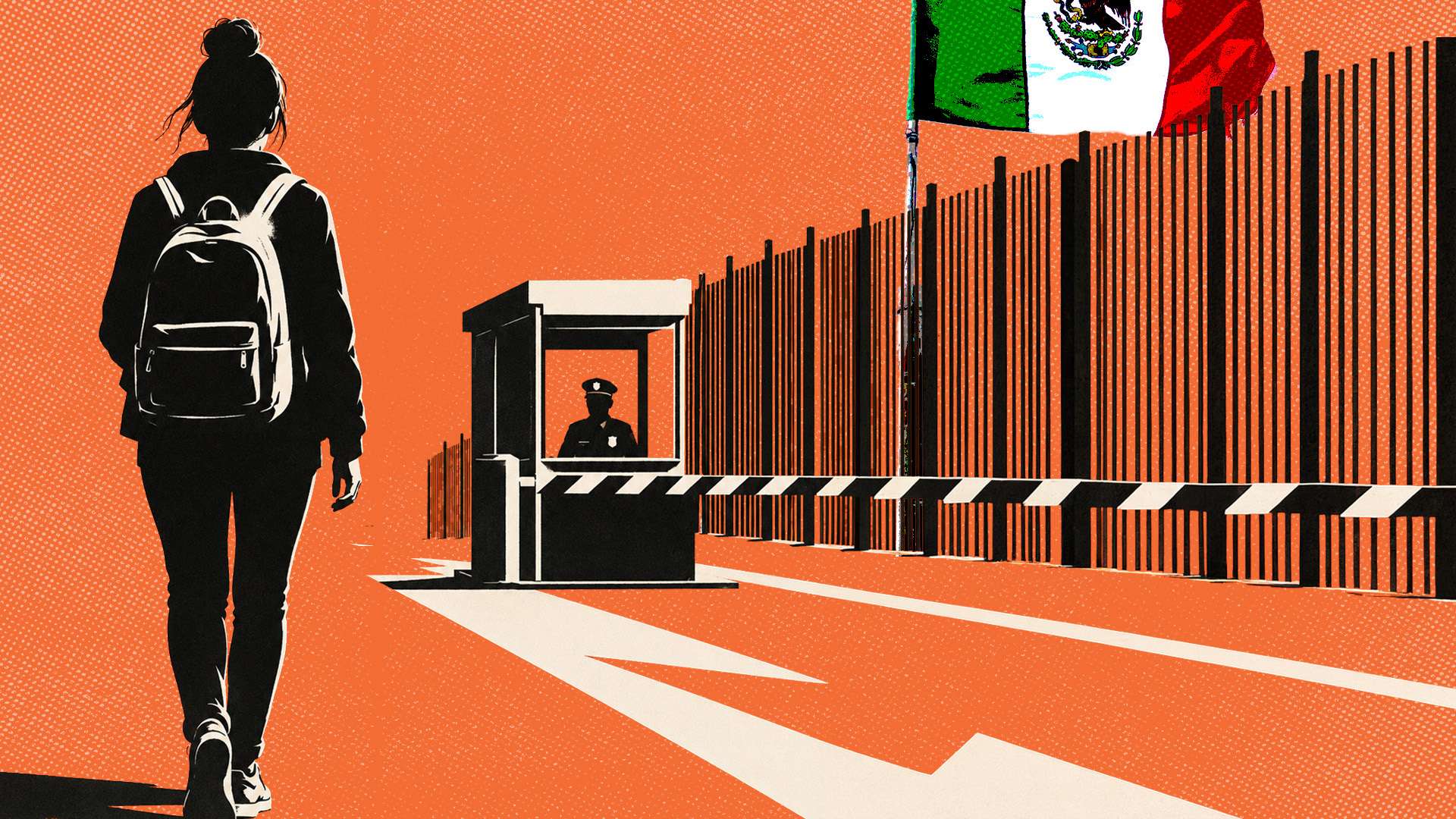
“Documented Dreamers” arrived in the United States legally as youngsters. A loophole in immigration law leaves them vulnerable to removal.
Naturalization ceremonies on Independence Day are uniquely joyous occasions. New citizens are officially welcomed into the American project on a day that celebrates that very enterprise. So what does a July 4 self-deportation look like?
Patricia Rojas, now 25, learned the answer this month after relocating to Mexico. Like many migrants, she had hoped to remain in the United States. Unlike many, she had lived here lawfully since she was four months old and has never known another homeland.
In other words, Rojas is a Dreamer, the label given to those who came to the United States as children through no fault of their own. The Deferred Action for Childhood Arrivals (DACA) program shielded many young people who arrived illegally as children from deportation. Yet there is a crucial caveat in Rojas’ case—and in roughly 250,000 others: she is what you could call a Documented Dreamer, meaning she entered the country legally. If her parents had entered illegally, she might not be facing self-deportation.
But the route to legal permanent residence is far from straightforward. In a statement, Rojas explained that her father arrived in the U.S. on an E-2 visa, which permits some foreign entrepreneurs to establish businesses here. Although the visa can be renewed, it does not place the holder in the line for a green card. The H-1B visa, by contrast, does allow such a path, but country-of-origin caps can stretch for decades, and many hopeful applicants die while waiting. Those like Rojas risk aging out of eligibility if their parents cannot obtain permanent residency before they turn 21.
The remaining options are limited. In Rojas’ case, which she outlined in a New York Times essay published today, she did not win the H-1B lottery after three tries—the maximum. This outcome is not unusual: Roshan Taroll, another Documented Dreamer whose case I covered two years ago, experienced the same and ultimately had to self-deport to Taiwan.
This gap in the law has drawn some attention in Congress, though no legislative fix has yet crossed the finish line. Senators Rand Paul (R–Ky.) and Alex Padilla (D–Calif.) have introduced the America’s Children Act multiple times, backed by Representative Deborah Ross (D–N.C.). The bill’s co-sponsors span the political spectrum. “My bill America’s Children Act fixes the documented dreamer problem by prioritizing the children of legal immigrants for permanent status,” Paul told me in 2024. “So, a child whose parents entered legally will not have to face deportation when they turn twenty-one.”
The immigration debate has grown even more heated of late, in part due to the Supreme Court’s ruling upholding birthright citizenship. Paul, for his part, has made clear he does not support birthright citizenship. Yet his advocacy for addressing the challenges faced by Documented Dreamers underscores a broader consensus that we should not punish people for entering the country “the right way.”
The question of birthright citizenship also weighs on Rojas’ mind. How could it not? “Those four months altered my life trajectory,” she writes in the Times. “Had I been born after my family relocated, like both of my younger siblings, I would be an American citizen today.”
