
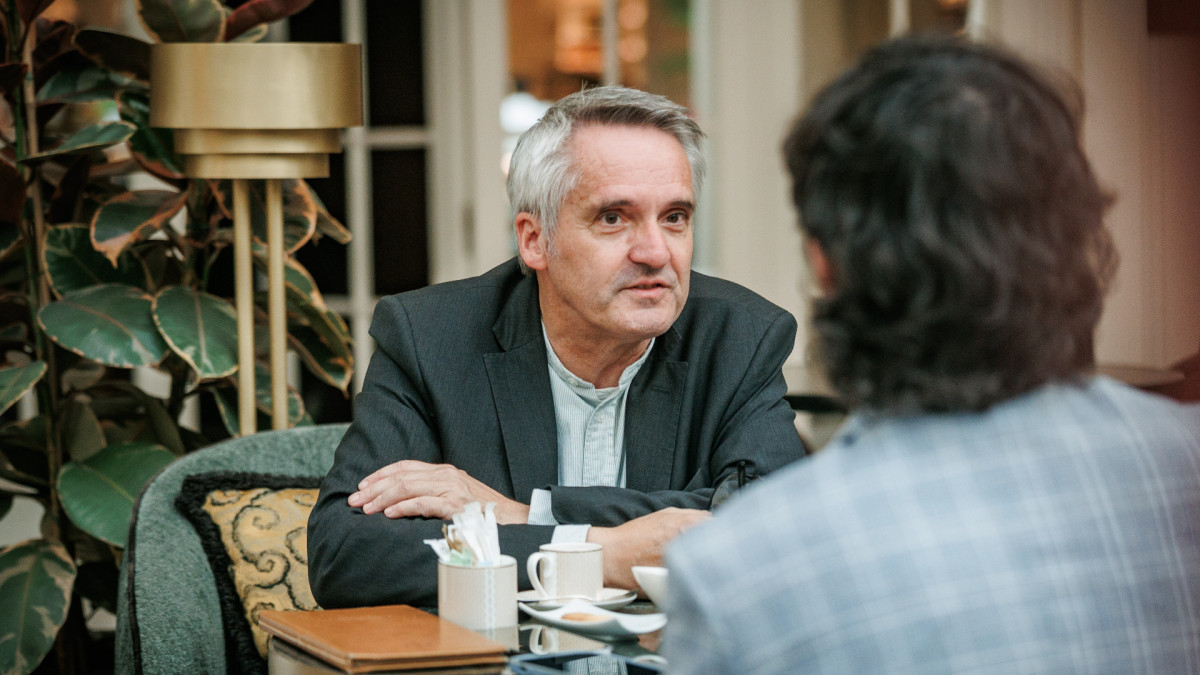
Germany’s current difficulties are widely acknowledged: a government that fails to win broad support, a rising radical right in opposition, and the erosion of the country’s once formidable economic edge. Yet the question of how Germany arrived at this juncture—and how Germans, pursuing their own interests as well as those of Europe, can escape the standstill—remains less clear. Although Frank Decker, a professor at the University of Bonn, did not arrive in Madrid bearing a crisis manual tucked under his arm, he nonetheless offered several notably pertinent insights. In this exchange, he broadens the diagnosis of the “crisis of social democracy” to encompass the very German party system. On one side stands the SPD, which he describes as suffering from “a leadership problem.” On the other: the Christian Democratic Union, led by Chancellor Merz—“a somewhat old-fashioned conservative politician”—and a government that “performs poorly in technical terms.” To complicate matters further, public discontent is being exploited by the AfD. Among the consequences of the ascent of the radical right, Decker emphasizes that “democracy also depends on having a strong democratic opposition.”
There are also substantial economic hurdles to overcome. Asked to identify the causes of Germany’s lackluster economic performance, Decker—who is visiting Spain at the invitation of the Friedrich Ebert Foundation—flips the question on its head: if we want to understand today’s fragility, we should first ask why the German economy operated so strongly five, six or seven years ago. His answer highlights that “cheap Russian gas, security benefits derived from the United States, and privileged access to the Chinese market” were powering Germany’s status as the eurozone’s strongest economy. Today, all of these elements have vanished or are in retreat. As the academic explains, this shift is reverberating through society, producing a notable erosion of trust in democracy and a mounting pessimism about the future.
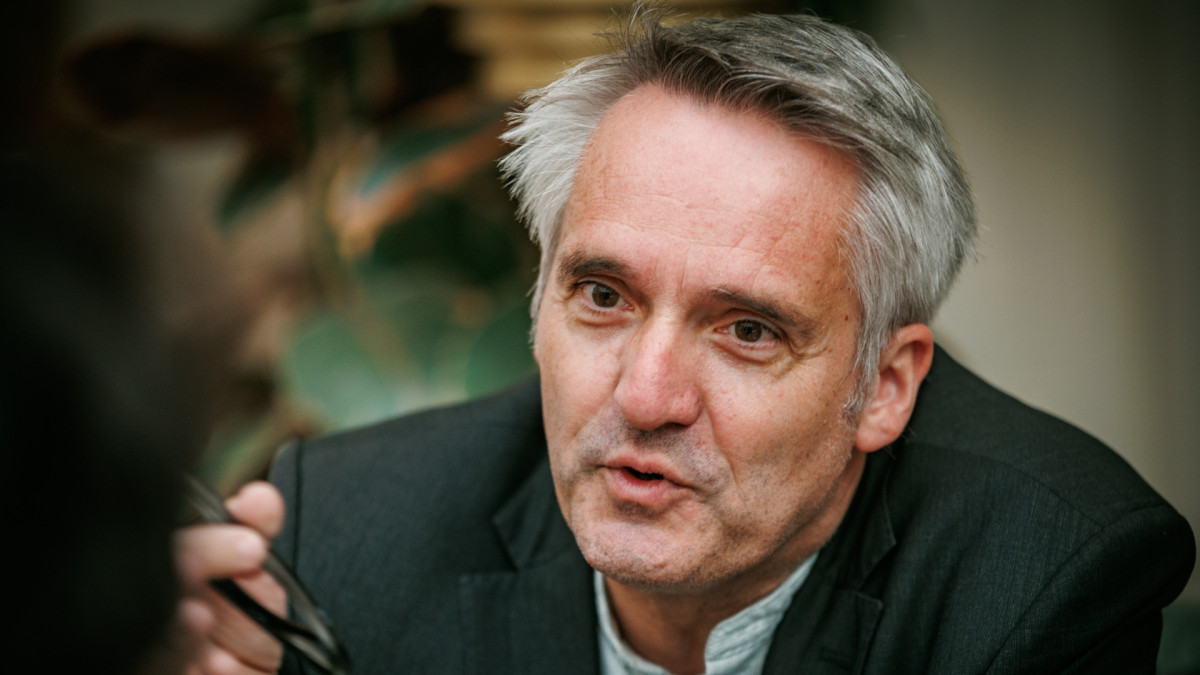
Frank Decker analyzes the current state of German politics in Madrid. Photo: Agenda Pública / Tania Sieira
Professor Decker, my initial inquiry concerns the SPD. It remains one of Germany’s principal parties, yet current polls are discouraging. It seems to symbolize a broader European crisis for social democracy, especially in Germany. How do you interpret this crisis—ideological deficiency, leadership gaps, or something else?
It is likely a combination of all of these. And it’s a profoundly deep crisis. It began after the SPD joined the Greens in government. When the party returned to power in 1998 and Gerhard Schröder became chancellor, the SPD surpassed 40% in the ballot. When Schröder exited after seven years, the SPD still attracted about 35%. That marked the start of a slide.
The 2021 election was an exception. Olaf Scholz became chancellor with only 25% of the vote. The campaign was nearly flawless, but the victory mainly reflected the outright failures of the SPD’s rivals—most notably the CDU/CSU—and the Greens’ weakness. The SPD captured the chancellorship by a margin of just 1.4 points.
Thus it was an anomaly within a longer, more continuous downward trend. And that trend aligns with the broader trajectory of European social democracy. There are national differences, but in Germany, France, Austria and even the Scandinavian states, social democracy as a party family has been in trouble for more than two decades. Spain may be the exception.
Specifically in Germany, why is the SPD struggling so intensely? Olaf Scholz was in office as chancellor and the party faltered. Now the SPD remains part of the government, yet no longer holds the chancellorship, and it is underperforming in polls and in state contests. Why the persistent weakness?
There is a leadership problem. After Andrea Nahles stepped down as party chair, the SPD opted for a new leadership model, introducing a dual leadership structure—one man and one woman—as co-chairs. That organizational principle—the same approach the Greens had adopted from their inception—was, at the time, prudent, given that the SPD was the junior partner in a CDU/CSU coalition. Merkel’s party had been in government through three grand coalitions, and that fact placed the SPD in a disadvantaged position, since even the reforms it could push—such as the introduction of a minimum wage—often appeared to bear Merkel’s stamp. Merkel enjoyed sustained popularity after more than a decade in office, while the SPD’s position weakened.
The new leadership then designated Olaf Scholz, who had served as finance minister in Merkel’s final administration, as the SPD’s candidate for chancellor. That proved to be the right call. Norbert Walter-Borjans, Saskia Esken and the general secretary, Lars Klingbeil, mounted a strong electoral campaign with the slogan “respect”—a nod to ordinary people and the workers who toil daily. It was a savvy campaign decision.
“If elections were held today, the CDU/CSU and the SPD would not have a majority together. The Greens would also have to be part of the coalition”
But now the dual leadership structure has become a problem, particularly because the two party leaders—Lars Klingbeil and Bärbel Bas—are also part of the government. Klingbeil serves as finance minister, and Bas as labor minister. She is tasked with enacting reforms that require compromise with conservatives. It might have been preferable if at least one leader had remained outside the government.
This situation makes it difficult for the Social Democrats to articulate their own ideas, identity, and distinguishing characteristics from the Christian Democrats. The party essentially finds itself a prisoner of this coalition. This also distinguishes the German situation from Spain’s: Germany has no alternative internal to the party system that could replace the coalition.
If elections were held today, the CDU/CSU and the SPD would not command a majority together. The Greens would also need to be part of any coalition. The outcome would be a government formed by a coalition of democratic parties, with two smaller parties in opposition. That arrangement does not bode well for democracy. It might benefit the ruling party—the Christian Democrats—but it would again be a setback for the SPD.
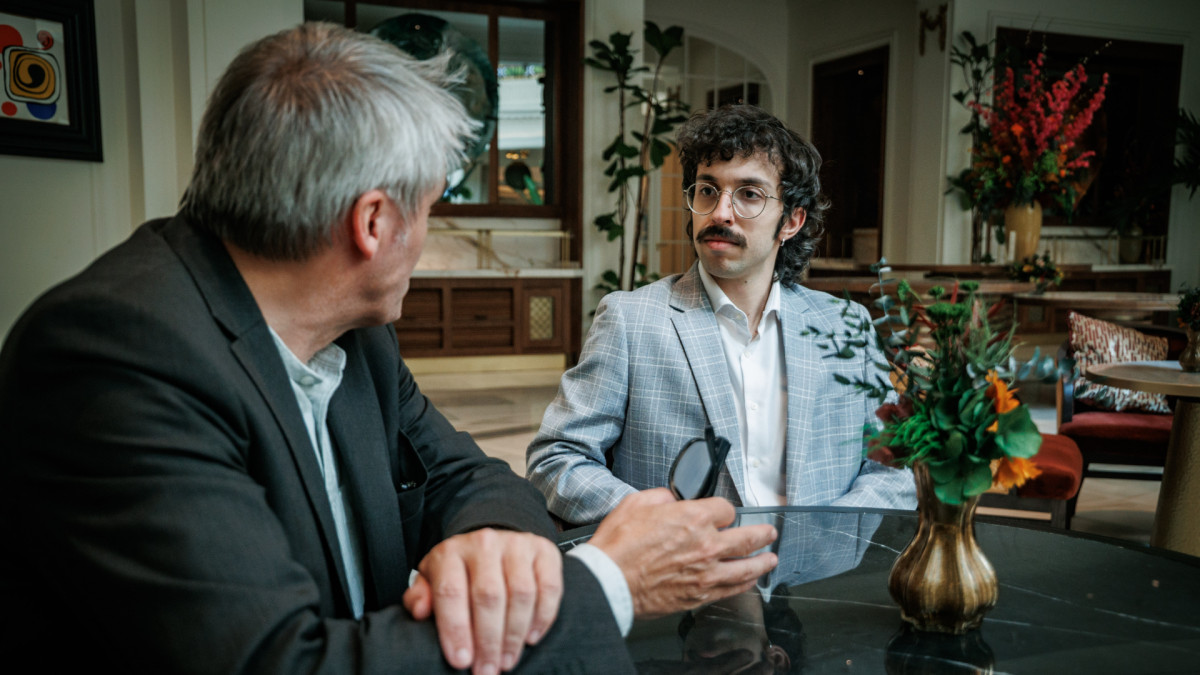
Decker explains the SPD’s difficulties in distinguishing itself from the CDU/CSU within the grand coalition. Photo: Agenda Pública / Tania Sieira
You mentioned something intriguing about Angela Merkel: how she managed to keep her popularity high. The CDU/CSU’s numbers are striking: 43% of its voters doubt it can fix the economy. We’ve discussed why the SPD struggles to compete; but what about the CDU/CSU?
Chancellor Merz is broadly unpopular. He represents a rather conventional, old-school conservative outlook. Merkel avoided bold reforms; there were no major changes to pensions or health insurance because she understood that voters punish ambition when reforms are too unpopular.
That calculus looks different now, as Germany clearly needs those reforms. Yet the two major parties diverge on what a modern welfare state should look like. That divergence is part of the explanation.
Another factor is Merkel’s grasp of the media landscape in a democracy. She was seasoned and adept at governing. She had previously been a minister in Helmut Kohl’s government in various portfolios, including environment and women’s affairs. By contrast, Merz and Klingbeil had not previously held government posts. Consequently, the current German government operates with technical shortcomings. Both parties shoulder blame for this, and public trust in the government has dwindled, now matching the unpopularity seen in the traffic-light coalition around 2023–2024.
So far we have traced the SPD’s decline and the Union’s decline in parallel terms because they form a governing duo. Could Germans be tiring of this grand-coalition logic and begin to see the two main parties as interchangeable? This also feeds into the question of the AfD, a party that leverages a message opposing the central bloc.
In Germany we still speak of the cordon sanitaire, the Brandmauer. There will be no cooperation between any of the democratic parties—especially the conservatives—and the radical right AfD, neither at the state nor the federal level.
I’ve learned that in Spain there are regional governments formed by conservatives with Vox. That scenario will not occur in Germany. It is simply not feasible. Of course, some CDU politicians, particularly in the eastern regions, wonder why not. But if such a move were made, Christian democracy would fracture. The party would not survive a decision to join forces with the radical right.
“Democracy means that voters have the chance to vote out a government and get another one”
That is the real dilemma. The parties are prisoners of this coalition. Yet there are differences between the federal level and the Länder. We observe varied government compositions across the states. There are left-leaning coalitions in city-states like Hamburg and Bremen, and the possibility of Berlin repeating that pattern. There are conservative coalitions in Bavaria, and coalitions between conservatives and Greens in Baden-Württemberg and North Rhine–Westphalia.
Democracy, after all, allows voters to replace a government and choose another. At the state level there is some alternation; at the federal level, however, the competition mostly centers on which party will be the dominant partner in a coalition. If the Christian Democrats and the Social Democrats form a coalition, the stronger party tends to seize the chancellorship.
That point matters enormously. The party holding the chancellorship enjoys a positional advantage over the junior partner. But for the SPD, the challenge is that polls place the Christian Democrats around 25%, while the SPD hovers around 12–14%. The gap is widening. The Social Democrats have little chance to regain the status of the strongest party, except in exceptional years like 2021. And, as I said, that year was an anomaly that is unlikely to recur.
That is a genuine problem because democracy also hinges on a robust democratic opposition. Today that opposition is the AfD—whose democratic credentials are questionable—and Die Linke. I wouldn’t classify Die Linke as anti-democratic since it accepts the rules of parliamentary democracy. Yet even the SPD refuses to cooperate or form a coalition with Die Linke at the federal level. For instance, Die Linke opposes rearmament, while Germany must increasingly invest in the Bundeswehr. They would never consent to such a policy. Consequently, a coalition remains off the table.
This represents a real challenge, and I don’t profess to know a ready-made solution. The only plausible remedy would be for the two principal parties to regain broad support and trust. But at present there are no clear signs this will happen.
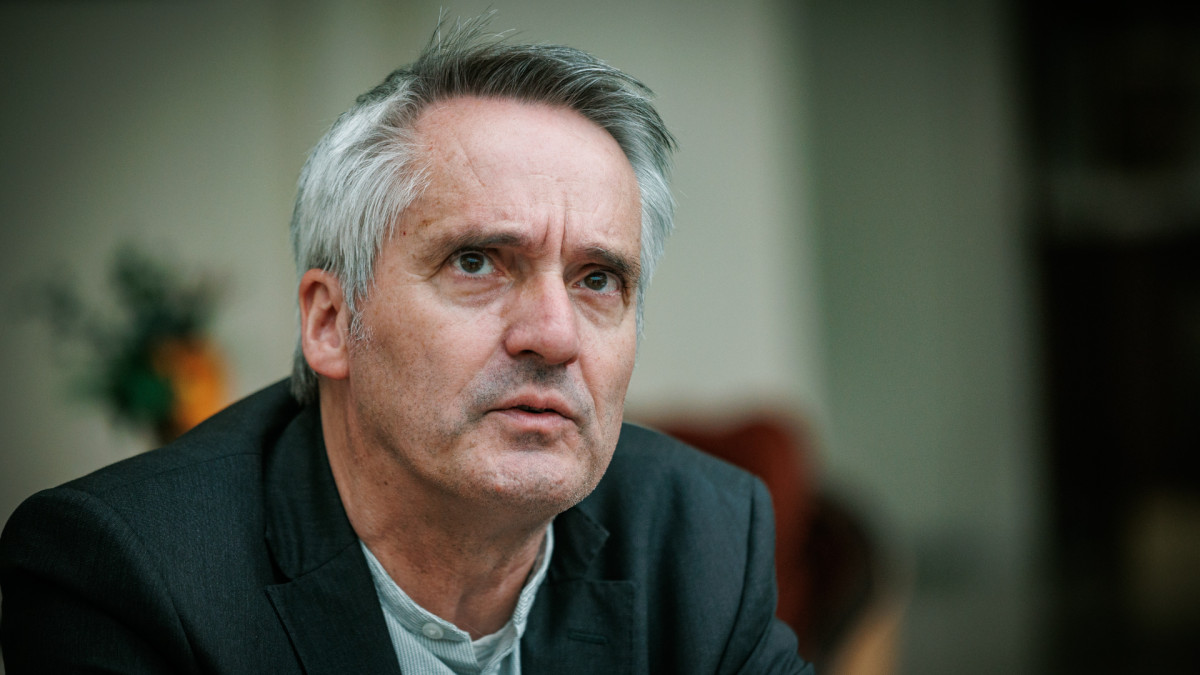
The political scientist discusses the cordon sanitaire amid the AfD’s rise in eastern Germany. Photo: Agenda Pública / Tania Sieira
In Saxony-Anhalt there will be ballots, and polls place the AfD at roughly 40%. To form a government, the CDU would have to cobble together a coalition including nearly every other party, even Die Linke, with whom they fundamentally disagree. A Europe-wide debate is underway about ways to curb the radical right’s growth. If the cordon sanitaire cannot hold in Germany, what does the future hold?
The elections in Saxony-Anhalt are expected to be very difficult. The same is true for Mecklenburg-Western Pomerania, where votes will also take place later in the season. It’s conceivable that one seat could go to an AfD candidate and another to a candidate from the democratic bloc.
In Mecklenburg-Western Pomerania, for instance, that AfD candidate might be the incumbent minister-president, Manuela Schwesig, a Social Democrat. CDU voters could opt for Schwesig in order to prevent the AfD from winning, even if they would ordinarily support their own party. It’s an absurdly counterintuitive situation.
“It is not entirely unlikely that the AfD could win an absolute majority of seats with only 41% or 42% of the vote”
This could also lead to a scenario in which smaller parties fail to cross the 5% threshold required to secure seats—thus weakening the whole democratic camp. It is not entirely implausible that the AfD could obtain an absolute majority of seats with just 41% or 42% of the vote, according to current polling. It is a very serious state of affairs.
Perhaps some voters, if they pause to consider the consequences of backing an AfD candidate and the party itself, might decide against it. Yet that remains a possibility rather than a certainty. And this situation stems from the federal government’s poor performance, where the two governing parties struggle to work together on a foundation of trust. I’m not particularly optimistic about a imminent change.
Many observers expected Germany to take the lead in Europe after the elections—especially amid concerns about Ukraine, Trump’s stance, and Macron’s difficulties in France. That leadership has not materialized. From Madrid, Merz’s posture at the White House drew considerable criticism. And in Washington there was disapproval of his recent remarks on Iran. Why do you think Merz has found it hard to craft a coherent foreign policy agenda?
There exists a relatively steady consensus among Germany’s democratic parties on foreign policy aims: support for Ukraine. Naturally, there are nuances—how much to invest militarily, for instance—and there are differences between the SPD and the CDU/CSU. Because of Germany’s history, its position on Israel differs markedly from Spain’s, even among conservatives and especially among socialists.
Yet in eastern Germany, those who oppose military aid to Ukraine are not limited to the AfD. Die Linke and the new Alliance Sahra Wagenknecht also oppose it; they are conservative on migration but vehemently pro-Putin. This stance has broad backing among eastern voters, making it hard for democratic parties to leverage foreign policy to gain popularity. They find themselves on the defensive on these issues as well.
In any case, for the German public at present, while these concerns are interconnected, the dominant anxieties are economic: labor-market frictions, and reforms to health insurance and the pension system.
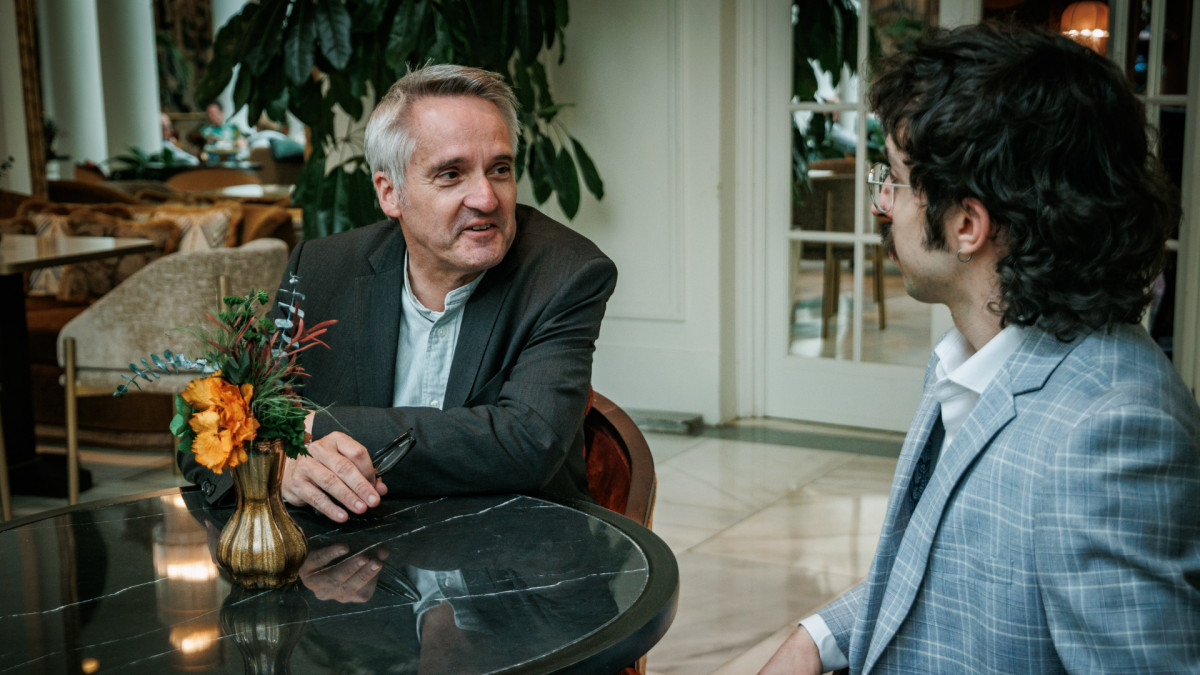
Decker analyzes the roots of Germany’s economic slowdown, from Russian energy to Chinese competition. Photo: Agenda Pública / Tania Sieira
Why has the German economy underperformed? What sorts of reforms lie ahead, and how might voters respond, especially with elections on the horizon?
If you pose that question, you must also consider why the economy performed so well a few years ago. We enjoyed inexpensive gas from Russia, strong export performance—particularly in the German automotive sector in China—and low security costs because the U.S. provided that shield for us.
All those conditions changed dramatically in a very short span. And that creates a timing problem: the German economy must adjust to new realities, which will take time. That helps explain current weak performance.
“We lived in peace for many decades and thought that, after the end of the Cold War, there would be an era of eternal peace. That has changed dramatically”
You may recall Bill Clinton’s maxim: “It’s the economy, stupid.” In Germany, today, security—broadly defined—also slots into that equation. The Ukraine war affects us more directly here, and it has altered our sense of security. War has returned to Europe; we had grown accustomed to peaceful times after the Cold War, and Germany feels that impact more acutely than many peers.
Additionally, we face incidents of attacks by asylum seekers within the country. Migration remains a central concern. Germany also grapples with challenges posed by Muslim newcomers. Then there is the economy: the growth needed for social policy, for instance, directly influences what is possible in health care and pensions. Everything seems interwoven.
Undoubtedly, this is a difficult, even daunting, set of circumstances for any government. The central question is whether the economy will recover, and there is currently little evidence of a robust turnaround, despite the government’s outward optimism that improvements could take place within the year. Then geopolitical shocks—the Iran crisis and Trump-era tariff policies—further complicate Germany’s position. Tariffs affect Germany more than many other countries, presenting a significant obstacle.
And elections are a constant reality. Governments pay for unpopularity at the polls, and regional elections often mimic midterm trends. It echoes what happened in Andalusia recently: when the governing Socialists lose popularity, voters shift to conservatives or right-wing contenders.
You initiated this discussion by asking about organization within the SPD. The SPD’s own internal divisions compound the challenge: several factions mimic two social-democratic camps. On migration, some SPD members favor tighter policies, while others defend asylum-seeker rights and a humanitarian approach—the so-called welcoming culture in Germany.
Similar divides appear in economic and social policy. Some insist the party’s primary objective is to improve competitive conditions by boosting supply, while others call for greater redistribution and social justice, and for defending the pension system.
Consequently, voters confront a basic question: which SPD are they voting for? The party must broker compromises not only in a coalition arrangement with conservatives, but also within its own ranks. That doesn’t present an especially attractive choice for voters. That is the present assessment.
How do German citizens perceive democracy, and what about their outlook for the future?
Three years ago we conducted a survey asking people whether they believed their children and grandchildren would be better off in the future. If you had asked that same question fifty years ago—when Spain was re-establishing democracy and the 1970s were marked by crises like the first oil shock, terrorism, and left-wing extremism in Germany—roughly 90% would have answered in the affirmative. Today, that figure has fallen to about 15%.
“Politicians must be able to convince voters that the future may be better”
And that sentiment appears evenly across age groups, genders, and professions. It’s rather disheartening, because politics should be about persuading people that the future can be brighter. A world powered solely by renewable energy could be better than today in some respects; even a future shaped by artificial intelligence might be preferable in certain ways. Yet politicians have not succeeded in conveying that message.
We also asked whether people were satisfied with how democracy functions in their country. About half replied yes, half no. And what does that mean? There are many reasons to argue that democracy does not work flawlessly. Trust in the future is a more telling metric than trust in the democratic system’s mechanics.
Naturally, we must also consider how democracy could be strengthened. This represents a central challenge for Germany. The national discourse around democracy tends to revolve around defending it from its adversaries, particularly the AfD. Yet we also need to ask how to improve institutions, the political system as a whole, and how to foster greater citizen engagement—especially at the local level.
We should pose those questions, but researchers hesitate because the current focus is on defending democracy itself. We are largely on the defensive, and being on the back foot is never an ideal position.
López Plana asks about German society’s pessimism and the lack of suggestive futures in European politics. Photo: Agenda Pública / Tania Sieira
In Agenda Pública, the writer Andrés Ortega authored an article titled “No one offers suggestive futures.” Is that the essence of what you’re describing? First we must imagine where we want to end up, and only then determine how to get there. Is that the essential first step?
Yes. We must first define the objectives, and then design the path to achieve them. But before we map the route, we need to establish the destination. What is your vision for the future?
Some contend that Willy Brandt embodied that kind of forward-looking politics in Germany. His successor, Helmut Schmidt—whether he truly said it or not—allegedly remarked that if you have visions, you should visit a doctor. Brandt was likely closer to the mark. We do indeed need visions.
Pedro Sánchez, in some sense, can articulate a blueprint for a better society. He also possesses a certain charisma. In Germany, that type of leadership is sorely lacking. Merkel commanded broad support, but she was not a charismatic leader. In certain moments you need that sort of politician. Yet you cannot conjure such figures if they do not exist.
Thank you very much.
