
Spain’s decision to veto the use of Rota and Morón for United States attacks against Iran opens a debate that goes beyond the bilateral frame and also appeals to the European Union. At stake is something more than the relationship with Washington, as the discussion concerns Europe’s ability to defend an independent position in security, trade, and international legality.
In this crisis, the EU emerges as a key actor for two reasons. The first is strategic: European autonomy in defense remains a distant aspiration, but every episode of geostrategic upheaval promoted by the White House reopening the question of how far Europe can act without becoming subordinated to its Atlantic alliance. The second is institutional: trade policy is a community competence, so any retaliation by the United States would affect—or should affect—the entire Union.
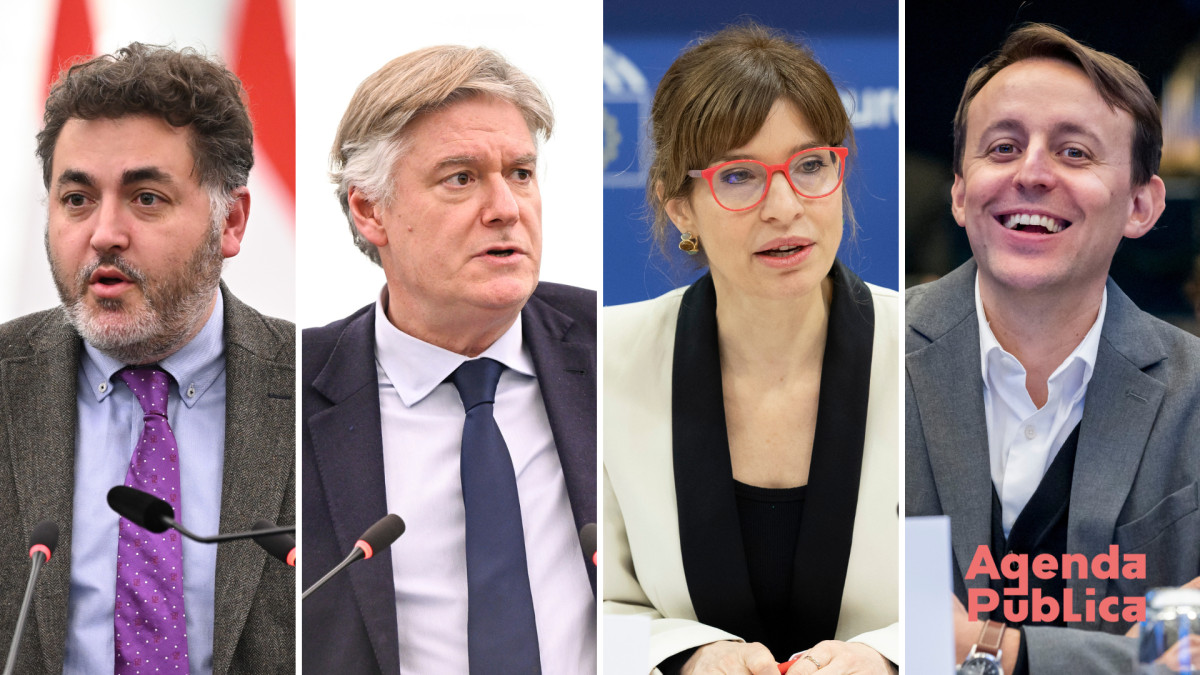
In that crossroads between NATO, international law, and European sovereignty lie the responses of four MEPs from the Agenda Pública UE section. Hana Jalloul, Antonio López-Istúriz, Javi López, and Jonás Fernández respond with knowledge of Spanish policy, but also with a deep understanding of the European institutional framework.
By denying the United States the use of Rota and Morón for attacks on Iran, is Spain asserting its independence or risking the credibility of the alliance?
Jonás Fernández: Spain exercises a prerogative contemplated in the agreements between the United States and Spain that governs the use of such bases, whereby any military operation outside the umbrella of NATO or the United Nations requires Spain’s formal authorization.
Spain acts, therefore, within the framework of cooperative arrangements signed with the United States with full normalcy.
Antonio López-Istúriz: Spain has every right to defend its sovereignty and to participate in decisions that affect its foreign and security policy. However, this legitimate autonomy must be exercised with responsibility and, above all, in coordination with our allies. The Rota and Morón bases are part of a framework of strategic cooperation with the United States and of our commitment within NATO.
“The credibility of an ally is built precisely on predictability and cooperation”
For this reason, any decision affecting its use should be managed with transparency and dialogue within the alliance, avoiding signals that could be interpreted as a lack of reliability. The credibility of an ally is built precisely on predictability and cooperation. Sánchez acts by imitating regimes that are precisely not on the democratic side of history: he makes decisions outside the General Courts, without informing His Majesty the King and without counting on his European allies.
Hana Jalloul: That dichotomy does not reflect the reality of the situation. Spain does not reaffirm its independence; it acts within the framework of the 1988 cooperation agreement with the United States, which grants Spain the authority to authorize movements that take place at the base, such as bomber takeoffs. This is something that has happened on previous occasions and is framed within the normality of the cooperation that exists at the bases that the United States has on our territory.
What we must emphasize is the illegality of the intervention. The attack on Iran, launched by the United States and Israel, contravenes International Law and the United Nations Charter, lacks Security Council backing, and does not even have the backing of the U.S. Congress.
This stance is compatible with condemning the Iranian regime and its oppression of the Iranian people, and especially its women, as we have condemned repeatedly, in addition to advocating for designating the Revolutionary Guard as a terrorist organization.
Javi López: Spain is a reliable and top-tier partner within the context of NATO and the United Nations. What is happening is a reaffirmation of its unwavering commitment to international law and peace by denying that its territory be used for an unjustified and illegal war that lacks both UN Security Council backing and is not framed within the NATO context.
The government of Pedro Sánchez rejects, unlike the Aznar government in 2003, participating in a war that would only bring more violence, regional destabilization, and risks to global peace.
What puts at risk the alliance’s credibility are unilateral interventions co-organized with third countries outside of it, not that its members comply with their obligations under international law.
Does the threat of U.S. commercial retaliation force Spain to choose between economic interest and strategic autonomy?
H. J.: Spain’s position regarding the alleged commercial retaliation mentioned by President Trump has been stated unequivocally by the European Commission itself. Spain’s unity and the European Commission—which leads our trade policy—reflect that Trump’s comments do not hold.
Commercial competencies are exclusively communal, not those of the Member States, so this is not a threat to Spain but to the EU as a whole.
“This stance is compatible with condemning the Iranian regime and its oppression of the Iranian people, and especially its women”
In any case, we must remember that this is not new. Even since the agreement reached with the United States last summer, where Ursula von der Leyen agreed to accept tariffs of 15%, the Trump Administration has threatened various countries for their support of Danish sovereignty over Greenland. Europe’s economic interest depends precisely on this strategic autonomy and on unity in the face of threats.
J. L.: Trump’s threat is not directed at Spain; it affects the entire European Union. His ignorance of how transatlantic trade relations work is nothing new. Nor is his unpredictability and lack of restraint regarding the consequences of his actions.
Honestly, nothing new under the sun. Trump already dismantled the Turnberry principles after the Supreme Court ruling on his tariff measures, to which he responded with public statements about a new general global tariff of 15%.
The Trump administration is not a reliable partner. It responds to any setback, external or internal, in the same way: impulsive and indiscriminate. Europe’s economic interest also depends on genuinely achieving strategic autonomy.
A. L. I.: We should not accept a false dilemma between strategic autonomy and economic prosperity. Spain, as a member of the European Union, is part of a single market and a common trade policy that exists precisely to strengthen our negotiating capacity against major powers.
What we must do is act with strategic intelligence: defend our economic interests, but also maintain a strong relationship with the United States, which remains a fundamental partner in security, trade, and democratic values.
Impulsive decisions or short-term political gestures can have consequences that go beyond the diplomatic sphere… we still remember Zapatero’s snub to the flag and the consequences that it still has today.
J. F.: Trade policy is a full EU competency, not a national one. Therefore, there is no place for commercial retaliation against a particular country of the Union.
We can recall, for instance, the case of Algeria and its gas exports to Spain, where the North African country’s government announced retaliations it could not implement.
To what extent has public opposition to interventions in the Middle East conditioned the decision? Can political caution prevail over strategy?
J. L.: I think that more relevant than public opposition to interventions in the Middle East, which exists, is the public consensus on the need to respect international law and to preserve peace.
“The Government’s decision is based on the firm values and the legitimate interests of Spanish society”
El Gobierno no solo es consciente de ello, sino que forma parte de su ADN: defensa del multilateralismo, el diálogo, la diplomacia, la desescalada y la paz. Así lo ha expresado en el seno de la Unión Europea y en todos los foros multilaterales. Ahí está la hemeroteca del Gobierno y de su presidente. Lo ha dicho anteriormente sobre Ucrania, Gaza o Groenlandia.
La decisión del Gobierno está basada en los firmes valores y en los legítimos intereses de la sociedad española: una guerra ilegal no beneficia a nadie.
A. L. I.: Es evidente que en España el Gobierno se ha esforzado mucho en polarizar a la sociedad; el propio Sánchez lo afirmó en su discurso de investidura.
Los gobiernos democráticos lo son si respetan la separación de poderes. Y, en este sentido, las Cortes Generales son la expresión institucional de la soberanía popular y el principal foro donde se articula y representa la opinión pública de la ciudadanía. Sánchez ignora a las Cortes reiteradamente. Toma decisiones sin contar con el Congreso y el Senado, y sin someterse tampoco a las preguntas de la prensa: esto de las “declaraciones institucionales” es una broma de mal gusto para los periodistas.
J. F.: Identifico una estrategia nítida en la acción del Gobierno español cuando, en el marco del acuerdo de cooperación con Estados Unidos, no aprueba el uso de las bases militares para operaciones fuera del marco de la OTAN y de Naciones Unidas.
Esa estrategia se asienta en el compromiso de denunciar cualquier incumplimiento flagrante de la Carta de Naciones Unidas, tanto en el caso de Rusia en Ucrania, de Israel sobre Palestina o, en estos momentos, de Estados Unidos e Israel sobre Irán, o de este último país sobre sus vecinos regionales.
H. J.: Cualquier estrategia que adoptemos no puede pasar por legitimar una intervención militar fuera de la legalidad internacional, que ponga en peligro la estabilidad de la región y que no contribuya a la desescalada y al diálogo diplomático. Si esta es la oposición pública, es porque a los ciudadanos les importa el derecho internacional, la importancia de la paz y conocen la historia. No podemos ser ambiguos al condenar el uso ilegítimo de la fuerza militar y la violación del derecho internacional.
La posición expresada por el Gobierno de España coincide con la de una gran mayoría de la ciudadanía, que más allá de ideologías y partidos, rechaza la guerra y el uso ilegal de la violencia. Hace dos décadas, los españoles salieron a la calle alzando la voz contra la guerra de Irak, cuyas nefastas consecuencias trajeron violencia e inestabilidad para todo Oriente Medio y para la cual se demostró que no había armas nucleares.
Tenemos memoria. Y, por ello, el Gobierno de Pedro Sánchez elige no ponerse de perfil y defender firmemente la vuelta al marco de Naciones Unidas como única vía para la desescalada y la paz en la región.
¿La postura de Sánchez es una apuesta por la autonomía estratégica europea o expone a España al aislamiento dentro de la OTAN?
A. L. I.: Europe must advance toward greater strategic autonomy, especially in defense and security. But that autonomy is not incompatible with a strong NATO; in fact, both dimensions should reinforce one another.
The risk arises when certain decisions are presented as internal political gestures rather than part of a coordinated European strategy. Spain must be an actor who builds bridges, not one that creates doubts about its position within the alliance. Our country holds a key geostrategic position and should use it to strengthen both transatlantic cooperation and Europe’s ability to act.
J. F.: This military operation has begun without the involvement or approval of NATO.
“The only country that isolates itself by launching a military operation without even seeking NATO’s support is the United States”
Rejecting the use of bases on our soil cannot be interpreted as a sign of isolation within NATO, since the only country that isolates itself by starting a military operation without even seeking NATO’s support is the United States.
H. J.: The position expressed by President Sánchez is a commitment to responsibility, to multilateralism, and to peace. Spain has been, is, and will continue to be a committed NATO partner, which assigns great importance to its role within the Atlantic Alliance. Our commitment to peace and to international law are compatible and necessary for the importance we give to our NATO membership.
The Government and the PSOE have always supported building a European defense architecture that is guided by respect for the dictates of the United Nations Charter.
Proof of that commitment is the support shown for Ukraine by our country or the recent deployment of a Spanish frigate in Cyprus, within the framework of a joint European operation, to help protect this country against attacks. We have rejected the attacks Iran has launched against various countries, while at the same time we continue to urge the EU to show coherence and resolve so that it stops acting according to double standards, as has happened with Gaza.
J. L.: Many European leaders have been entrenched in complacency and subservience to the United States since Trump took office. That strategy has yielded disastrous results in political, economic, and security terms. It is evident.
Spain challenged that approach from the outset and argued that the EU should be a stronger pillar within NATO, capable of defending its values and interests autonomously. Today that position is fully vindicated.
The same has happened with the position on this illegal war. Spain was the first to denounce it, but other European countries have followed, and not only European ones.
It reflects a willingness to exercise our geopolitical potential autonomously to defend our values and interests, and the EU and many of its member states are mistaken, in my view, in failing to grasp the enormous consequences that participating in this new folly of Trump and Netanyahu could have.
