
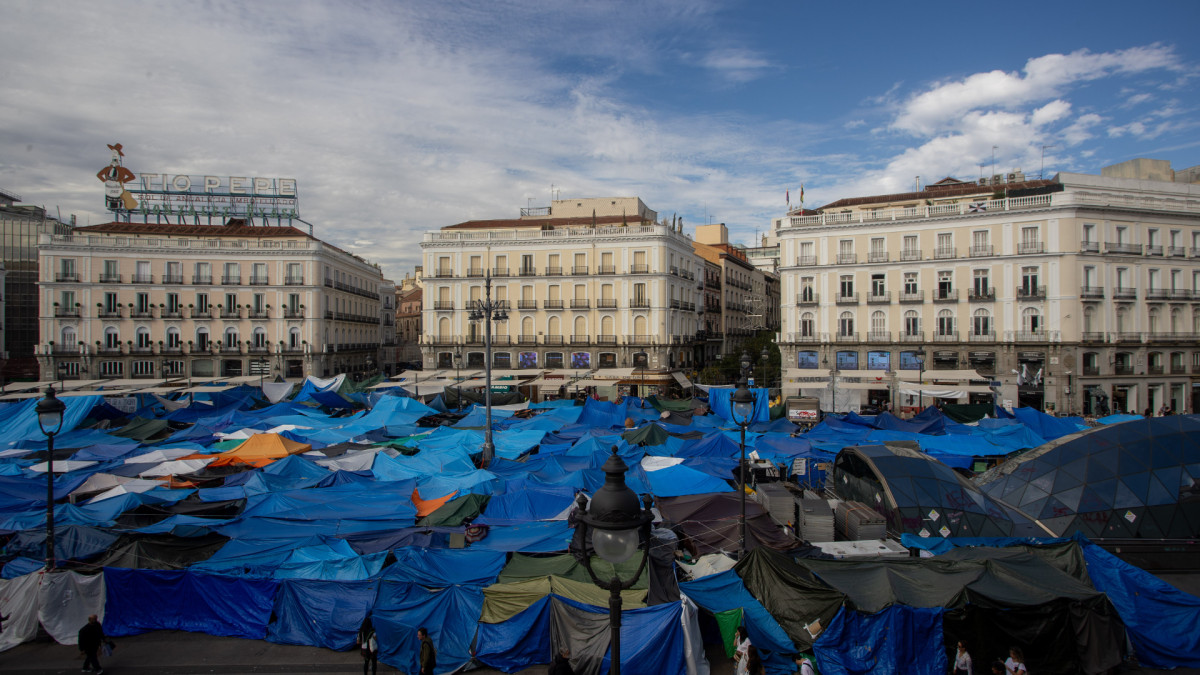
“Shameful. They have turned the streets into Ceuta’s beaches.” With this phrase, spoken on October 15 regarding the housing encampment at Puerta del Sol, Isabel Díaz Ayuso, the president of the Community of Madrid, joined two crises into a single image that have marked the end of summer and the start of autumn. On the one hand, the mobilization that the right and the far-right built around Ceuta under the slogan “Ceuta is not for sale, Ceuta is defended,” which took the migrant crisis from the stands to the street and gave cover to a repertoire we will call brigade-style mobilization, the aim of civilian groups to monitor, patrol and “defend” a territory against a designated enemy. On the other hand, the Sol encampment, raised on September 26 after the eviction of an 87-year-old woman and replicated later in at least eighteen cities, which has forced the involvement of other actors with calls for a general strike, a framework aimed at reactivating other social movements such as the “mares” associated with major public services like healthcare (white tide) or education (green tide). This process condenses the shift of the political conflict toward the street and the territory, where the extremes mobilize and, increasingly often, clash.
In a first installment, published on these pages, we analyzed how the migrant crisis of July 30–31 became a political weapon. This text takes a step further and broadens the focus. In Kartex we have used the slogans of the mobilization as a probe to reconstruct the informational cartography about Ceuta on X from August 15 to September 9 (14,450 publications and a graph of 66,590 accounts) and, for the housing movement, the Instagram interaction graph between mid-August and October 13 (nearly 85,000 accounts), completed with another 50,000 posts in the following week. The radical right lives a long mobilization cycle that did not begin in Ceuta, the left reactivates with strategies very similar to those of 15M and the elections of November 29, preceded by the general strike of the 11th, will not cool the conflict, but will act as a catalyst for a political violence that has ceased to be episodic.
“Ceuta is not for sale”: the territorial grievance as a mobilization strategy
The night of August 27, a group of Ceuta residents blocked the passage of a Red Cross truck that was delivering food to migrants camped on the Trampolín beach. Six days later, militants from Núcleo Nacional gave a fascist salute and sang the Cara al Sol in front of Congress, shouting “Ceuta is not for sale,” while the left gathered five hundred meters away, in Callao, “against racism.” The migrant crisis became a driving force behind street mobilization, with violence against migrants (blockades, patrols, assaults and attacks) and an increasingly antagonistic relationship between radical right and radical left.
Pase sobre el grafo para hacer zoom. Figura 1. Movilización de la derecha y la derecha radical y sus vínculos con el fútbol español. Flujos informacionales en X, 15 de agosto-9 de septiembre de 2026 (66.590 cuentas y 185.641 interacciones) | Fuente: Kartex.
On August 15, the fans of AD Ceuta (the Sevillian Front, with club support) unfurled in Andorra the banner “Ceuta is not for sale, Ceuta is defended,” an expression of a territorial grievance born from the Ceuta crisis. On the 22nd, T-shirts with the slogan of AD Ceuta and UD Las Palmas amassed 15,073 retweets in a single night, a notable impact. The stands launched the slogan, though it was Vox that politicized it, with Santiago Abascal predicting a Ceuta that foreshadowed “the mañana of many cities.”
“The elections of November 29, preceded by the general strike on the 11th, will not cool the conflict, but will act as a catalyst for a political violence that has ceased to be episodic”
Clubs made the demands their own, probably due to pressure from fans among whom there are sizeable ultras groups. Football pitches have a cross-cutting effect on political ideas, and the most active groups have a large impact with their political slogans on the entire fan base. On social networks, ultranationalist influencers intensified the narratives with the images from the marches to the Trampolín; on television, aggregators and police unions (Jupol) linked to the right or far-right nationalized it; and the PP capitalized on it on September 2, europeanizing the conflict. No actor steered the conversation for more than two consecutive days (figure 2), but each relay left a layer that the next ones reused to mobilize the public.
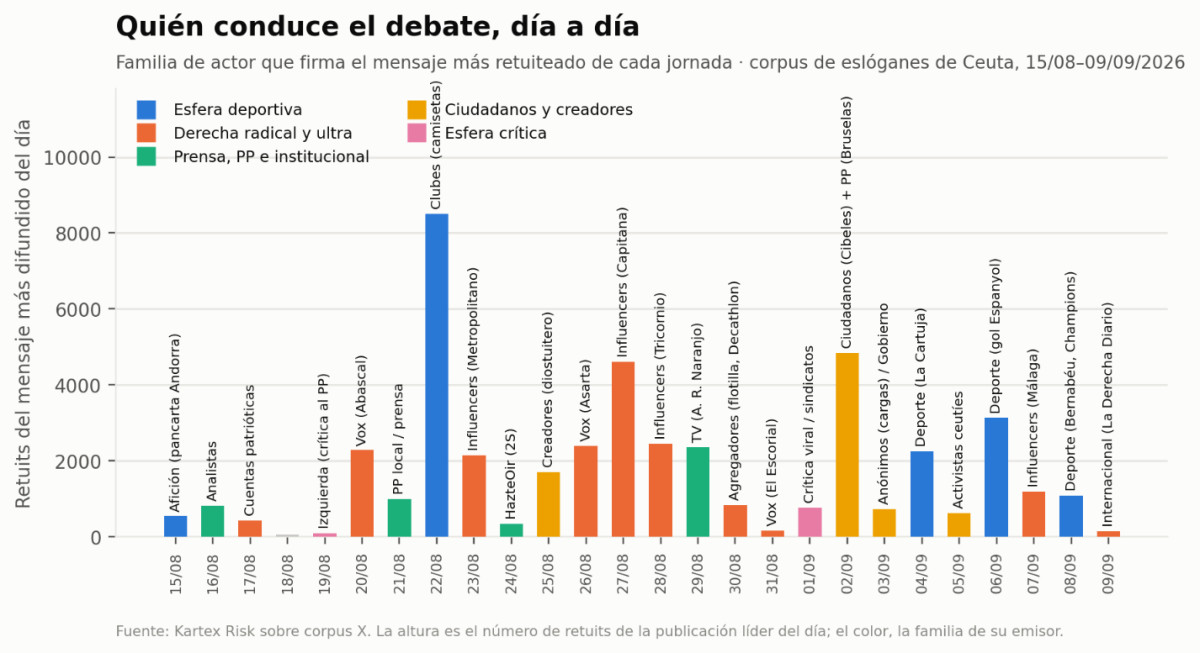
Figura 2. Quién conduce el debate: familia de actor que firma el mensaje más retuiteado de cada jornada (X, 15 de agosto-9 de septiembre de 2026) | Fuente: Kartex.
The September 2 mobilization was born online as a citizen initiative, but its institutional uptake was significant. The Spanish Federation of Municipalities and Provinces embraced it, and more than 260 municipalities backed it, with more than 300 street concentrations in front of town halls. The PP europeanized it with a protest before the European Parliament under the slogan “Ceuta is Spain, Ceuta is Europe,” the most viral institutional message of the corpus and a white-glove normalization with which it disputed Vox for leadership of the frame. Madrid showed the other side. The unpermitted demonstration before the Congress spilled over, the organized radical right marched within it openly and unmasked, and the police charges of the following day became proof of “repression.” Abascal then shifted the target of Ceuta to the political regime, with the “bench” for the “traitors” and the warning that the next elections, then expected for 2027, could be “not free.”
“The PP euroized it with a protest before the European Parliament under the slogan ‘Ceuta is Spain, Ceuta is Europe,’ the most viral institutional message of the corpus”
The mapping of the conversation (figure 1) shows a space dominated by the right. At the top, the large blue blot of clubs and ultras, alongside the magenta of the viral sports world and the local press and the green of the La Liga milieu, form the major sphere of the graph and provided the mass, 22% of all diffusion with only 7% of the publications. In the center, the conservative press and activism, from HazteOir and Jupol to OKDiario or El Español, provided validation and call-infrastructure, and to their left the PP milieu arrived late to capitalize on the big day. The ultrainfluencers and the Vox surroundings, in the lower-right quadrant, pushed radicalized narratives, while on the other side of the double dotted line remained, isolated, the organized and radical left, signaling its activation in front of the radical right. There were no bots behind the phenomenon. Ten accounts, with barely 59 of their own publications, activated 34% of all accounts that retweeted something in the graph, and their ultrainfluencers share between 16% and 26% of their amplifiers with Abascal, Vox or HazteOir, that is, they mobilize the same base. The Government, for its part, lost the narrative window, and when Pedro Sánchez replied on September 3 with “Ceuta is not Spain’s border, Ceuta is Spain at the border” he barely achieved 329 retweets, compared with 46,452 for the ten most disseminated posts of the mobilized camp.
From chant to brigade
In another Kartex installment, we documented the neighborhood brigade-style militancy that “shielded” Ceuta’s neighborhoods after the July crossfire, heir to the model tested in Torre-Pacheco in 2025, when groups such as Deport Them Now fostered the “hunts” of migrants, though attempts of brigades were already forming in other territories, such as during the DANA crisis, in Catalunya during the procés, or against migrants in several other points.
The slogan of the football grounds and social media later gave it a legitimizing umbrella. The night marches to the Trampolín and to Loma Colmenar, the blockade of the Red Cross, the August 26 demonstration in which part of the attendees tried to reach the migrant camps and wreck shelters or the “recovery” of beaches celebrated as an “honor” presented direct action as defense of the territory, and in September appeared the “avengers,” sometimes hooded groups that patrol city zones. Núcleo Nacional, which has been absorbing the brigadismo of the Torre Pacheco cycle, also called its own block in Gijón under the label #Remigración, and the Solidaridad union or the Sevillian Falange joined the calls with the slogan as their signature. They are minority presences, but they show that the slogan serves as an interface between respectable mobilization and street activism of the radical right, which can march within the general demonstration without changing a word on its banner.
“The slogan serves as an interface between respectable mobilization and the street activism of the radical right”
The beneficiaries’ balance is clear. The PP achieved institutional and European capitalization, the ultrainfluencers gained audience and the narrative hegemony, and brigade-style mobilization found a respectable banner under which to march. The left failed to respond to the territorial grievance, and its only effective message, the rebuke of “bracelet patriotism” toward those who shout the slogan while their communities reject hosting unaccompanied migrant minors, worked because it accepted the patriotic frame. The slogan, now generalized as “Spain does not sell out, Spain defends,” was left available for the next crisis, and the machinery set up in August soon found a new target in the Sol housing encampment.
Sol, fifteen years later
The left found its own turning point on September 23, when, after several delays, the eviction of Maricarmen Abascal, 87 years old, was carried out, despite a request for suspension from the UN Human Rights office. She was admitted to the hospital that same day and died on October 7. Between those dates, the Sol encampment occurred, the Congress rejected the housing decrees with votes from the PP, Vox and Junts, protests on October 3 in around fifty cities (more than 70,000 people in Madrid according to the Government’s delegation and up to 500,000 according to the organizers), the snap election on October 5, two new popular decrees known as the “Maricarmen decree” and the call by CCOO and UGT for the first general strike in fourteen years, which according to a poll by Ateneo del Dato for elDiario.es is supported by 60% of those surveyed.
The comparison with 15M is apt. This movement was, in the end, the crystallization of an accumulation of forces, with a dense network of non-state actors that had been preparing for years (between 2007 and 2013 cultural and ideological associations increased from 638 to 1,417) and with PAH and Observatori DESC at its center. Today something similar is happening, though the central problem is no longer mortgage but rent, and the actor that underpins the mobilization is the Tenant Union and its territorial counterparts. The 2011 subject was the indebted homeowner, and in 2026 it is the precarious renter of a generation that has stopped aspiring to ownership, while the representation that mobilizes them has shifted from mortgage fraud and political corruption to the right to housing against rentierism, which explains why there is a smaller potential grievance than in 2011 amid the economic crisis.
Mapping the mobilized left
The housing graph (figure 3) draws a federated movement across a dozen territorial communities (Madrid, Catalonia, Valencia, Andalucía, Canary Islands, Asturias, Galicia or Cantabria) that together, with the means that amplify it the most, account for 6,357 accounts and 19.3 million “likes.” It is a federated movement, but with a center. The Madrid Tenant Union’s account is the most cited node, linking ten communities and through it pass more than half of the shortest paths in the entire network (a betweenness of 0.54), well ahead of the Confederation of Tenant Unions and the Sindicat de Llogateres. Surrounding that red core sits the purple cluster at the top, with the Catalan housing unions, the Barcelona Acampada per l’Habitatge, theStudent Union, Izquierda Revolucionaria, La Izquierda Diario, or CGT. Parties and mainstream media sit lower still, and in the bottom-right extreme, detached from the rest, appears the yellow cluster of the radical right.
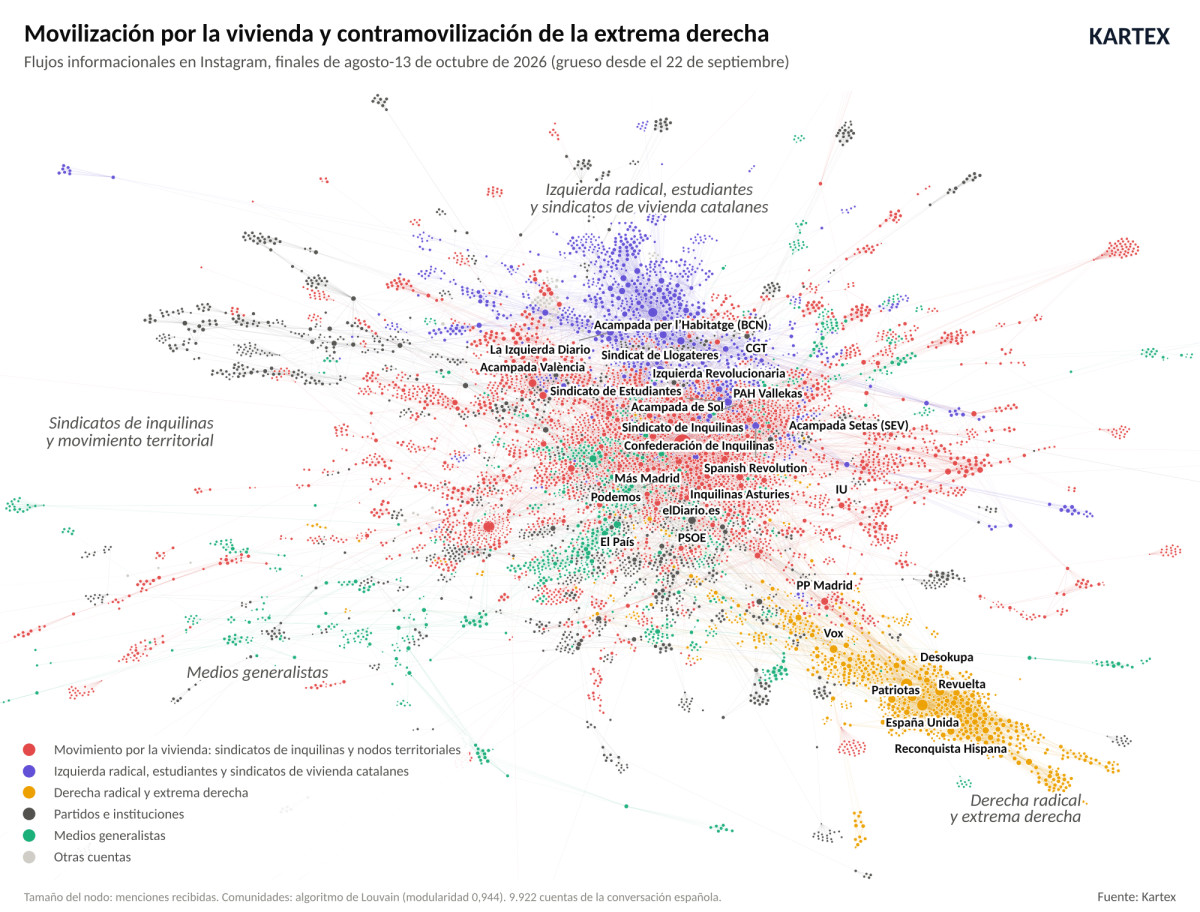
Pase sobre el grafo para hacer zoom. Figura 3. Movilización por la vivienda y contramovilización de la derecha radical. Flujos informacionales en Instagram, finales de agosto-13 de octubre de 2026 (tamaño, menciones recibidas; color, comunidad) | Fuente: Kartex.
The network composition reveals a genuine mobilization engineering. Around 117 trade unions and housing groups, from tenant unions to Barcelona neighborhood assemblies or the latest PAH, 79 education and student movement accounts, 125 from labor unions, 59 from the radical left and anti-fascism, 117 from left-wing parties, 35 in solidarity with Palestine and 15 encampments have joined. Radical left has disproportionate visibility, since its 59 accounts accumulate more “likes” than the 117 housing groups, and in its community the most popular account is Spanish Revolution, a media outlet born in the 2011 plazas.
“The subject of 2011 was the indebted property owner and the 2026 subject is the precarious tenant of a generation that has stopped aspiring to ownership”
The Student Union, which connects seven communities, acts as a hinge, and the general strike, called by CCOO and UGT, rests on the network of alternative unions, because the 54 accounts of CGT receive more mentions than the 118 of CCOO, whose accounts mainly gravitate around mainstream media. Major unions set the call and alternative unions weave the fabric, and the 2025 Palestine solidarity network sits embedded in the housing communities, as if a single militancy has shifted its cause without changing its network.
From the square to the general strike and the tides
The left reproduces the logic of 15M. The Sol encampment, which by mid-October was approaching the 28 days that the 2011 occupation lasted, was replicated in at least eighteen cities, from the Catalunya Square to Sevilla’s Setas or Valencia’s Town Hall square, and even crossed into Portugal, where the encampments in Lisbon and Porto, inspired by Madrid, were cleared with dozens injured and detained. The square functions as symbolic territory and as a mobilization vector, and the general strike as the umbrella that converts sectoral discontent into a broad challenge, as happened in 2012 with the two strikes of the plaza cycle. Between October 13 and 21, 2026, the strike on November 11 was the first framework of the organized left’s ecosystem, with 27.8% of its publications, ahead of the encampments and the very right to housing (figure 4).
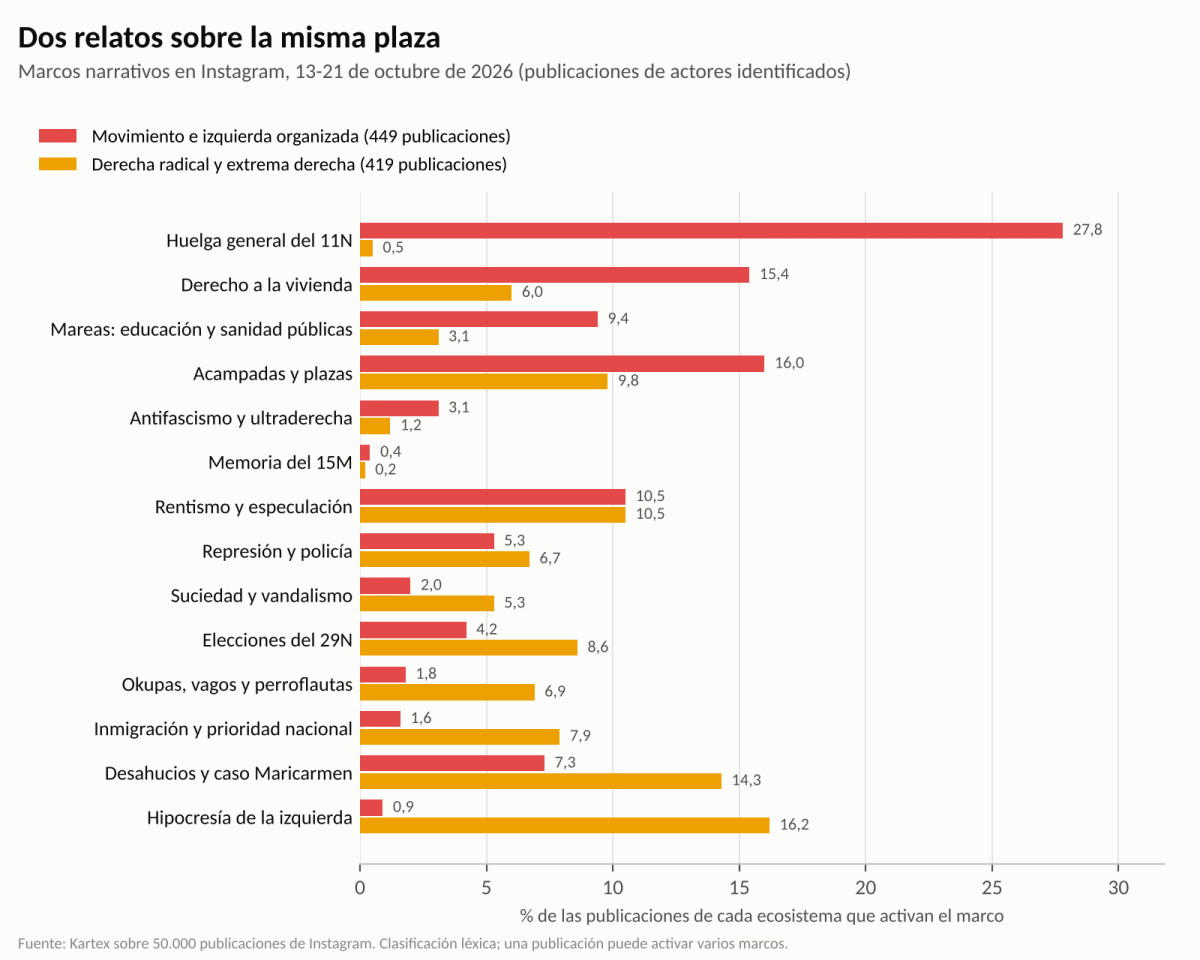
Figura 4. Marcos narrativos de la izquierda organizada y de la derecha radical en Instagram, en porcentaje de publicaciones (13-21 de octubre de 2026) | Fuente: Kartex.
The third piece is the tides. Between 2011 and 2012, the 15M cycle gave way to various tides, such as the education green tide and the health white tide (among others), taking over from the plaza movement, which was very hard to sustain over time.
“The square functions as symbolic territory and as a mobilization vector, and the general strike as the umbrella that converts sectoral discontent into a broad challenge”
The indefinite strike of Madrid’s public education began on October 14 after a sit-in at the Complutense University’s Information Science faculty, and its first day ended with police charges and students detained. The education and student movement accounts signed the 28% of the left’s organized posts that week, and from Sol a student spokesperson described a day in which “the fight for the public and the fight for housing merge.” Notably, the movement hardly invokes the 15M anymore (only 0.4% of its posts), pointing to a continuity of repertoire and infrastructure rather than memory.
From Gürtel to Maricarmen: strategic litigation
During the indignados movement, Observatori DESC played a very relevant role in shaping the framework for the left’s conflict preparation, and thus for the PAH’s rise as a movement and for the commons and Podemos (among other forces) as political expression. One of its tools, strategic litigation, which the Observatori itself defined as the “judicialization of an emblematic human rights violation case” to, through a representative case, “change laws, regulations or administrative practices,” is one of the most effective. This happened with Gürtel, when in February 2013 its lawyers, together with Izquierda Unida, denounced the passivity in handling the scandal, a judicialization that helped situate corruption at the center of the narrative about the political system.
The Maricarmen case follows that pattern. The Tenant Union accompanied her for seven years, her defense took the case to the UN DESC Committee, which issued precautionary measures, and the eviction carried out despite those measures turned an individual tragedy into an international noncompliance by the State, publicly noted by UN Special Rapporteur Koldo Casla. After her death, the Union is preparing a criminal complaint for manslaughter against the owner company, and the case has given its name to a decree-law. If in 2011-2013 strategic litigation helped place corruption at the center of the system, today it serves to locate rentierism in that position as well as to mobilize the left. After it was revealed that the partner of the socialist spokesperson, Montse Mínguez, runs a company with at least thirty rental properties, the Union called the PSOE a “rentier party” and directed the general strike against it, in a challenge reminiscent of the “they do not represent us” stance of 2011. The radical right has responded with the same instrument in reverse, and on October 13 Vox filed a lawsuit against the Madrid Government Delegate and against spokespeople of the Union for the encampment, accusing them of failing to pursue crimes and of prevarication.
The contested square
The big difference with 2011 is that the square no longer belongs only to those who occupy it. The 15M did not face an organized counter-movement in the street, and Vox did not even exist, whereas today the radical right disputes the same territory and even the same lexicon. On October 3, around 400 people, mostly young men, summoned by a platform called “Indignados por España” and backed by Núcleo Nacional and Democracia Nacional, attempted to march on Sol to demand a “social and national” housing policy, until about 500 riot police prevented them. The appropriation of the term “indignados” seeks to contest the 15M’s symbolic heritage and redirect housing discontent toward the “national priority,” the same bridge that connects Sol with Ceuta. On October 12, after the National Holiday parade, ultranationalist groups, many of them minors, appeared at the encampment with Falangist flags and Burgundy crosses, Nazi salutes and shouts such as “red I see, red I kick,” in a day that left a police officer injured and five detained. Days later, Maricarmen’s altar appeared smashed.
“If in 2011-2013 strategic litigation helped situate corruption at the center of the system, today it helps place rentierism there as well as mobilize the left”
Not all violence comes from the same side; a television reporter claimed to have been assaulted by an encamped person live on air, but the asymmetry is also visible in the networks. In the housing graph, the radical right’s community, with accounts like Vox, Revuelta or Desokupa and a constellation of “patriotic” profiles, gathers barely 905 accounts, seven times less than the movement, although each generated on average 2.4 times more interactions and its activity followed almost day by day the mobilization’s pulse (figure 5). On October 2, the day before demonstrations and the counter-march, it registered more interactions than the Tenant Union’s own community, and in the week following October 12’s attack, its posts generated 2.7 times more comments than the organized left. It is a reactive counter-mobilization, smaller in numbers but more intense and confrontational.
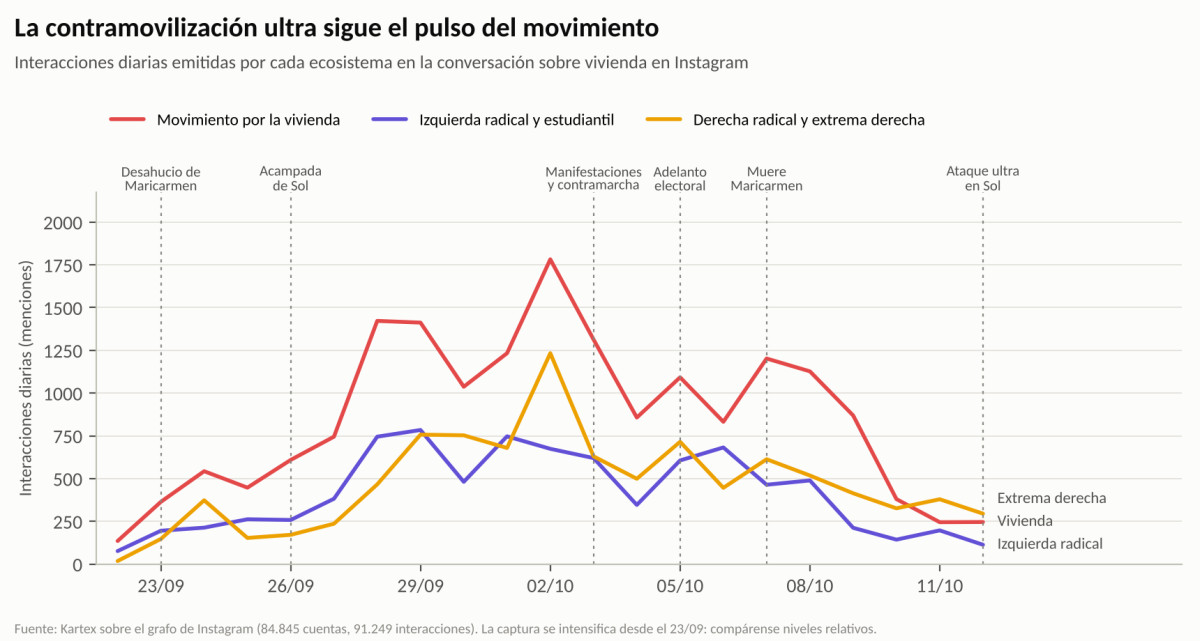
Figura 5. Interacciones diarias emitidas por el movimiento por la vivienda, la izquierda radical y estudiantil y la derecha radical en Instagram (22 de septiembre-12 de octubre de 2026) | Fuente: Kartex.
Two spaces do not talk about the same thing either (figure 4). While the organized left speaks of the strike, of the squares, of the right to housing and of the tides, the radical right hardly mentions the strike (0.5% of its publications) and builds its counter-narrative on the left’s hypocrisy (16.2%), fueled by the spokesperson’s case, on the appropriation of the eviction framework turned against the PSOE, on immigration and on the “national priority,” and on portraying encamped people as squatters or hippies in a dirty square, the same frame Madrid’s Community used to justify closing Sol metro station. The spokesperson’s case thus feeds the Union’s “rentier party” and the right’s “hypocrisy,” a clamp on the PSOE from both ends. And as with Ceuta, both spaces hardly talk to each other on the network, because less than 1.5% of ultra-right community interactions are directed at the movement and barely 0.5% in the opposite direction, though they clash in the streets.
Toward November 29: the radical right’s long cycle
My hypothesis is that the Spanish radical right has not mobilized around Ceuta, but has been mobilizing for almost a decade, and Ceuta is the last rung in a chain of events that has allowed it to accumulate forces. On the Spanish scale, the first rung was the procés. Autumn 2017, with the “let’s go after them,” balconies with flags, the great unionist manifestation in October in Barcelona and the brigadismo quitazeros, opened the window through which Vox entered the Andalusian Parliament in 2018 and Congress in 2019, with Ferraz’s protests against the amnesty in 2023 as an epilogue. Then came COVID, which united transnational conspiratorial and radical-right audiences under Trump’s presidency and the rise of right-wing populisms. The 2024 DANA in Valencia made the state’s failure the central argument of “only the people save the people”; Torre Pacheco in 2025 positioned migrants as enemies and the hunting as a response; and Ceuta combines all the above with the border, the army in the street and brigades.
“My hypothesis is that the Spanish radical right has not mobilized around Ceuta, but has been mobilizing for almost a decade”
The pandemic had the opposite effect on the left, as it halted a cycle that had resurged with feminists’ strikes on M8 of 2018 and 2019 and with the pensioners’ movement. The mobilized left took years to reclaim the street, with the great housing demonstrations of 2024 and 2025, the Palestine protests of 2025, and now the encampments, partly as a reaction to the radical right, and this is not purely a Spanish phenomenon. Since 2025, protests by the so-called Generation Z have followed, from Nepal to Morocco or Madagascar; France saw the “Bloquons tout”; Italy and Spain experienced general strikes for Gaza and this October protests against the cost of living spread through France, Italy, Belgium and Portugal. Even so, in intensity, organization and transnational connection, the activation of the radical right remains clearly above.
The start of a turbulent period
The Ceuta and Sol cartographies show two distinct mobilizations that share the same shift of political conflict toward the street and the territory. In the right and the far-right, the mobilizing representation was the territorial grievance, condensed in a slogan born in the stands. Clubs, influencers, Vox and the PP made it their own, taking it to more than three hundred municipal concentrations and to the European Parliament. The football crowds provided the mass and cross-cutting reach, the ultrainfluencers supplied radicalization of the narrative and the PP provided institutional capitalization. Under that same slogan, brigade-style mobilization found respectable coverage for direct action against migrants. The Government arrived late and with a counter-slogan without traction, leaving the information window in the hands of its rivals.
In the left, the central representation is the right to housing against rentierism, and its strategy reproduces the logic of 15M. The square functions as symbolic territory for the accumulation of forces, the general strike as the umbrella to bring in other grievances and the tides of education as a relay to sustain mobilization over time. The movement has a clear center in the Tenant Union and a radical left with visibility far beyond its organizational weight. Alternative unions provide the fabric for a strike called by the major confederations. Strategic litigation, which in the previous cycle placed corruption at the center of the narrative, now locates rentierism in that place and mobilizes the left. Its main limit is a potential grievance smaller than in 2011, in the midst of an economic crisis. Its capacity to grow will depend on whether it can bring in other social sectors and not get locked into a militant space.
“Its capacity to grow will depend on whether it can bring in other social sectors and not get locked into a militant space”
The big difference with that cycle is the competition for the same territory. The radical right no longer mobilizes only for its own causes; it also disputes the square, the indignados lexicon, and even the courts. It does so with a less numerous but more intense and conflictive counter-mobilization. The two spaces barely speak to each other on the network, locked in echo chambers that algorithms reinforce, and only meet on the street, where the conflict becomes physical, as shown by Ceuta’s patrols or the October 12 attack on the Sol encampment.
On a national scale, the activation of the radical right responds to a long cycle that begins with the procés, expands with the pandemic and accelerates with the DANA, Torre Pacheco and Ceuta. The left reactivates later, partly in reaction and in tune with protests sweeping Europe and other regions, but still lower in intensity and in transnational connection. That asymmetry, the multipolarization of networks and a metropolitan violence of a new kind as Blocus depicts, heralds an autumn of high tension. There will be a general strike on November 11, elections on the 29th and a new Blocus call for the following day. The ballots will act as accelerators of this mobilization cycle, and the ability of institutions, parties and platforms to contain political violence will be the decisive variable in the coming months.
We will continue in a second part of this series, in which we will analyze Blocus and violence in the major metropolitan areas.
