
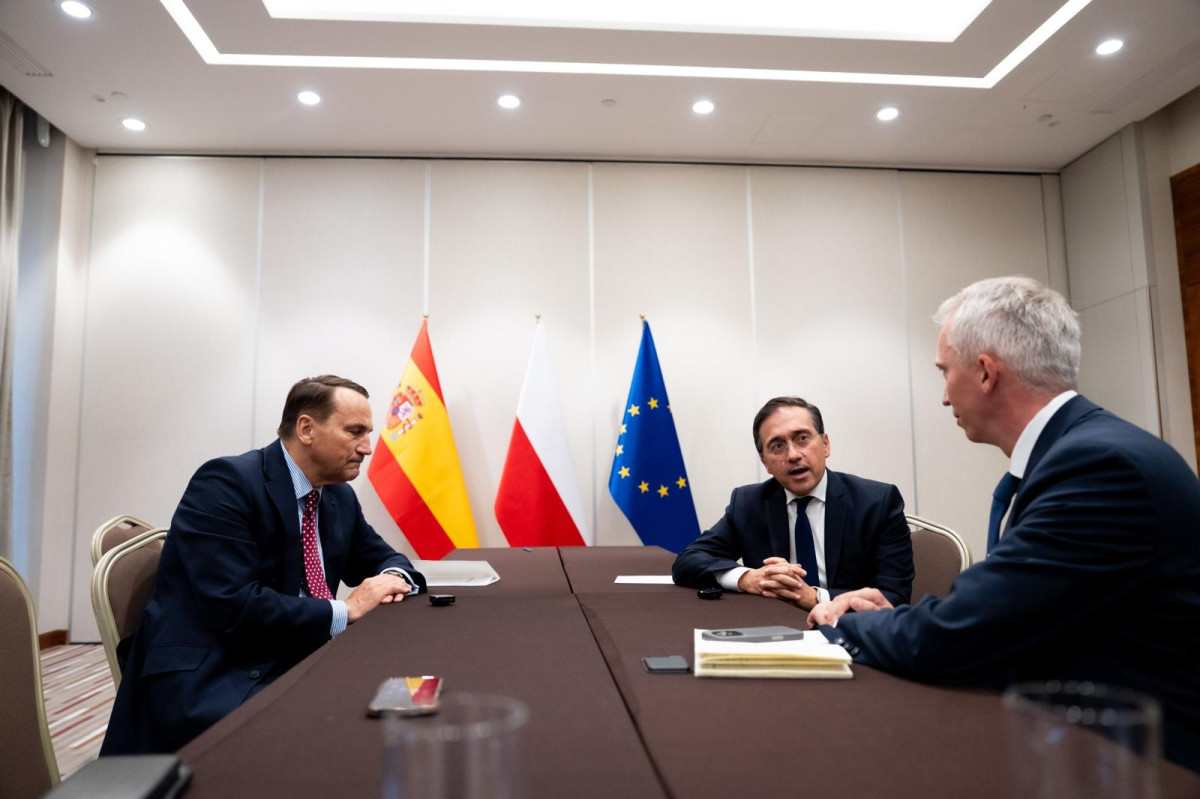
In Warsaw, solidarity emerges almost from the very first response. Sikorski thanks for the Spanish support in the face of pressure from Belarus and recalls that Poland also stood with Spain during the Ceuta crisis. Albares takes up that idea and brings it into the military arena: he recalls the Spanish deployment in Eastern Europe and asserts that they will be in Poland if necessary. Asked whether Spain would be willing to die for Danzig, the minister insists that the aim of that commitment is precisely to avoid war.
The issue of migration also occupies a large part of the conversation, though each minister approaches it from the experience of their own border. Sikorski defends tightening controls with Belarus and the construction of a barrier in which Poland has invested more than 1 billion euros. Albares speaks of cooperation with African countries and recalls something he considers fundamental: “We need immigrants.” There is also time to address the application of international law, the recognition of Palestine, and the difficulties in maintaining a common European position amid the various international conflicts.
The Spanish minister was received by his Polish counterpart in Warsaw. Photo: Ministry of Foreign Affairs
What stance do Spain and Poland share on European border policy?
Radosław Sikorski (R. S.): The integrity of the outer borders of the Schengen area is absolutely fundamental to preserve freedom of movement within this zone. Therefore, we have a duty to be solidarity-making and to protect both the eastern and southern borders. Poland and Spain spoke with a single voice during the Ceuta operation. I am also grateful to my Spanish counterpart for his support when we faced attacks coming from Belarus.
José Manuel Albares (J. M. A.): In the end, we share a common vision. Both the eastern and the southern borders are borders of the European Union and, therefore, our borders together and we feel them as our own. It is about having a sense of community and knowing that when we act together, we are more protected, we are stronger, and our deterrence against those who want to harm us is greater.
R. S.: If I may add something, Warsaw is the seat of the European Border and Coast Guard Agency (Frontex) and Poland is the host country. Therefore, we have a special responsibility to ensure Frontex is a useful tool to address these problems.
Minister Albares, you have mentioned deterrence, which is part of the defense strategy. Speaking of Spain and Spanish voters, would Spain be willing to die for Danzig (Gdansk)? Why?
J. M. A.: I think the first thing that comes to mind when we talk about the EU and NATO is precisely the concept of deterrence. We ensure that war ceases to be an option in Europe, because everyone knows that we will always defend each other. Therefore, we do not have to reach those dramatic extremes.
We have demonstrated, and we will continue to do so, that we are fully committed to the security of the eastern flank. Today we have a historic deployment of soldiers, aircraft, and ships wherever we have been asked to protect Eastern Europe. We are present in Estonia, Romania, and Slovakia and, of course, we will be in Poland if necessary, just as we hope to receive that same solidarity when it comes to our borders, especially the land borders with Africa, in Ceuta and Melilla.
When we remain united, when we show solidarity, and when everyone outside Europe understands that we will defend one another, that is the best deterrence. It is the best way to prevent war.
R. S.: Geography influences our sense of security or insecurity. But the minister has mentioned the word solidarity, something that in Poland we hold sacred, and we have to demonstrate that we understand others’ challenges. That is why Poland has sent military missions to Africa under the United Nations flag.
“The minister has mentioned the word solidarity, something that in Poland we hold sacred, and we have to demonstrate that we understand the challenges faced by others”
We hope our Spanish colleagues are also aware of what the Russians are doing in Africa. The Wagner Group is destabilizing African governments, something that ends up affecting Spain and also us. So solidarity has a material dimension and we are very satisfied with it.
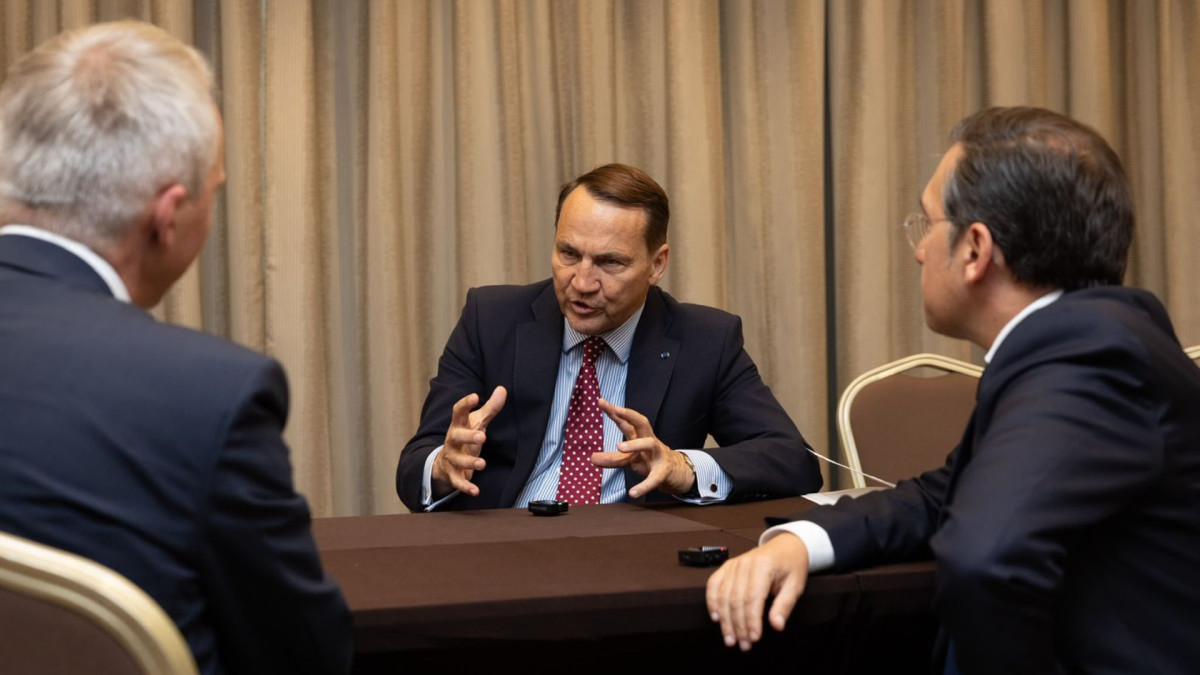
Sikorski and Albares discuss the European external border. Photo: Andrzej Wiktor / MSZ
Minister Sikorski, a question about European foreign policy and international law. There seem to be evident contradictions in how European governments tackle different crises, whether in Iran, in the Middle East in general, or, previously, in South America. What is Poland prepared to do to contribute to a more unified European position on international law, especially in those difficult cases where countries disagree on how to apply it?
R. S.: For that we have the Foreign Affairs Council. That is where we debate and bring our positions closer. But regarding the Middle East, as you know, Poland has recognized the independence of Palestine. We have a Palestinian ambassador here in Warsaw, fully accredited to the head of state. We also consider that the Israel-EU Association Agreement applies to Israel’s internationally recognized borders, and not to the occupied territories. I think our positions are quite close on this matter.
J. M. A.: For Spain it is very important to maintain a coherent foreign policy, defending the same principles both in Ukraine and in the Middle East or anywhere else in the world. That means defending international law, protecting civilians, and ensuring that war is not used as an instrument of foreign policy to resolve disputes between States.
“For Spain, it is very important to maintain a coherent foreign policy, defending the same principles in Ukraine as in the Middle East or anywhere else in the world”
That was the meaning of our recognition of the State of Palestine and of our ban on trade with settlements in Palestinian territory. They are the same principles we defend in the face of Russia’s aggression against Ukraine.
It is very important that Europe be credible to what we today call the Global South, so that no one can accuse us of applying a double standard. After all, all those principles — the UN Charter, international law, and the idea that war can no longer be a tool of foreign policy — were born in Europe and we must defend them.
One last question for both. Migration policy seems to be the arena where principles are put to the test in practice. What are Poland’s and Spain’s main priorities in European migration policy? Do you find it easy to reach agreement on new initiatives, such as return centers or the expulsion of those who cross borders irregularly?
R. S.: Let me add first something to the previous question. As a nation that spent 123 years without its own state, we obviously also defend Israel’s right to exist within secure and internationally recognized borders.
Regarding migration, we have recorded 25,000 attempts to irregularly cross the border from Belarus into Poland [According to the Polish Border Guard, there were more than 25,000 attempts between January and mid-September 2025, compared with about 472 during the same period of 2026].
We have invested more than 1 billion euros in building a large, high-tech, magnificent barrier, and we have enacted laws that make it harder for irregular migrants to file fraudulent asylum requests. And we will not apologize for it.
The countries, individually or collectively, have the right to control who enters their territory and who does not. If we did not believe in that principle, visas, passports, consulates, and border posts would not be necessary.
“The countries, individually or collectively, have the right to control who enters their territory and who does not”
At the same time, we all have migration policies. We have family reunification policies, we decide what kind of migrants we want to welcome and how to ensure they integrate into our society, contribute to the economy, and, over time, become loyal citizens of the country. All of these are issues on which it is legitimate to debate.
J. M. A.: As Minister Sikorski has noted, we also firmly defend the two-state solution and the existence of the State of Israel living in peace and harmony with a State of Palestine.
Regarding migration, we are a country of first entry. We have a land border with Africa, so we know this phenomenon very well. Moreover, we have some of the best results across the Mediterranean in reducing irregular entries, the best compared with other countries [According to the Interior Ministry, irregular entries in Spain fell by 42.6% in 2025, to 36,775].
We achieve this by acting in three areas. The first is high-level political dialogue with countries of origin and transit. The second is development cooperation, which we have tripled with West and Sub-Saharan African countries so that, for their young people, emigrating is an option and not an obligation. The third is maximum firmness against the mafias that traffic in human beings.
We have to tell European citizens the truth. We need immigrants. We need legal immigration to sustain the dynamism of our economy and continue growing as we are doing.
“We need legal immigration to sustain the dynamism of our economy and continue growing as we are doing”
There are people who, out of despair, resort to irregular channels and must return to their countries. But there are also people who need our protection. We must respect the human rights of all of them, and the right to asylum is one of the EU’s fundamental pillars.
Otherwise, we will be pushing voters toward far-right parties. Those parties, and those who want to divide and weaken the European project, know that today nothing divides Europe as much as migration and that no other issue fuels far-right votes as much.
R. S.: I think that is a very good conclusion.
Thank you very much.
This interview was recorded and transcribed on September 13, 2026. It is a joint production of Agenda Pública and Visegrad Insight, conducted in Warsaw by Wojciech Przybylski, director of Visegrad Insight, and Marc López Plana, editor and director of Agenda Pública, present remotely from Madrid.
