
This article, the third in the series, offers a geostrategic snapshot of cyberspace at the 29th Ibero-American Summit, held in Cuenca (Ecuador) on November 14 and 15, 2024 under the motto “Innovation, Inclusion and Sustainability,” and an initial assessment of the impact of the XXX, held in Madrid under the motto “Ibero-America. Together we build our Community. Together we project it toward the future and toward the world.”
The Ecuadorian case reflects the tensions among the countries on the continent, allows observing the behavior of actors on social networks, and shows the weight of language as the delimiter of large transnational cybercommunities connected to local phenomena. The concern about cyberspace as a realm of informational strategies with territorial impact turns these summits into spaces of risk, increasingly linked to the conflicts inherent in the Ibero-American sphere.
The Ibero-American Summit in Ecuador as a Cyber Conflict
On April 5, 2024, a serious diplomatic incident complicated Ecuador’s relations with several Ibero-American countries. That day, Ecuadorian security forces irregularly entered the Mexican embassy in Quito to seize former vice president Jorge Glas, who had sought asylum there after having been part of Rafael Correa’s government (2007-2017). In October, the United States Department of State barred the entry of Correa and Glas, barely a month before the summit.
The summit concluded in an unprecedented manner, with limited agreements and a sharp confrontation between representatives of Argentina under Javier Milei and Cuban delegates, underscoring the ideological fragmentation of the Ibero-American space. On social networks, especially on X, media, political leaders, activists, governments and institutions configured a highly polarized environment in which local and international actors blended.
“On social networks, especially on X, media, political leaders, activists, governments and institutions configured a highly polarized environment in which local and international actors blended”
The analysis rests on a corpus of 3,761 Spanish tweets captured between November 6 and 20, 2024, which accumulate 48,648 retweets from 2,009 accounts, with a ratio of 12.9 retweets per tweet, higher than that of comparable corpora, confirming the high political charge of the debate. The geographic distribution reflects the transnational nature of the event, with Ecuador as the dominant origin (36.6% of the tweets), followed by Cuba (4.9%), Spain (4.3%), and Venezuela (3.9%), and a significant presence of the United States, El Salvador and Argentina.
A low-profile media event thus sparked a plural debate in which Ecuadorian media spanning opposing spectrums coexisted with the Cuban communications apparatus, Spanish institutional coverage and the Correaist ecosystem led by @MashiRafael, with four million followers.
Ecuador facing multiple challenges. Ecuador is going through a period of deep political instability, corruption, security crisis and expansion of drug trafficking. Since Lenín Moreno (2017-2021) broke with the correísmo, the collapse of oil and the use of the territory as a drug trafficking route to the United States and Europe led to a serious security crisis, with mobilizations, political violence and terrorist activities since late 2022.
The government of Guillermo Lasso (2021-2023) failed to reverse the trend and called early elections in which, despite the correísta Luisa González taking a ten-point lead in the first round, Daniel Noboa prevailed with an anti-establishment platform backed by frustration with corruption. The arrest of Glas in April 2024, days before the security referendum promoted by Noboa, strained Ecuador’s domestic politics and its foreign relations.
The summit was held late that year in Cuenca, a heritage city in the interior away from drug-trafficking routes, which was not enough to prevent the mobilizations of the “Counter Summit” nor the political tension. In the 2025 elections, Noboa and González nearly reached 44% in the first round and the president won clearly in the second.
The polarization of cyberspace, a vector of regional tension. The days leading up were marked by numerous absences of heads of state, criticized by progressive media such as Radio Pichincha and by correísta figures like Correa or Guillaume Long. Also notable was the interest of the Cuban official accounts and their media environment, focused on following their representatives, and that of Spanish left-wing academics and activists, who questioned the scope of the gathering.
In parallel, the environment around Ecuador’s institutional accounts, the summit and the Royal Household drew toward sections critical of Pedro Sánchez positioned on the right, while a set of media limited itself to informational coverage, consumed mainly by conservative audiences.
Hover over the map to zoom. Figure 1. Debate and information flows on X about the 2024 Ibero-American Summit in the Spanish cyberspace. Kartex elaboration (DECIGODI Project).
Interactions peaked in the closing phase, when the contrasts between Argentina’s Milei and Cuba’s Miguel Díaz-Canel surfaced over the drafting of the Cuenca Declaration. The episode reactivated the digital environment of the main leftist communities in Latin America, such as correísmo, chavismo and castrismo, which intensified their activity and polarized the debate with large echo chambers and a mobilizing role within the regional progressive spectrum.
The corpus allows identifying six narrative frameworks organized into two macro-clusters. The first, the institutional failure framework, concentrates nearly 70% of the corpus through the record of absences, the Cuba-Argentina clash, and Noboa’s domestic isolation. The second, the ideological and geopolitical positioning cluster groups pro-Cuban solidarity, the positive institutional narrative, and, notably, the structural decline of Ibero-America relative to the BRICS.
The most viral tweet, from @UHN_Plus, with 2,404 retweets on November 15, shows how the blockage of the final declaration reproduced the fracture between left and right in the hemisphere, while the Cuban communications apparatus, headed by @CubaMINREX, synchronized the hashtag #TumbaElBloqueo in a state digital diplomacy operation, coordinated and legitimate.
Among the most significant phenomena is the influence of Spanish far-left intellectuals such as sociologist Aníbal Garzón, author of BRICS. The Transition to an Alternative Global Order (2024), whose anti-Western and pro-Russian discourse aligns with BRICS’ multipolarity and the decolonial theory. Two of his publications, with about 1,800 retweets and 50,000 views, were widely disseminated among Ecuadorian and Cuban leftist communities and spilled over to other currents of the Ibero-American left.
His message criticized absences and questioned Spain’s capacity to influence compared with the BRICS summit held in Russia. Although the context was conducive to Russian intervention, no signs of activity in that direction were identified, suggesting a strategic disinterest from Moscow regarding Cuenca.
It is worth qualifying that conclusion, because the absence of activation does not imply absence of vulnerability. The discursive preconditions were and remain in place. There are militant communities with high self-organization capacity, legitimized ideological mediators who articulate anti-Western frames for relevant audiences, and a proven transnational amplification infrastructure in other settings. Cuenca shows that the low priority given by a foreign state actor to a specific event coexists with the immediate availability of the vectors needed to activate it. This distinction between episodic activation and structural vulnerability is the key to reading Madrid.
What Was Not Seen in Cuenca
The leakage of internal documents from “the Company,” the Russian influence network inherited from the Prigozhin structure analyzed in the previous article of this series, obliges us to reread that conclusion. During the same weeks that Cuenca showed no detectable Russian activity, the network was working in two countries of the Ibero-American community.
In Bolivia it had planned focus groups in seven cities between October 28 and November 9, 2024, and on November 5 it received from the president Arce’s circle the task to “level the political influence of Evo Morales” from the information space; in Argentina it had posted in October posters against Milei in five districts of Buenos Aires and planned the following quarter, according to Kartex’s documents.
“Cuenca evidences that the low priority a foreign state actor assigns to a concrete event coexists with the immediate availability of the vectors necessary to activate it”
The absence of activation in Cuenca was not lack of regional interest, but a scale choice. In 2024 Moscow prioritized national political processes over multilateral forums, to advise a government in Bolivia, wear down another in Argentina and lend legitimacy to a third in Venezuela. And the frameworks that the Company worked on those processes, such as the clash between Milei and the Latin American left, the legitimacy of chavismo, or the regional fragmentation that the network framed as a “pan-Latin disintegration” attributed to the Argentinian president, coincide with those that emerged spontaneously in Cuenca. The vectors were available and another actor was already exploiting them in the same region.
Institutional and Social Responses to Regional Disinformation
Spanish functions as a transnational communication space, not a mere sum of states, and thus the narratives and campaigns easily spill across both shores of the Atlantic. The battle for cognitive dominance in that space is today fought among ideologies that mix (anti-colonialisms, ultraliberalisms, populisms of various stripes) and state and non-state actors with coordinated manipulation strategies.
“Spanish functions as a transnational communication space, not a sum of states, and therefore the narratives and campaigns spill easily between both sides of the Atlantic”
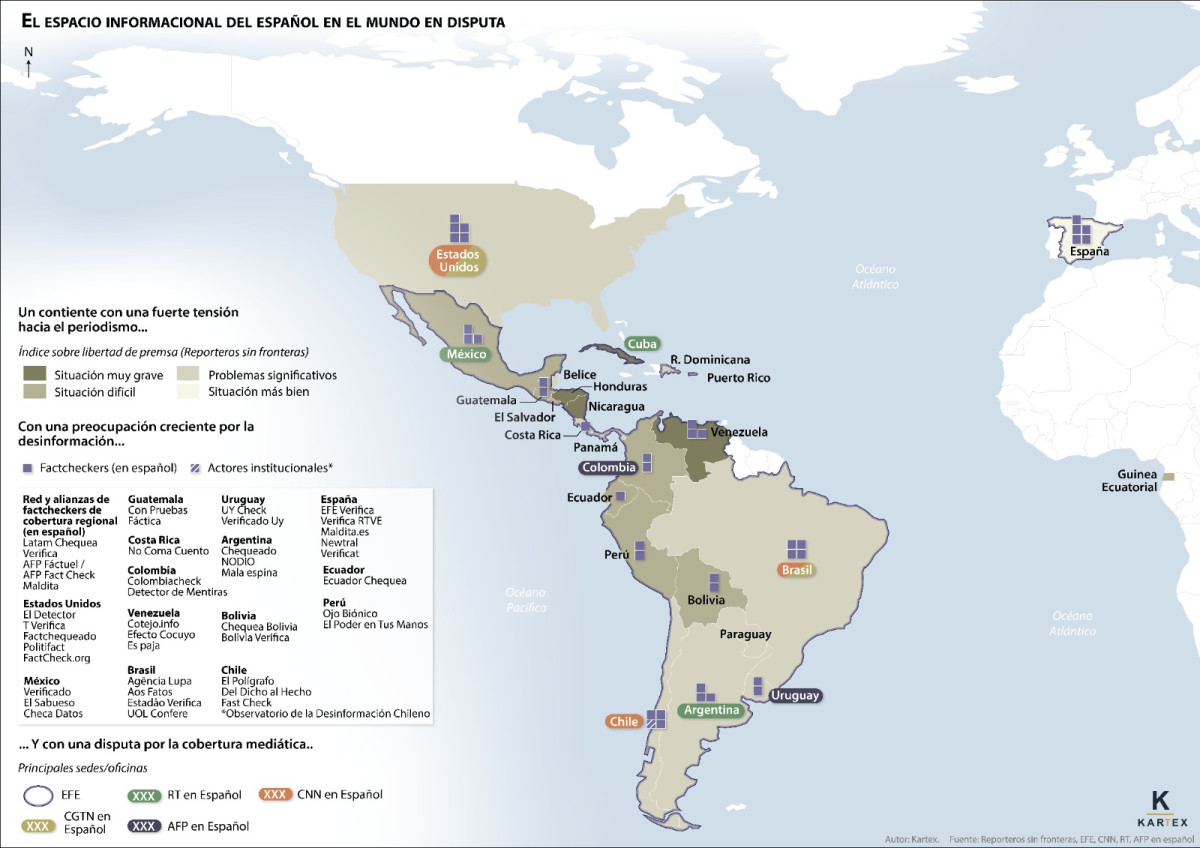
The map The Spanish informational space in the world under dispute (Figure 2) represents the distribution of media and actors dedicated to verification in Spanish-speaking countries and the state of press freedom. According to the Reporters Without Borders index, Venezuela, Cuba or Nicaragua are in a very grave situation, and Mexico or Colombia face significant problems, while Uruguay, Chile or Costa Rica offer more favorable conditions.
The map also captures numerous local verification projects, such as Chequeado in Argentina, Animal Político in Mexico or Maldita.es in Spain, whose strength and independence depend on the political context of each country, and the competition among major Spanish-language international media, such as EFE, RT, CGTN, CNN and AFP, in a contest for the information space where political, economic and strategic interests converge.
Pase over the map to zoom. Figure 2. The Spanish informational space in the world in dispute. Kartex elaboration.
In regulatory terms, the European Union sets the standard with the Digital Services Act (DSA), which obliges large platforms to assess systemic risks, including coordinated disinformation campaigns, and to mitigate them with transparency, data access for research and independent audits, with the Code of Practice against Disinformation integrated as a regulatory instrument for electoral periods.
The European External Action Service further consolidated the FIMI approach (information manipulation and foreign interference), shifting the focus from true/false to manipulative behavior and its attribution; its fourth report, published in 2026, analyzes 540 incidents recorded in 2025, of which 29% are associated with Russia and 27% involved artificial intelligence. UNESCO’s guidelines for platform governance add a counterweight, with diligence rights and human rights regulations to avoid overly restrictive responses.
Spain has articulated its national procedure through the Orden PCM/1030/2020, which defines activation levels and coordination circuits between the National Security Council, the Situation Committee, the State Secretariat for Communication and the Permanent Commission against Disinformation, connected with the European Union’s Rapid Alert System, and strengthened in 2025 with the assignment of a National Strategy against Disinformation Campaigns.
The Forum against Disinformation Campaigns of the National Security Department has institutionalized public-private collaboration; the IBERIFIER node, linked to the European Observatory of Digital Media, combines verification, research and media literacy; and the National Institute of Cybersecurity has supported with European funds strategic projects like DECIGODI (UC3M), which address disinformation from a multidisciplinary perspective.
In Latin America, there are asymmetrical advances and centers of innovation. Brazil is the reference, with a permanent program of information integrity in its Superior Electoral Court since 2019, the prohibition of deepfakes in electoral propaganda and the obligation to label content generated with artificial intelligence. Mexico has the CERTEZA program of the National Electoral Institute, with verified corrections, social listening and alliances with universities and platforms, and Costa Rica has produced from its Supreme Electoral Court a comparative guide that functions as a regional standard.
The social ecosystem has matured networks such as LatamChequea, led by Chequeado, which integrates 48 organizations in 21 countries and enables coordinated operations in critical moments; in Spain, Maldita.es, Newtral, EFE Verifica and Verificat are signatories of the principles code of the International Data Verification Network. Civil initiatives such as Monitor Disinfo, among others, are good examples of anti-disinformation projects and demonstrate the growing awareness.
Still, three critical gaps remain open. A linguistic gap, because moderation, integrity systems and search perform worse in Spanish than in English, amplifying spillover between countries and weakening traceability outside the European Union. Asymmetries in infrastructure and governance between states that limit coordinated responses.
And the expansion of para-state media in Spanish in non-EU markets, whose clearest case is Telecanal in Chile, with RT broadcasting since 2025 and a development, with sanctions in 2026 and the revocation of concessions, showing that a national regulator can act applying concession rules rather than content criteria. From comparative evidence, patterns of effectiveness emerge.
Coordination through inter-institutional collaboration with a single-entry point and clear escalation protocols works; public-private coalitions with accredited fact-checkers and the academic sector; verifiable obligations for platforms and sustained prebunking and media literacy adapted to echo chambers and diasporas. The Company’s leak adds a lesson. In the face of the most well-documented covert operation in the region, the responses that worked were national.
In Argentina, the documents themselves note that the recreation of the SIDE “substantially limits” the network activists, and the Government announced its detection in June 2025; in Chile, the regulator acted. None relied on an Iberomo erican alert-sharing mechanism.
The Madrid Summit on Social Media. A First Assessment
The XXX Summit arrived in a context very different from Cuenca. The second presidency of Donald Trump, with his anti-immigrant rhetoric and his “anti-communist fight” discourse, culminated in the operation that captured Nicolás Maduro in Caracas on January 3, 2026; the 2025-2026 electoral cycle, from Noboa to Rodrigo Paz, José Antonio Kast, Nasry Asfura, Laura Fernández, Keiko Fujimori, Abelardo de la Espriella and Lula’s reelection, redrew the regional political map; RT lost its frequency in Chile and gained one in Nicaragua; and the summit coincided with the Spanish pre-campaign for the November 29 elections.
Milei attended after a harsh clash with Sánchez and without recognizing Lula’s reelection, who did not travel, as did Claudia Sheinbaum or Delcy Rodríguez. Ten of the 22 countries were represented at the highest level and Volodymyr Zelensky arrived unexpectedly in Madrid, where Sánchez affirmed unanimous support for Ukraine. Unlike Cuenca, a consensual declaration was approved, although Argentina, Paraguay, Colombia and Costa Rica dissented from the section rejecting coercive measures, and Honduras held the Pro Tempore Secretariat.
All this raised fears of a battlefield of information. Kartex monitoring allows a first assessment based on 2,037 posts collected between October 26 and November 6 on five platforms (Facebook, X, Instagram, Telegram and TikTok) and a specific base of 33 posts from 17 Russian and pro-Russian channels on Telegram. The X capture only covers from November 2 and the inquiry is not identical to Cuenca’s, so volume comparisons are indicative; the structure is solid.
A lot of reach, little conversation. The first result is the gap between potential reach and actual interaction. The accounts that posted about the summit yield 529 million impressions in the period, 351 on Facebook, 100 on X and 78 on Instagram, with a maximum of 254 million on November 5 (Figure 3). The figure measures the audience reached by the publisher, not the attention obtained, and should be read with two cautions.
Large Latin American media pages inflate it on Facebook and Instagram, and half of X impressions come from six responses by @grok, the network’s AI assistant, which several users asked to verify claims about the summit, signaling the incorporation of these assistants into the political conversation. Actual attention was much lower.
Compared with Cuenca’s 3,761 tweets and 48,648 retweets, Madrid captured 1,974 tweets and retweets from 1,748 accounts, with 3.5 retweets per original tweet versus 12.9 in 2024. 60% of posts concentrated on two days, November 3, with the king’s audiences, and the 5th, with the plenary; the opening on the 4th, with Zelenski’s arrival, generated less volume than the prior day on all platforms except Telegram. 40% of Facebook posts received no reaction, a single TikTok video accounts for half of the corpus’s 588,000 views, and the ten most retweeted tweets concentrate 55% of the retweets.
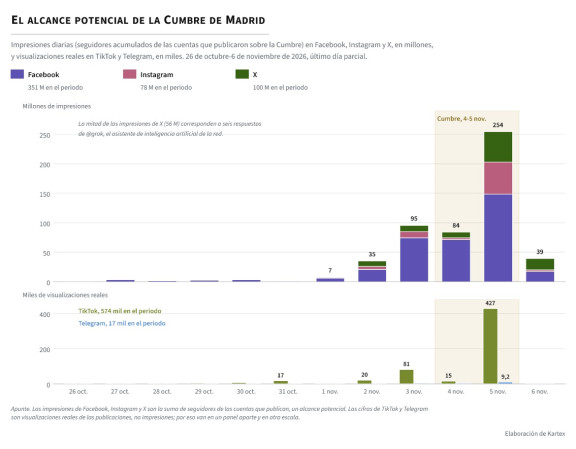
Figure 3. Daily potential reach of posts about the Madrid summit on Facebook, Instagram and X.
“The figure measures the audience reached by the publisher, not the attention obtained”
A fragmented conversation. The second result is the structure. The X graph has a modularity of 0.82 and decomposes into about two dozen star-shaped communities that barely touch. Each revolves around a single axis: an Ecuadorian journalist, the Cuban Foreign Ministry, the Venezuelan opposition, Milei, the Royal Household, Kast’s circle, or Mexico’s Foreign Affairs Secretariat. Ten accounts receive 65% of mentions and retweets.
Unlike Cuenca, there is no macro-cluster of institutional failure organizing the debate; the left-right fracture does not structure the network, which organizes itself by country; and transnational ideological mediators that connected communities in 2024 do not appear among the influential nodes. RT, Sputnik, or pro-Russia channels do not appear among the influential nodes.
The frameworks that worked were not those of the summit. The most retweeted tweet in the corpus, from an Ecuadorian journalist, celebrates the eviction of the pro-Palestinian camp from Puerta del Sol with a “all set for the Summit” and attacks Sánchez; the second is the videoconference between Alberto Núñez Feijóo and María Corina Machado “while the Summit gathers the region’s governments in Madrid.”
The TikTok, Instagram and Telegram episode with the most interaction was the cool greeting between Milei and Sánchez in the plenary, which each community read in its own way, as libertarian triumph, as rudeness, or as evidence of the forum’s irrelevance. The only transnational narrative was the Cuba blockade. Foreign Minister Bruno Rodríguez’s phrase about the “obsessive war of economic strangulation” was synchronously echoed by Cuban digital diplomacy on X, Facebook and Telegram, and picked up by teleSUR, Mexico and Sputnik, in a smaller-scale repetition of the #TumbaElBloqueo pattern.
Outside Spain, the summit was read domestically. Bolivia, Honduras, Peru and Argentina contributed more Facebook posts locally than Spain; the speech by Rodrigo Paz drew 711 mocking reactions on his own page, Honduras celebrated taking Pro Tempore Secretariat, Paraguay linked the summit to Santiago Peña’s decision not to attend, and Venezuela with Machado and Edmundo González’s electoral roadmap and Delcy Rodríguez’s absence. The official agenda, from the Iberian-American Artificial Intelligence Alliance to the care charter, circulated through institutional accounts with little interaction. And Zelenski’s visit, the summit’s news for European press, barely appeared in Latin American networks.
Russia, attentive but with no operation. That there was no campaign does not mean there was no discourse. The Russian and pro-Russian channels in Spanish were, in fact, the only ones on Telegram to discuss the summit with a thesis of their own during these months, and that thesis was its limited impact. The specific base gathers 33 posts from 17 channels between September 19 and November 6, to which are added posts from allied channels appearing in the general base; together, a constellation of about thirty channels with around 570,000 cumulative subscribers and about 7,000 views of their posts about the summit (Figure 4). They did three things.
First, they cover and syndicate. Sputnik Mundo published ten pieces between November 4 and 6, with 2,825 views, outlining their editorial line: an analysis on why “Latin American presidents attend fewer and fewer regional summits,” the Cuban denunciation of the blockade, Paz’s intervention about Potosí’s silver, the Mexican foreign minister on conquest and the Milei-Sánchez clash, concluded by a political scientist who notes that the episode “tamps the importance of participation in a Summit.”
The Cuban denunciation appeared with identical wording, in less than four hours, in Sputnik and in three pro-Russian current affairs channels with more than 75,000 subscribers each: Irina, Guerras y Geopolíticas, and El Ojo, a syndication chain showing how a Sputnik piece reaches militant audiences without any order.
The second was to mass-distribute the irrelevant narrative. The channel Ucraniando published on November 4 “The Autopsy of a Diplomatic Illusion,” which presents Lula’s and Sheinbaum’s absences as “a cold and sovereign geopolitical decision” against a Spain that “only thinks about saving Ukraine from the Russian ogre,” reduces Sánchez to a host “exposed” and Milei to the enfant terrible needing European press, and concludes that the Iberian-American concept “as a tool of Spanish influence is dead” and that “Europe keeps talking alone.”
That same night, the piece traveled within the Diario de bitácora, the shared bulletin signed by Russian Disinformator and published simultaneously by nine channels: Geopolítica Actual, Rokot | Tormenta, Líneas Invisibles, En Plena Luz, Nuevos Paradigmas, Herrien Arteko Adiskidetasuna, the Basque committee Euskal Herria-Donbass, and Ukraine itself. They are old acquaintances of pro-Russian propaganda in Spanish in Spain since 2022, with audiences ranging from 2,000 to 37,000 subscribers, that function as a single distributed editorial. It is, in other words, the framework of the decline of Ibero-America that Cuenca spread by the Spanish far left, now without mediators with an X audience but with an infrastructure of their own on Telegram.
On the other hand, none of those channels mentioned Zelenski’s visit or support for Ukraine that Sánchez claimed —the only issue in which the summit was adversarial to Moscow—; only one allied channel, Geopolítica Sin Censura, covered it in an informational tone. The embassies and the Russian Foreign Ministry, for their part, restricted themselves to cultural diplomacy, with the Russian language congress at UNAM, a conference on Iberian-American art with Guatemala and the 240th anniversary of Miranda’s journey to Russia, without a word about the summit. Silence is also a publishing decision, and the combination of the three behaviors —amplifying what erodes, distributing the irrelevance in block, and omitting what is uncomfortable— is the form that Russian influence takes when there is no operation.
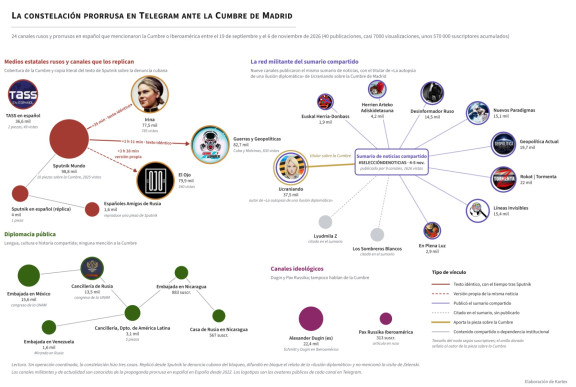
Figure 4. The pro-Russian constellation in Telegram that posted about the Madrid summit.
“Silence is also a publishing decision, and the combination of the three behaviors —amplifying what erodes, distributing the irrelevance in block, and omitting what is uncomfortable— is the form that Russian influence takes when there is no operation”
Silence as data. The summit has barely received coverage or conversation, even in Spain. Spanish pages contribute 13% of Facebook posts, less than the Bolivian and Honduran posts combined; the institutional community (Royal Household, Moncloa, SEGIB) accounts for 7% of the X graph and the balance of the summit published by La Moncloa did not reach a hundred interactions on Facebook; the official agenda circulated without echo and the Spanish press read the summit almost exclusively through the Milei lens.
Two explanations, which are not mutually exclusive, seem plausible. The first is political will. The government organized a summit with a deliberately low profile, three weeks before general elections, with a declaration that Sánchez himself called a “common minimal denominator,” without the Cuba block in the text to facilitate agreement, without a photo with Delcy Rodríguez and without disinformation among its priorities, and downplayed absences without evaluating their reasons.
An host in pre-campaign had more to lose than to gain in a forum where any clash, with Milei or with the Bolivarian bloc, would have immediately translated into domestic polarization, and thus it avoided it. The second explanation is the loss of impact of the format itself, which is precisely what underpins the Russian narrative of “Europe speaks alone.” The data give some support to this claim.
Absences recur from Cuenca to Madrid, conversation is organized by country and not around a community, and the countries that spoke the most about the summit did so in domestic terms. Yet the Cuenca channel’s conclusion, that the Iberian-American concept “is dead,” does not hold up in the same data. There was a consensual declaration, there were agreements and the event made headlines in Bolivia, Honduras or Paraguay; what there was not was a Spanish narrative that rendered it visible.
Silence was therefore, above all, a host’s choice, useful for arriving at the elections without open conflict. It has, however, an informational cost. A forum that its organizer does not publicize leaves the field open to those who declare it dead, and in the Spanish-speaking space the narrative of Spain’s irrelevance takes hold more easily the less it is contested.
Final Reflection
The three articles in this series describe the same space from three layers. The first is material. The Spanish cyberspace, with more than 600 million potential users, rests on cables, data centers and platforms decided outside the region, and even the covert interference of the Company circulates through American platforms. The second is the actors layer.
Russia combines a visible layer, RT and Sputnik, retreating on X but with a television presence that closes in Chile and opens in Nicaragua, and a covert, cheap and modular layer, organized by languages, that operates within governments or against them and transposes its narratives from the Sahel to the Andes. The third is the communities layer. The Cuenca and Madrid graphs show that these narratives do not need to be imported, because the Spanish-speaking ecosystem produces them in country-organized echo chambers that a mediator with an audience can connect at any moment.
“A forum that is not spoken of by its organizer leaves room for those who declare it dead, and in the Spanish space the narrative of Spain’s irrelevance takes hold more easily the less it is debated”
The two summits teach different things about the same vulnerability. Cuenca showed that a single argument, the comparison between the three summit representatives and the more than twenty heads of state gathered by the BRICS, was enough to plant a geopolitically meaningful question about Spain’s place, with no artificial coordination or bots, only with an ecosystem predisposed to receive it. Madrid has shown the opposite and the same.
Without open conflict, without mediators and with a host determined not to make noise, the conversation narrowed and fragmented, and yet the irrelevance narrative circulated normally. It was produced by legitimate local actors and picked up, effortlessly, the pro-Russian constellation in Telegram, which was the only one to discuss the summit with a self-contained thesis, that of its little impact, and did so with an already-known infrastructure, syndicated Sputnik to current affairs channels and a bulletin shared by a dozen militant channels that have years of pro-Russian propaganda experience in Spain.
The saturation logic described in the second article, to install frames that later produce and amplify others, also operates in silence, and the host’s silence makes it easy. And hundreds of millions of impressions against minimal interaction remind us that attention is won today on visual platforms and messaging, where the public capacity to detect is lower and where AI assistants begin to act as arbiters of what is true.
The absence of coordinated operation is therefore not absence of risk, but the acknowledgment that preconditions are installed and immediately operable. The Latin American fracture now couples with a transatlantic fracture that puts Spain and the United States on opposing sides, the frameworks circulate in both Spanish and English, diasporas function as connecting vessels, and the Company confirms that amplification is supported by willing actors and allocated budgets.
Classical metrics for detecting coordination prove insufficient, because what was seen in Madrid is not coordination, but a distributed drafting that does not need it. Defending the Iberian-American space is not about reacting to evident campaigns, but about anticipating convergences between opposing communities that coincide in questioning the forum’s legitimacy, and in something prior, which is to tell the forum’s story. A community that does not speak about itself allows others to describe it, and in Madrid those who described it were, above all, those who deem it dead.
“Classical metrics for detecting coordination prove insufficient, because what was seen in Madrid is not coordination, but a distributed drafting that does not need it”
The Madrid summit has been, therefore, much more than a diplomatic event. It has been a maturity test for the cognitive sovereignty of the Iberian-American space and for Spain’s ability to lead cyberspace protection in Spanish, starting with infrastructures and platforms, continuing with the surveillance of the visible and covert layers of interference, and ending with the communities that give meaning to what circulates.
Defending that space is defending the language as a geopolitical asset, the Spanish-speaking democracies as a shared ecosystem, and informational quality as the best guarantee of the Spanish language’s global appeal. Cuenca gave us the map of vulnerabilities; Madrid has shown that they remain open and that institutional response, from the Digital Alliance to an Iberian-American alerting channel, remains to be built. Anticipating is not an option but the condition of possibility for Spanish to continue being, in cyberspace in the 21st century, a language of excellence, reliability and freedom.
