
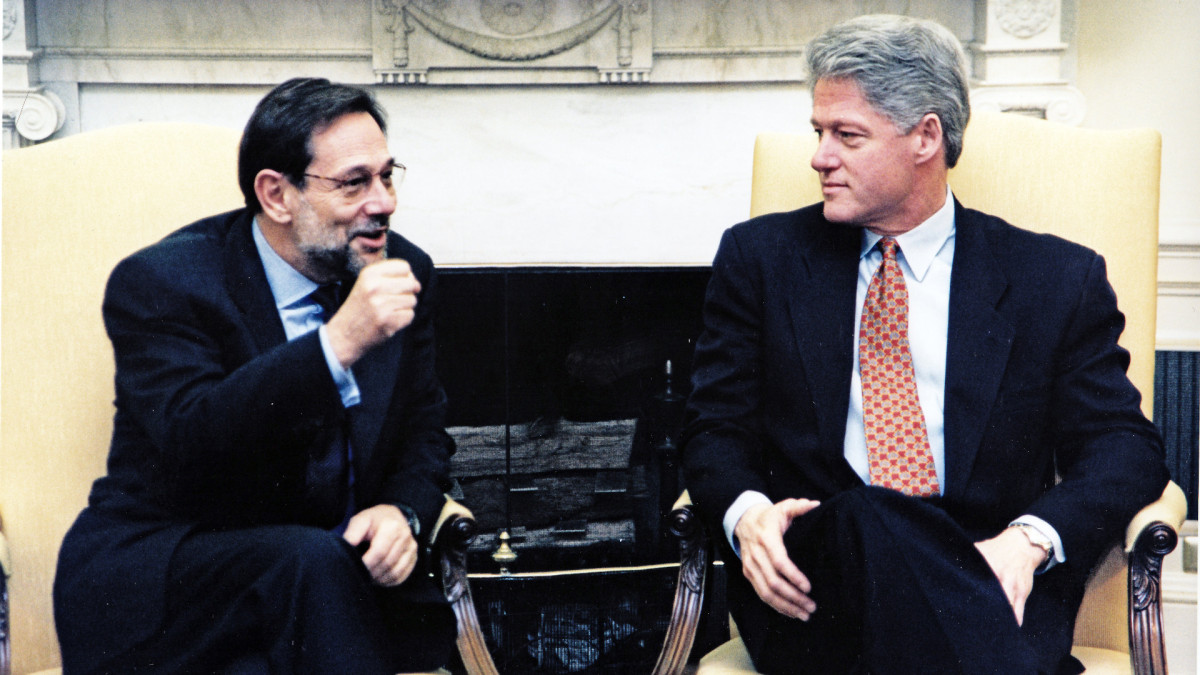
On October 22, 1996, two weeks before the United States presidential election, Bill Clinton traveled to Detroit to deliver a speech in which he announced that the first Central and Eastern European countries invited to join NATO should become full members by 1999. He did so to coincide with NATO’s fiftieth anniversary.
The choice of Detroit carried a particular significance. Michigan, like Wisconsin, Pennsylvania and Illinois, housed significant communities of Americans of Polish origin and of other Central and Eastern European countries. Many maintained family and cultural ties with the societies that had just shaken off Soviet domination. Poland’s accession to the Atlantic Alliance was a security matter, but also an aspiration tied to its identity.
“The incorporation of Poland into the North Atlantic Alliance was a security issue, but also an aspiration tied to its identity”
Clinton understood the importance of these voters. So too did his Republican opponent, Bob Dole, who advocated accelerating NATO enlargement and criticized the president for the slow pace of the process. Both vied for the support of communities that could prove decisive in several states. After delivering his speech, Clinton visited the Polish Village Cafe, a Detroit restaurant of the Polish-American community. In March 1999, Poland, Hungary, and the Czech Republic joined NATO. To what extent was one of the most important geopolitical decisions of the late twentieth century conditioned by the need to win American elections?
Ian Shapiro has little doubt about the importance of the electoral factor. “Clinton wanted to win Michigan, Wisconsin and Pennsylvania”, he tells me during a dinner in New Haven, near Yale University, where he teaches Political Science. He is the author of After the Fall: From the End of History to the Crisis of Democracy, How Politicians Broke Our World, a book in which he examines the decisions that shaped the post–Cold War international order.
In the first installment of our conversation, published in Agenda Pública, we discussed Pedro Sánchez’s snap election, the missteps of social democracy, and the political opportunities that leaders do not always know how to seize. NATO’s enlargement is another historical episode that Shapiro analyzes from this perspective.
Foreign policy also serves to win votes
In October 1996, Radio Free Europe/Radio Liberty published a chronicle on the electoral weight of American communities from Central and Eastern Europe. Its members were concentrated especially in a swath of states stretching from the Northeast to the Midwest. In a system in which presidential victory hinges on results in each state, their influence could be considerable, especially where the Democrat and Republican contests were tight.
For Clinton, NATO enlargement allowed him to present himself as a guarantor of the independence and security of the countries that had belonged to the Soviet bloc. It was not a campaign improvisation: his administration had begun to formalize it in 1994, after several years of debates about the Alliance’s future. However, the proximity of the elections provided an extra incentive to firm up the commitments and make them visible to particular voting groups.
“The proximity of the elections provided an extra incentive to lock in the commitments and make them visible to specific voting blocs”
The president argued in Detroit that NATO could help stabilize Central and Eastern Europe in the same way it had helped secure Western Europe after 1945. His approach had strategic logic, but the location chosen to announce the enlargement timetable also reflected electoral considerations.
A study by the Carnegie Endowment for International Peace, published in 2024, documents the pressure exerted by Central European-origin American organizations in favor of enlargement and the importance the Clinton administration attached to their support in battleground Midwestern states. The report notes that the White House leveraged the reelection campaign to announce progress in a policy that was already under way.
Richard N. Haass, an American diplomat who would later head the Council on Foreign Relations, also identified in 1997 the pressure from these communities among the factors that had driven the decision. In his analysis he acknowledged the strategic reasons that could justify enlargement, although he warned of the risks of deteriorating relations with Russia and weakening European security.
Electoral calculations were not the sole cause of enlargement. The decision enjoyed the backing of the Central European governments that sought to join, a large portion of the American political class, and various European allies. But domestic political interests were part of the process. Even major international security decisions can be conditioned by the most immediate electoral needs.
Was NATO enlargement inevitable?
Shapiro goes much further in his critique of the decisions of those years. “I would have shut NATO in 1991 or replaced it with a pan-European security alliance,” he explains to me. He insists that this is not a conclusion reached after knowing the events that followed: there were already other proposals for organizing the continent’s security.
“I would have shut NATO in 1991 or replaced it with a pan-European security alliance”
François Mitterrand and Hans-Dietrich Genscher, among other European leaders, had advocated pan-European cooperation formulas that would allow overcoming the military divisions inherited from the Cold War. In the United States, figures such as George Kennan, Brent Scowcroft, and Senator Sam Nunn also questioned the advisability of enlarging NATO and warned of the consequences it could have for relations with Russia.
Shapiro wonders why there should be a need to maintain and continue growing a military alliance created to contain a Soviet Union that had ceased to exist.
The end of the Cold War offered, in his view, an exceptional opportunity to reform international institutions and establish a different relationship with Moscow. Russia was experiencing a period of weakness, its leaders sought ways of cooperating with the West, and the old ideological divisions seemed to have lost much of their meaning.
Nevertheless, Washington interpreted the Soviet collapse as a confirmation of the superiority of its own model. The United States had emerged as the hegemonic power and chose to extend the institutions that had organized the Western world during the previous decades. “What strategic interest did the United States have in 1999 in admitting Hungary, Poland, and the Czech Republic?” he asks. For him, there was no sufficiently convincing need to justify that decision.
His position is controversial, especially when viewed from the countries that had lived under Soviet influence. For Poland and its neighbors, the disappearance of the Soviet Union did not guarantee that Russia would renounce its territorial ambitions permanently. The Central European historical experience, marked by invasions and occupations, made American protection seem like a guarantee against the possibility that Moscow would reclaim an expansionist foreign policy.
The Russian invasion of Ukraine in 2022 reinforced those fears. From Warsaw, the enlargement of NATO can be interpreted as a decision that allowed Europe to preempt a real threat. Therefore, any critical analysis of that process must take into account the willingness of the governments and the societies that sought to join the Alliance.
Shapiro does not deny that Poland had reasons to seek that protection. He questions whether the American response should necessarily consist of enlarging a military organization. He believes there were other ways to provide security to Central Europe and to build a cooperative relationship with Russia. It is one of the main arguments of After the Fall. Great historical transformations are not entirely determined by economic structures, institutions, or ideologies. There are moments when leaders have an extraordinary margin to choose among different options.
“There are moments when leaders have an extraordinary margin to choose among different alternatives”
In the nineties, the West could have built other security institutions and established a different relationship with Russia. NATO enlargement was the result of decisions that responded to strategic interests, international commitments, diplomatic pressures and also to the electoral incentives of American leaders.
From Clinton to Trump: the European problem
Thirty years after the Detroit speech, Donald Trump has again placed the United States’ commitment to European security at the center of the debate. I ask how he interprets the differences between the two presidents and their respective conceptions of America’s role in the world.
Clinton believed that his country had left the Cold War with the capacity to organize the international system around its institutions and priorities. His foreign policy followed an internationalist vision that attributed to Washington the responsibility to lead the Western bloc. NATO enlargement was part of that project.
Trump, by contrast, views international relations from a much more nationalist and transactional perspective. His readiness to question historic commitments to European allies has cast doubt on some of the foundations on which the post-1989 order was built.
In 1996, a U.S. president defended NATO enlargement as a guarantee of security for Europe and as a tool to consolidate his country’s leadership. Three decades later, another president repeatedly questions the obligations the United States had assumed to protect its allies.
Europeans, meanwhile, depend on decisions taken by leaders they cannot vote for. I pose to Shapiro this democratic contradiction, which I consider especially relevant to understanding the limits of European sovereignty. The security of Poland, Germany or Spain is conditioned by the outcome of U.S. presidential elections in which their citizens have no ability to intervene.
“The security of Poland, Germany or Spain is conditioned by the result of U.S. presidential elections in which their citizens have no ability to intervene”
The Polish-origin voters in Michigan could influence, in 1996, the decision to admit Poland to NATO. Those living in Warsaw, directly affected by that measure, were not participating in the U.S. presidential election.
This dependence does not absolve European governments of responsibility nor diminish the legitimacy of decisions taken in Washington. But it reveals how far the internal priorities of a great power can determine the security conditions of other countries. Even when a presidential election is decided by a narrow margin in a few states, its consequences can extend far beyond the borders of the United States.
The risk of a nationalist Europe
I ask what would happen if the leading European countries ended up governed by nationalist forces. We are talking about a possible victory of France’s far right, the rise of Alternative for Germany, Giorgia Meloni’s government in Italy, and the possibility of a PP–Vox coalition in Spain. His answer is direct: “I think it would massively raise the chances of war in Europe and among Europeans”.
Shapiro fears that some nationalist governments could resort to foreign confrontation if their economic programs fail and they cannot satisfy their voters’ expectations. The recourse to a common enemy, initially used to mobilize voters against immigration or certain internal adversaries, could spill over into relations between states.
“The appeal to a common enemy, used first to mobilize the electorate against immigration or certain internal adversaries, could transfer to relations between states”
The hypothesis is debatable. Not all nationalist governments share the same international positions, nor can we infer from their ideological orientation that they will necessarily provoke armed conflicts. The political scientist does not present this scenario as inevitable either. His warning points to the risks of a policy that treats relations between groups and countries as a competition in which gains of some must come at the expense of others.
The problem would be especially grave in a Europe whose security depends on deals among governments with divergent interests. Treaties and international institutions provide cooperation mechanisms, but their functioning is also conditioned by the coalitions that come to power and by the decisions their leaders make.
Europe could find itself with governments increasingly reluctant to cooperate with one another, precisely when Washington is redefining its international priorities. A combination that would considerably complicate Europe’s ability to respond to external threats.
The elections that changed European security
Clinton’s visit to the Polish Village Cafe helps illuminate the connections between domestic politics and international relations. The American president met with Polish-origin voters after announcing a decision of immense consequence for European security, during the reelection campaign.
Clinton did not go to Detroit solely to win votes. His administration had a strategic vision of Europe, shared by many Western leaders and supported by the Central European governments seeking to join NATO. Enlargement responded to security demands that cannot be reduced to the interests of a presidential campaign.
“The enlargement responded to security demands that cannot be reduced to the interests of a presidential campaign”
But that international strategy was also electorally attractive. The commitment to admit new members to the Alliance was announced to a particularly receptive audience, just two weeks before the elections. Shapiro believes that the end of the Cold War offered opportunities that Western leaders failed to seize. It’s possible to disagree with his proposal to dismantle NATO or with his assessment of the advisability of expanding it, especially in light of what happened later in Ukraine. But his analysis compels us to examine those decisions of the era considering both their strategic underpinnings and the interests of those who propelled them.
On October 22, 1996, Clinton announced in Detroit a commitment that would help transform European security. The Polish-origin Americans who heard that speech could vote in the presidential elections on November 5. The citizens of Poland, who had been demanding NATO membership for years, did not.
Thirty years later, Europe remains largely dependent on Washington’s decisions to guarantee its security. And those decisions can be conditioned by the electoral interests of leaders whom Europeans cannot vote for.
