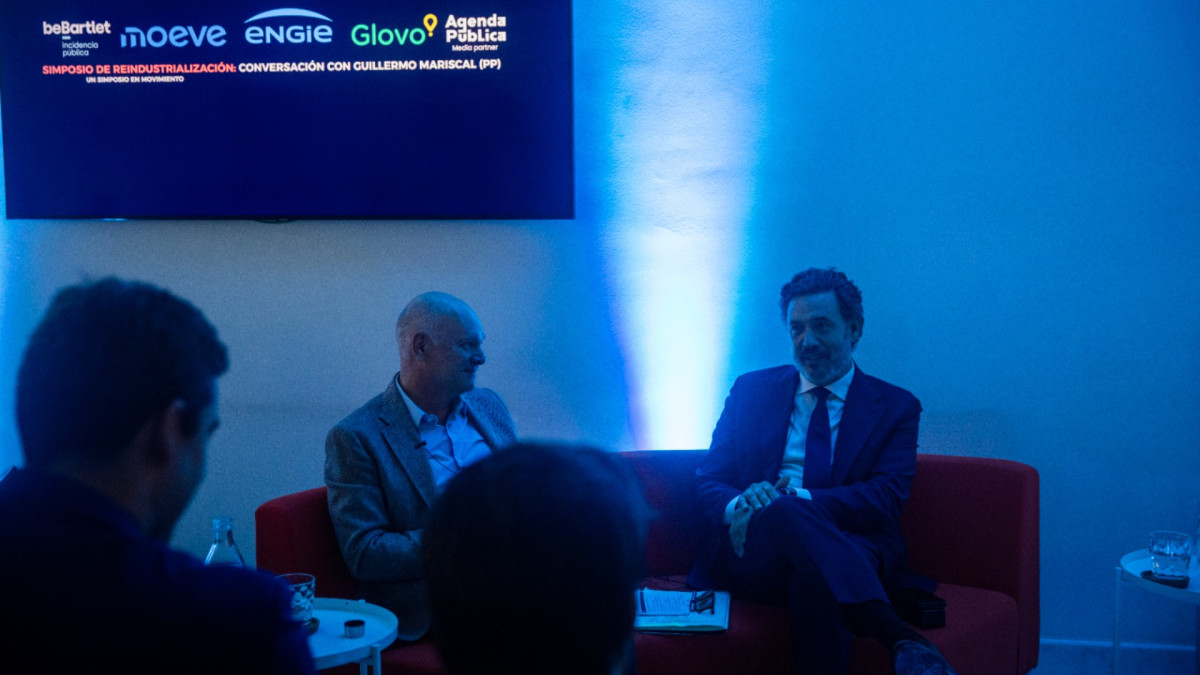
“Nous pénétrons dans un monde plus axé sur le pouvoir que sur les règles”. This reflection, articulated by Juan Llobell, Director of Corporate Affairs at Moeve, described the international landscape that is reshaping the priorities of governments and businesses, in a conversation with Guillermo Mariscal, deputy of the Partido Popular and secretary of the Congress Board, held within the framework of the Reindustrialization Symposium. In this context, energy, trade, and access to strategic resources have acquired an increasingly decisive geopolitical dimension, compelling Europe to rethink its dependencies and the role of its industrial capacity.
Both agreed that Spain possesses exceptional conditions to seize this transformation, thanks to its natural resources, its energy potential, and its technological capabilities. However, they warned that these advantages could be squandered if not accompanied by a favorable regulatory framework, greater agility in decision-making, and political leadership willing to face the economic and social consequences of reindustrialization.
Geopolitics Redefines Energy and Industrial Priorities
The transformation of the international order has broadened the scope of the energy debate, traditionally linked to sustainability and decarbonization. Llobell began the discussion by noting that the difficulties in achieving the Paris Agreement climate objectives are driving a broader reflection on the strategic role of energy, in which issues such as sovereignty, autonomy, and security of supply gain increasing prominence in government and corporate decisions.
From his perspective, energy and natural resources have become instruments of influence and, in certain scenarios, of economic and political coercion. This evolution forces Europe to reassess its vulnerabilities, diversify its trade relationships, and build an ecosystem of reliable partners and allies to safeguard supply chains and sustain its industrial objectives.
“This evolution forces Europe to reassess its vulnerabilities, diversify its trade relationships, and build an ecosystem of reliable partners and allies”
Llobell linked this need with the recommendations of the Draghi and Letta reports, which have helped to place competitiveness and economic integration at the center of the European agenda. Among the identified priorities are the development of large European companies capable of competing internationally and the strengthening of European value chains, especially in strategic sectors where external dependence constitutes a vulnerability.
The growing international uncertainty has also changed how multinationals plan their investments. He explained that geopolitics has ceased to be a secondary issue and has become a central element of corporate strategy, in an environment whose changes occur at speeds scarcely comparable to earlier eras. Energy companies must monitor developments in the United States, China, and the European Union to anticipate risks and evaluate the markets in which they operate or seek to be present.
In this sense, Llobell considered that the transformations in U.S. trade policy have a structural character and that even a potential return of the Democrats to the White House would hardly imply a return to the previous scenario. The competition among major economic blocs will continue to condition investment decisions and Europe’s ability to preserve its productive base.
The Popular Party deputy in the 14th legislature, during his conversation with Moeve’s Director of Corporate Affairs.
Spain’s Resources as an Advantage for Strategic Autonomy
Guillermo Mariscal shared the diagnosis of the growing international unpredictability, though he emphasized the opportunities this scenario opens for Spain. In his view, the country has conditions less common in other periods of industrial transformation, when its economy joined the major technological and productive changes belatedly.
“Now it’s like we’ve hit the lottery,” he declared to illustrate the potential offered by Spain’s energy and natural resources, convinced that the main challenge is to develop the instruments necessary to translate these advantages into economic activity, investment, and employment.
Among the strategic areas he highlighted mining, a sector whose role is insufficiently recognized in public debate despite its importance for European autonomy. Mariscal recalled that Spain possesses relevant mineral resources, such as tungsten, used in industrial and defense applications, and argued that its extraction must be addressed from a perspective of national interest.
“Guillermo Mariscal shared the diagnosis of the growing unpredictability of international affairs, though emphasized the opportunities this scenario opens for Spain”
This approach requires, according to him, overcoming certain social resistances and accepting that exploiting natural resources entails impacts and complex decisions. For Mariscal, it is necessary to restore a strategic vision of mining and prevent issues crucial to the country’s competitiveness from being conditioned solely by territorial political dynamics.
Spain’s opportunities also extend to the energy sphere, where he pointed to the potential of biogas, biometane and hydrogen, as well as the possibilities offered by a consolidated gas infrastructure. In his view, Spain tends to undervalue its own capabilities, while projects that could contribute to decarbonization and economic development encounter resistances arising, on occasion, from a lack of understanding of their implications.
In the electrical sector, Mariscal warned that the substantial growth in generation capacity has not been matched by a corresponding increase in demand, a situation that limits the full capitalization of the investments made. He deemed essential to foster the emergence of new industrial consumers and remove barriers that hinder business expansion, so that energy availability can translate into an effective competitive advantage.
“Projects that could contribute to decarbonization and economic development face resistances”
This reading was shared by Llobell, who argued that Spain has the conditions necessary to become a European energy reference. “We cannot be a hub, we can be the hub,” he asserted, highlighting the possibilities of attracting technology, companies, and investment thanks to the country’s geographical position and its productive capacities.
Political Leadership to Face the Costs of Transformation
The need to make long-term decisions occupied a large part of the discussion. Mariscal questioned what he called platformism, referring to the proliferation of movements opposing industrial and energy projects in various regions, a phenomenon he linked to the lack of political leadership and the difficulty of explaining to citizens the consequences of certain investments.
According to Mariscal, recovery of the value of data, knowledge, and transparency is essential to build social consensus. Public officials must be able to explain both the benefits and the costs of each project, avoiding presenting industrial transformations as processes without impact. “There is no harmless human labor,” he recalled, advocating for a more mature public conversation about the implications of economic growth.
This reflection extended to decarbonization targets, whose implementation should be tailored to the characteristics of each territory and productive activity. Mariscal warned that closing industrial facilities could trigger economic and social consequences that are difficult to revert, from job losses to the disappearance of strategic productive capacities, and therefore defended transition models capable of reconciling emission reductions with industrial continuity.
As an example, he mentioned the situation of three essential facilities for plastic production, two located in Tarragona and another in Puertollano, whose possible shutdown he identified as a threat to the national productive fabric. He also referred to the resistances facing projects such as data centers, whose establishment he considered relevant to seize new economic opportunities.
For the deputy of the Popular Party, much of these difficulties respond to the mismatch between the broad, decades-long horizon of industrial investment planning and the electoral cycles that tend to push decisions with immediate political backlash. In this context, he called for greater political and business courage, understood as the willingness to face challenges with responsibility and an awareness of their consequences.
“The closure of industrial facilities can trigger economic and social consequences that are difficult to revert”
Llobell agreed that industrial opportunities require an environment that allows risk-taking, with clear rules, regulatory stability, investor visibility, and proper infrastructure development. The possibility of strengthening Spain’s influence in Brussels depends, from his perspective, on demonstrating that the country can mobilize investments, generate jobs, and become an attractive destination for technology and industrial companies.
The discussion concluded with a shared warning about the limited nature of this window of opportunity. While economies such as China and India advance in reducing their energy costs and developing new productive capacities, Spain and Europe compete in a global market where execution speed is decisive. For both participants, having resources and competitive advantages is a favorable starting point, whose translation into industrial leadership will depend on the ability to make decisions before other competitors seize that space.
In partnership with: