
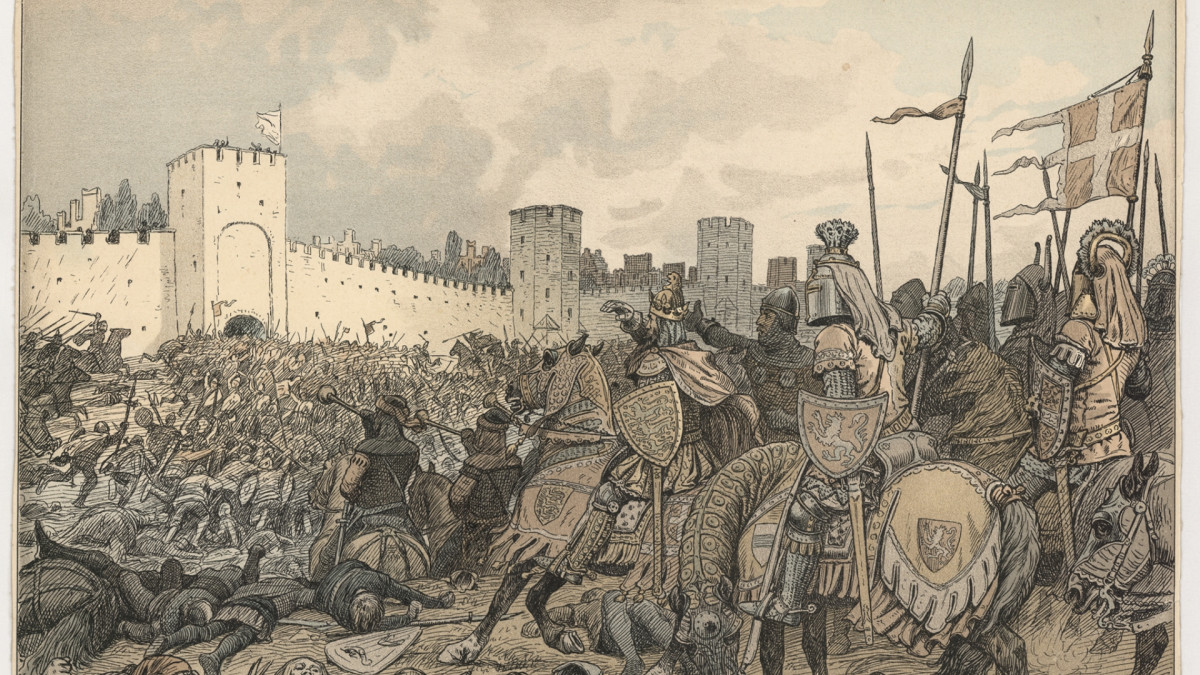
There are lessons from history that we must keep in sharp focus in our times. On July 27, 1361, Gotland’s peasants went out to meet an invading Danish army with whatever they had left: century-old chain mail and the same hoes and plows they used to till the soil. Opposing them, King Valdemar IV had aligned his mercenary Teutons, professional soldiers who lived off war. The clash took place at the feet of Visby, the island’s walled town, and the battle was as brief as it was unequal. Legend has it that the peasants, pressed against the wall, begged for the gates to be opened. The gates remained shut, and from the battlements the burghers watched as their neighbors died. Visby was a global city, connected to the great medieval trade flows, enriched as a member of the Hanseatic League, and its streets were crossed by Germans, Russians, Latvians, Swedes, and Estonians who traded with much of Northern Europe. Outside, the peasants of an island without land borders were a traditional and homogeneous society that basically had a single buyer for everything they produced: the city. Gotland could not live without Visby, but the cosmopolitan Visby already lived with its back to Gotland. Its walls protected the city not from the sea, but from the land. In a single island, a fracture had formed two societies with divergent interests and latent conflict.
“Gotland could not live without Visby, but the cosmopolitan Visby already lived with its back to Gotland. Its wall protected the city not from the sea, but from the land”
After dealing with the peasants, Valdemar demanded fealty and an exorbitant ransom in exchange for not sacking the city. The same gates that had closed to the neighbors opened to the invader, and the merchants had to hand over the fortunes they had hoped to protect. Visby never recovered its former splendor. It could have remained larger and more prosperous for a much longer time, but its history was bent in a way that it would never recover from. This story could be read as a medieval fable if its mechanism were not at work today across Europe. At bottom, the history of Visby and Gotland offers an interesting category for analysis. The great cities of the continent, where the intensity of their connectivity and their social heterogeneity greatly surpass that of their hinterlands, are turning away from the surrounding territory as a community of fellow citizens, and that territory has begun to push back. Europe’s rivals have already noticed and, as the Danes did, are taking advantage of it.
The Hinterland’s Reaction
For three decades, as people left the countryside for urban settings, European capitals competed with each other to attract investment, corporate headquarters, and talent. Thanks to that, they grew in extraordinary ways. That triumph, however, came with the consequence that the countryside was reduced to a provider of food, water, cheap labor, and weekend escapes. As with Visby, globalization, tariff elimination, and the free movement of goods, people, and capital allowed cities to no longer rely on the territories that surrounded them. The small towns and provincial capitals that had once functioned as centers of economic cohesion and regional administration gradually lost those functions as the automation of management and decision-making could be centralized in the big city. Rural banks and agricultural finance ceased to depend on local branches and managers who knew their lifelong clients, eroding trust. The fragmentation of decisions “with a human face” was replaced by bureaucratized and abstract risk departments. Thus, those who now live on the margins of a system have not only lost credit and income-earning capacities, but the decisions that shape their lives are taken elsewhere by people they do not know and who rarely visit them.
After the 2008 crisis, that quiet hinterland found its voice at the ballot box, and across Western countries voters chose to preserve old nations against the Hanseatic interests of the polis. This is accelerating the divide between these two worlds even more. In 2016, geographically distant England voted to leave the European Union even as London voted about 60% to remain, and the referendum’s slogan “Take back control” sounded like a complaint from a periphery against its global city. Two years later, the Yellow Vests occupied roundabouts in provincial France to protest a fuel tax designed in Paris, a city where the car is almost a luxury. And in the European elections of June 2024, the National Rally captured 31% of the votes and won in 95 of France’s 101 departments, while Paris itself remained a marginal force. The opposite happened too. Paris’s new socialist mayor, Anne Hidalgo, won almost 50% in the municipal elections, but only 1.75% when she ran for the presidency.
The map also repeats itself in the United States. Coastal metropolises accumulate power where political color and an open, heterogeneous culture become hegemonic because they serve their socioeconomic interests, and among them the flyover states, where the opposite happens, producing an even more pernicious effect: the gradual regionalization of ideologies and a growing clash of interests, whose result fuels the logic that “when others govern, they govern against us.” It is important to think in thresholds, and the lesson from London’s and Paris’s failures as capitals is paradoxically due to their success as global cities that concentrate between a quarter and nearly a third of GDP. Crossing the 20% threshold activates national antibodies outside the city. I think crossing the 30% threshold may be unsustainable for national integration. Turning the countryside into a hinterland of the global city would mean subordination, and for that to occur one would have to intensify the sense of otherness. The countryside becomes a distinct place, inhabited by different people, deemed contemptible for their backward and misinformed mentality, and as the ideal of shared spaces erodes, the only thing left is the fight for one’s own interests. That is why in many Western countries, parties whose support is urban-heavy begin to see it as legitimate to propose scrapping the corrections in electoral laws that still guarantee the balance of power between the countryside and the city.
A Periphery of Matryoshkas
Yet this conflict goes beyond the old boundary between city and countryside, because the periphery is not merely a geographic condition but a position within a system. It is the place one occupies when others concentrate investment, institutions, and the power to decide for oneself, and the same relation repeats itself at every scale (global, continental, national, and metropolitan), like a game of nesting dolls that fit inside one another.
“This conflict goes beyond the old boundary between city and countryside, because the periphery is not merely a geographic condition, but a position within a system”
In the largest doll, it seems that a Europe lagging far behind in frontier economic sectors is sliding toward the periphery of a world whose centers are in Washington and Beijing. Within it, money, research, and decisions pile up in the Blue Banana, the corridor that runs from London through northern Italy along the Rhine, and there migrate the best-educated youth from Spain, Italy, Poland, Bulgaria, and Greece. Within each country, the capital pulls away from the rest: the Île-de-France region generates 31% of French GDP and Madrid’s region 20% of Spanish GDP, a weight that keeps growing. And in the smallest doll, inside each capital, the center slowly moves away from its outer crown.
The perversity of the matter is that as the whole system loses energy, the remainder tends to concentrate, ever more rapidly, in the few points where there is still a critical mass. Each doll feeds the next. What we see today in several European countries is that when the hinterland dries up, its people rebel against its extractive logics or move toward the center, and when the hinterland cannot go further, the great city tends to turn other well-connected places in the world into new territories of its hinterland. In this way, today the hinterland of a global city spans the entire planet. Madrid attracts graduates from Seville and working families from Caracas, Santo Domingo, or Buenos Aires by the same mechanism, and they often end up in the same peripheries—the last places where one can still afford rent.
The Periphery’s Trap
Moreover, when the center of those same cities starts to fade, problems also arise for their ruling classes, and they too decide to invest in and even relocate (while they still have resources) to the centers of other great cities. Perhaps Miami, as a sanctuary city for Latin America, is the most paradigmatic example.
This situation causes the size of the centers within sanctuary cities to grow considerably, giving the impression that their wealth is ever greater. Yet the reality is that the entire metropolitan system expands like a fried egg that never stops growing. Gentrification does not break the cycle: when a poor neighborhood becomes fashionable, the center expands and the vulnerable are pushed a little farther away. According to geographer Christophe Guilluy, alongside the self-referential feedback of the economic and cultural elites who inhabit the centers, the policies they support — low-emission zones, urban tolls, etc.— act as expulsion mechanisms, like invisible walls.
“Not even gentrification breaks the cycle: when a poor neighborhood becomes fashionable, the center expands and the vulnerable are pushed a little farther away”
The yolk grows bigger, tastier, and more entertaining, but the surrounding white, the periphery, is not absorbed; it keeps growing, and with it the scale of the problems. The periphery remains on new margins. In other words, we are not richer, but larger, with a bigger center and a periphery that grows even faster. In those margins, every crisis hits first and hardest, because the airbags are much weaker there. When housing, employment, doctor’s appointments, or school places become scarce, the periphery begins to eat itself. The scene recalls less a lifeboat with room for all than Gericault’s The Raft of the Medusa, where survivors adrift argue about who must be thrown overboard. In our era, that raft is filling dangerously, and immigrants and their lumpenized descendants have become the most obvious target. The longtime neighbors, who compete with newcomers for the same rents, the same jobs, the same clinics, and the same public housing lists, end up seeing them as the cause of their own decline. Political entrepreneurs on both extremes understand this better than anyone and offer symmetrical responses: some promise native residents preferential access to housing and services; others seek to organize newcomers as a distinct identity bloc. Both turn the neighborhood into a zero-sum game, and both erode the only category that once united all their inhabitants, citizenship. That is how the world of clans reappears where citizenship stops making sense.
“Both turn the neighborhood into a zero-sum game, and both erode the only category that once united all their inhabitants, citizenship”
Thus the great cities, which were the cradle of the Enlightenment and of nations, are now (as the vast majority of Western populations are urban) becoming their tomb. Meanwhile, the void is being filled in other ways and hinterlands find their own routes back to urban connectivity. In 2021, Spanish police discovered 135,000 marijuana plants in abandoned warehouses near Toledo, an hour south of Madrid, and along the Campo de Gibraltar coast the narco-boats continue to supply demand for Europe’s metropolises. Where the state withdraws from the territory, other forms of authority (which also control the supposed local authorities) take its place. And gradually the Leviathan becomes a primus inter pares in many parts of the territory.
An Open Front Without Trenchlines
All this could remain a domestic problem if Europe’s rivals were not watching and fanning the flames that ignite in our cities. The fuel is often local, but to exploit a society’s internal fractures, it is no longer necessary to send an army to invade Visby to subjugate it. In the vacated Länder of the former East Germany, the discontent of those who saw their children move west fed Pegida’s marches first and then the rise of AfD. In the farming towns of Spain’s southeast, as in France’s banlieues, the coexistence of long-time residents and newcomers grows tenser with every crisis. From those embers, outsiders fan the flames.
“The fuel is often local, but, to exploit a society’s internal fractures, it is no longer necessary to send an army to invade Visby to subjugate it”
In autumn 2023, the French government attributed to the Russian network RRN/Doppelgänger the artificial spread of photos of Stars of David painted on the facades of Paris: more than a thousand bots that began posting them forty-eight hours before the first authentic image appeared. In Berlin, in 2016, the Russian state television and Foreign Minister Lavrov themselves turned a fabricated violation into a campaign against refugees that brought thousands of Russian-Germans into the streets. And in Torre Pacheco, in the summer of 2025, the Pravda propaganda network published about three hundred posts in five days about riots against immigrants, some of them hoaxes, that amplified fear and the sense of institutional abandonment. Today bot campaigns arrive promptly at every disturbance, catastrophe, or event involving an immigrant. In none of these cases did Russia light the spark. It only fanned the flames as soon as it saw smoke, because it knows that on Europe’s periphery a little air is enough for the fire to take hold. And cognitive wars, fed by press coverage, political pressure, or support for internal protests, can be more effective than force. France’s case is, given the scale of its images, the most paradigmatic. There is no evidence that those causing mayhem in French cities are being stirred on by Russian intelligence and disinformation. But the violence and looting have surpassed the impact of protests by those who merely demanded what a broken social contract had promised them. There is no evidence, but we should not be naive. The Italian government is already considering that Russia could have stirred Milan’s disturbances through social networks. And we will have to see who is behind last week’s clashes in Barcelona. Thus the weakest front in our democracies is an internal front that today appears in the images selected, segmented, and amplified by social networks, which do not show student protests but disorder, fires, and chaos in the centers of those cities that, like Paris, live on the margins of their peripheries and of their countries. The result is greater polarization, less social cohesion, and more estrangement among citizens. Divide and conquer. The outcome will only benefit the extremes. Bardella and Mélenchon both propose tackling the public debt with measures that could further weaken the country’s already strained coffers and also propose limiting financial or military aid to Ukraine. Who benefits?
“Thus, the weakest front in our democracies is an internal front that today appears in the images selected, segmented, and amplified by social networks”
The logic is as simple as it is unsettling. A power preparing for a real confrontation, in the Baltic or the Taiwan Strait, gains a lot if its adversaries arrive at that moment without energy, without resources, and without internal cohesion, and the cheapest place to drain that cohesion is the place where it is already scarce. My hypothesis is that one of the fronts in the battle for Taipei, as happened in its moment with the Algerian battle (the FLN network in Paris and the October 1961 repression), could also be fought in Saint-Denis, Marseille, Ceuta, Molenbeek, and Offenbach. It is a battle that does not require trenches, but barricades and a desstructured banlieue lacking an integrated civil society. A battlefield that has the potential to accelerate a society’s internal division, to heighten its country’s economic insecurity, to challenge the foundations of its democratic regimes, and to dissuade it from waging the battles that truly matter. Ten kilometers from the Élysée Palace, the French Republic struggles to control its territory.
The Spanish Cushion
If Europe’s future hinges on its ability to integrate its peripheries, France shows where the path leads if that is not done today. In June 2023, the death of a teenager at the hands of police in Nanterre sparked a week of disturbances in the banlieues, peripheries that have received public investment for decades and yet remain largely out of reach of the Republic. Since then, as we have all seen again, neither the latent unrest in the banlieues nor the sporadic episodes of violence have subsided.
However, it is worth looking at the counterpoint Spain offers. Its peripheries are poorer and receive less funding than the French ones, yet they are far more stable. The main reason lies in property ownership. In the French banlieues, and especially in the so-called priority neighborhoods, 85% of households rent, according to INSEE, most in social housing, surrounded by pockets of poverty and exclusion. Meanwhile, in Spain, a country economically more fragile than France, three out of four households are owners, a legacy of the 1960s and 1970s when the workers who built the belts of the great cities like Madrid bought the apartments they lived in. Their peripheries are more robust because the order’s incentives prevail. The homeowner has something at stake in their street, in their children’s school, and in the upcoming elections; the renter in a state whose debt exceeds 100% of GDP accumulates grievances against their landlord.
“Their peripheries are poorer and receive less funding than the French ones, yet they are much more stable”
That cushion, however, is deflating. Spain also has debt around 100% of GDP, the share of Spaniards who rent has risen from 19% in 2007 to 26% in 2024, and renters are, above all, young people and newcomers: in 2021, 56% of households formed only by foreigners lived in rental housing. The periphery is beginning to fracture between homeowners who fear for the value of their house and tenants who have nothing to lose, and it is in that crack that resentment grows the fastest. Yet the discontent does not erupt into high-intensity protests in the peripheries; for the moment, it is channeled into demonstrations in squares near political power, demanding changes within the system’s channels.
Opening Visby’s Gates
It is difficult to understand our era without looking at the thesis Christophe Guilluy builds across his books. The territorial fracture that led to a spatial distribution of classes and opportunities evolved into a structural crisis that weakened the economic and political foundations of Western democracies. Later that fracture turned existential, because the working classes, relegated to the system’s peripheries, no longer possess resources, recognition, or the capacity to define the rules that shape their own lives. Finally, in his recent book Métropolia et périphéria, Guilluy argues that the fracture has become civilizational since two worlds—the centers and the peripheries—still share the State, but have ceased sharing a project of society.
“Two worlds—the centers and the peripheries—still share the State, but have ceased sharing a project of society”
Robert D. Kaplan defines our world as a global Weimar. With globalization that is ceasing to be Western, and with a chain of connected problems, the natural impulse is to create sealed compartments that isolate problems and mark how far others’ interests can influence us. But the tragic history of Gotland and Visby teaches us that this does not work. It is a trap.
The answer cannot be to ignore the countryside or the banlieues or the interests of small towns, nor to shrink or curb the big cities. In an open market, a city that renounces growth ends up sending its capital and its talent to those cities that have not renounced to do so, and the problems of having a global city, a center, will always be preferable to lacking one and being someone else’s periphery. The crucial question, then, is whether that center will continue to live with its back to the surrounding territory. Or, in other words, whether the city has the capacity to reintegrate itself into its own internal geography and to weave shared interests with its country again.
That alternative involves multiplying centers to reduce the size of the peripheries. Strengthening a polycentric model within metropolitan areas means building commuter rail lines that turn provincial cities into neighborhoods of the metropolis, rather than stations for which high-speed trains whiz past. It means rebuilding urban developments that are not sectorized or functionalist, with mixed uses and their own identity, with new districts in the metropolitan belt, where young people and newcomers have easy paths to becoming homeowners. And it means decentralizing without each city sealing itself behind its own walls.
Because that, in the end, is Visby’s lesson. Its bourgeoisie believed the wall protected them from the countryside, when in fact it separated them from those who could have defended them. They shut the gates to their neighbors and ended up opening them to the enemy; they saved their houses that July afternoon in 1361, but they sacrificed their future forever. Western cities are vulnerable targets, but they are still within time to write another ending. Avoiding the margins is the same as saying we will not marginalize ourselves nor others. That is, ultimately, the only wall that truly protects us in this “century of cities.”
