
The owner of HeeHaw asserts that no prudent officer would have deemed that level of force necessary or justified.
The Georgia officer who shot and killed a 1-year-old miniature donkey named HeeHaw has submitted a motion to dismiss the civil lawsuit brought against him, arguing that body-cam footage demonstrates his reasonable belief that the animal posed an immediate danger to a fellow officer. Even if the footage does not prove that belief, the officer maintains he is shielded from liability by immunity.
In the pre-dawn hours of August 30, Hannah Michelle Israel was at her Cedartown residence in western Georgia when she received a disturbing phone call. A Cedartown Police Department supervisor bluntly informed Israel that a donkey on her property had been “dispatched,” according to her federal complaint. After clarification, she learned that officers had entered her private, fenced land in the middle of the night while searching for a missing person and had shot and killed her miniature donkey during the operation.
Israel immediately began searching for HeeHaw, a bottle-raised donkey she cherished, only to locate the lifeless body in an open field. She told ABC7 News that the incident left her traumatized and stunned, adding, “I can’t believe he’s not here…there are no words.”
Seeking accountability, Israel filed suit in the U.S. District Court for the Northern District of Georgia in September against Officer Trenton Ryan Garner for violations of her Fourth Amendment rights and separately sought $1 million from the City of Cedartown.
Recently, Garner moved to have the case dismissed, arguing, in part, that he did not infringe Israel’s constitutional rights by entering her property. He cites the open fields doctrine, which holds that individuals do not have a reasonable expectation of privacy in pastureland, even when fenced. The filing also states that there were exigent circumstances tied to the search for a missing 12-year-old girl.
As for HeeHaw, Garner claims his actions were reasonable in using deadly force and contends that the footage shows HeeHaw “charging” toward an officer and presenting an “imminent threat.”
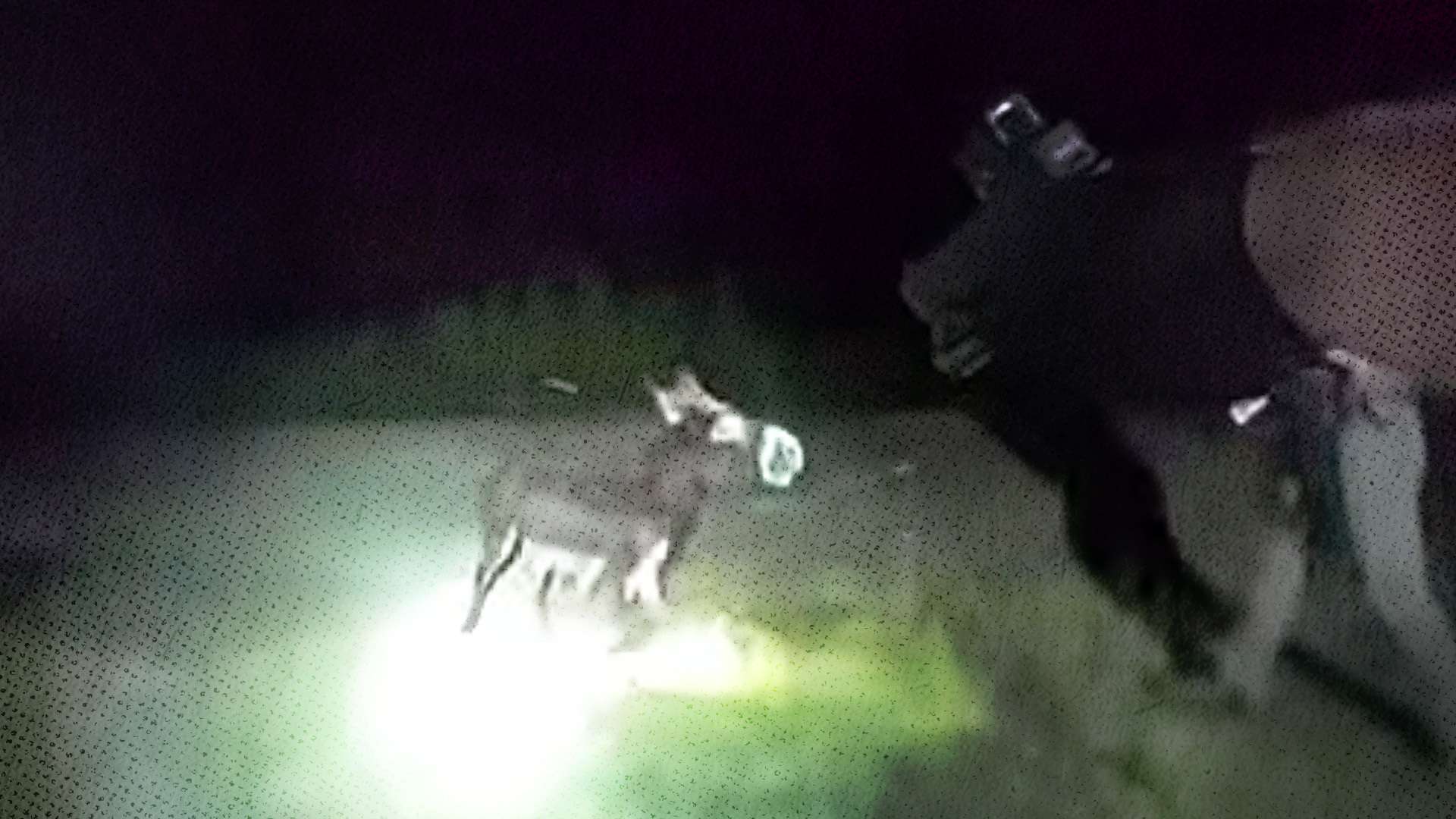
However, the released footage, shared by Civil Rights Lawyer Raw, may not be entirely definitive. Garner’s body camera was not recording at the moment of the shooting but had a rolling buffer that captured about 30 seconds of video without sound before activation, according to court filings. In the silent segment, two officers and a bloodhound search a dark field, flashlights aimed ahead. A small donkey, about three feet tall, comes into view and gradually moves toward one of the officers. The officer steps back, the donkey closes the distance, and accelerates. Garner then draws his weapon and fires. The donkey turns and bolts, collapsing shortly thereafter.
Whether Garner reasonably believed HeeHaw posed an imminent threat to a nearby officer remains a point of contention.
When the audio resumes, a fellow deputy asks, “Why did you shoot it?” Garner responds with a casual, “I don’t know,” before telling dispatch that the donkey had to be shot because “it was trying to attack.” If another officer on scene questions the justification for deadly force, the claim of reasonableness becomes more questionable.
Israel’s complaint accuses Garner of killing HeeHaw “needlessly, maliciously and recklessly, with deliberate indifference” to Israel’s rights. The document states: “No reasonable officer in Garner’s situation would have believed such force was necessary or justified.”
Yet regardless of whether Garner’s actions were reasonable, qualified immunity could still shield him from accountability. Qualified immunity is a legal principle protecting government actors from lawsuits alleging constitutional rights violations unless the right at issue is clearly established by prior case law. In practice, plaintiffs must point to a precedent that clearly delineates the same scenario as showing the right was obvious to officials.
The hurdle can be steep. For instance, in March the Supreme Court reversed a Second Circuit ruling in a case involving a protester who was rear-wristlocked. The Second Circuit had declined to grant qualified immunity, citing a 2004 case that clearly established that using rear-wristlocks to detain anti-abortion demonstrators constituted excessive force. Yet the Supreme Court disagreed, emphasizing that general principles such as “an officer may not use reasonable or excessive force” do not alone suffice to establish a right clearly.
And while there are numerous precedents about officers shooting domestic animals, instances involving miniature donkeys are rarer. If the court finds no clearly established rule that specifically forbids firing at a miniature donkey advancing toward a fellow officer in darkness, the case could be dismissed, avoiding a full discussion of reasonableness and constitutional issues.
