
The article’s story began, in fact, two years ago, in December 2024, when I first interviewed in Berlin Wolfgang Schmidt, then head of Olaf Scholz’s Chancellery. In that encounter, which now resonates as a prophecy of Germany’s current policy crisis, “unacceptable” social cuts demanded by the liberals—which had already sparked snap elections—were condemned, the need to reform the debt brake to unleash public investment was defended, and a stern warning was issued to the European People’s Party (EPP) against any temptation to flirt with the far right in order to govern.
Poco tiempo más tarde, me reuní con el ministro de Finanzas del Sarre, Jakob von Weizsächer, quien me explicó de primera mano la intrahistoria de cómo se fraguó la gran carambola institucional que terminó por salvar el presupuesto federal. I was told how a group of top economists — Clemens Fuest, Michael Hüther, Moritz Schularick, and Jens Südekum — managed to convince Friedrich Merz’s CDU and Lars Klingbeil’s SPD that they must reform the Constitution in an express fashion. The reasons were brutally urgent, both mathematically and geopolitically: economic stagnation, the poor state of infrastructure after years of neglect, and the defense investment needs. To complicate matters, the new Bundestag arising from the elections would lack the two-thirds majority required without the extremes (AfD and Die Linke). Propelled by the Saarland’s federal audacity, led by Minister-President Anke Rehlinger, this reform of the debt brake was approved in extremis in the old Parliament to unlock a 500-billion-euro fund and guarantee by a simple majority all military spending above 1% of GDP.
“The fiscal expansion in Germany is under full swing and defense spending is rising dramatically.”
Today, in June 2026, the political, industrial, and fiscal map of Germany shows that that diagnosis was the prelude to a painful and rapid metamorphosis. Today, in light of the latest macroeconomic data, we can confirm that this shift in paradigm was not a political mirage: fiscal expansion is in full swing and defense spending is rising dramatically.
But this awakening of public spending is not a victory of long-term planning, but a lifeline thrown in the middle of a perfect storm. Germany is undergoing a deep structural crisis, watching the three pillars of its historic success crumble: cheap Russian energy, the American security umbrella, and privileged access to the Chinese market. Moreover, Merz has erred in diagnosing its ills, fixating exclusively on energy prices and the suffocating European bureaucracy. Yet, as several recent analyses have noted, the true underlying structural problem is the loss of external competitiveness against China. The German export model no longer competes with an emerging economy that needs to absorb its technology, but against a first-rate industrial superpower that absorbs global demand, driven by massive subsidies and an unattainable scale of production. Today, China dominates entire strategic sectors, such as electric vehicles, threatening to destroy hundreds of thousands of jobs tied to German exports.
Radiography of Spending
Facing this existential threat, the faucet of spending has been opened fully. The April fiscal data provided to me by Niklas Garnadt, senior European economist for Germany at Goldman Sachs, is a clear testimony to this new direction. German federal spending reached €45.8 billion, notably above the €42.2 billion forecast and €8.0 billion above April 2025 spending.
The breakdown of these figures shows that the capital injection is happening on multiple fronts at once:
- The main budget: spending hit €38.6 billion in April, about €300 million above expectations. Both social spending and investment exceeded estimates.
- Rear-ward rearmament: spending in the off-budget military fund stood at €1.2 billion in April, slightly above the €1.0 billion anticipated. Year-to-date, defense spending has risen 34%, reaching €7.0 billion.
- Infrastructure and climate fund: disbursement stood at €6.1 billion, well above forecasts.
“The German federal spending reached €45.8 billion, notably above the forecasts of €42.2 billion and €8.0 billion above spending in April 2025.”
The impact of this massive disbursement on the state’s coffers is substantial. The cumulative budget deficit through April stood at €63.6 billion, which is €36.2 billion higher than in the same period a year earlier. The data support a view of notable fiscal expansion in 2026, projecting a fiscal impulse of around 0.6 percentage points.
The “Investment Minister” and the Execution Challenge
The shift toward a more expansive fiscal policy has a clear political dimension. When he took office last year, the Finance Minister, Lars Klingbeil, pledged to be the “Investment Minister.” The 2026 budget lives up to that promise, allocating around €127,000 million to federal investment (about 2.8% of GDP), up from €116,000 million budgeted the previous year. Transport remains the king of these outlays, representing about a third of total investment.
“Since 2020, real investment has remained far short of budgeted amounts due to a painfully slow execution.”
However, in Germany, planning does not automatically translate into execution. Since 2020, real investment has consistently trailed behind the budgeted sums due to a painfully slow implementation. To combat this bureaucratic bottleneck, the Parliament is debating the “Infrastructure Future Act,” aimed at accelerating planning procedures and permit approvals.
German Fear and Europe
The fear of deindustrialization has made Germany more defensive in Brussels and more focused on internal solutions. A clear example is the Agenda 2026, a CDU/CSU report proposing a broad deregulation of the European Union to bolster competitiveness and ease the bureaucratic burden on firms, which could, in the name of competitiveness, weaken gains in social rights, wage equality, and environmental protection.
Another timely example is the Industrial Accelerator Act discussion in Brussels. Germany, once Europe’s undisputed industrial locomotive, remains wrung by the loss of cheap Russian gas. If a chemical giant like BASF or a steelmaker like ThyssenKrupp sees energy costs in Spain consistently 30% to 40% lower than in Germany, the “accelerator” will not speed up German industry but push it to migrantize to the Mediterranean. In response, Germany could deploy its “fiscal bazooka” to bolster its industries in crisis. The risk is clear: the IAA could end up financing internal relocation, where factories move not to where they are most efficient or where energy is cheaper, but to the country offering the most generous public subsidy. In Brussels, this has a name: the “cannibalization of the single market” under the pretext of strategic autonomy.
The Discontent: CDU and SPD Represent Only About a Third of the Electorate
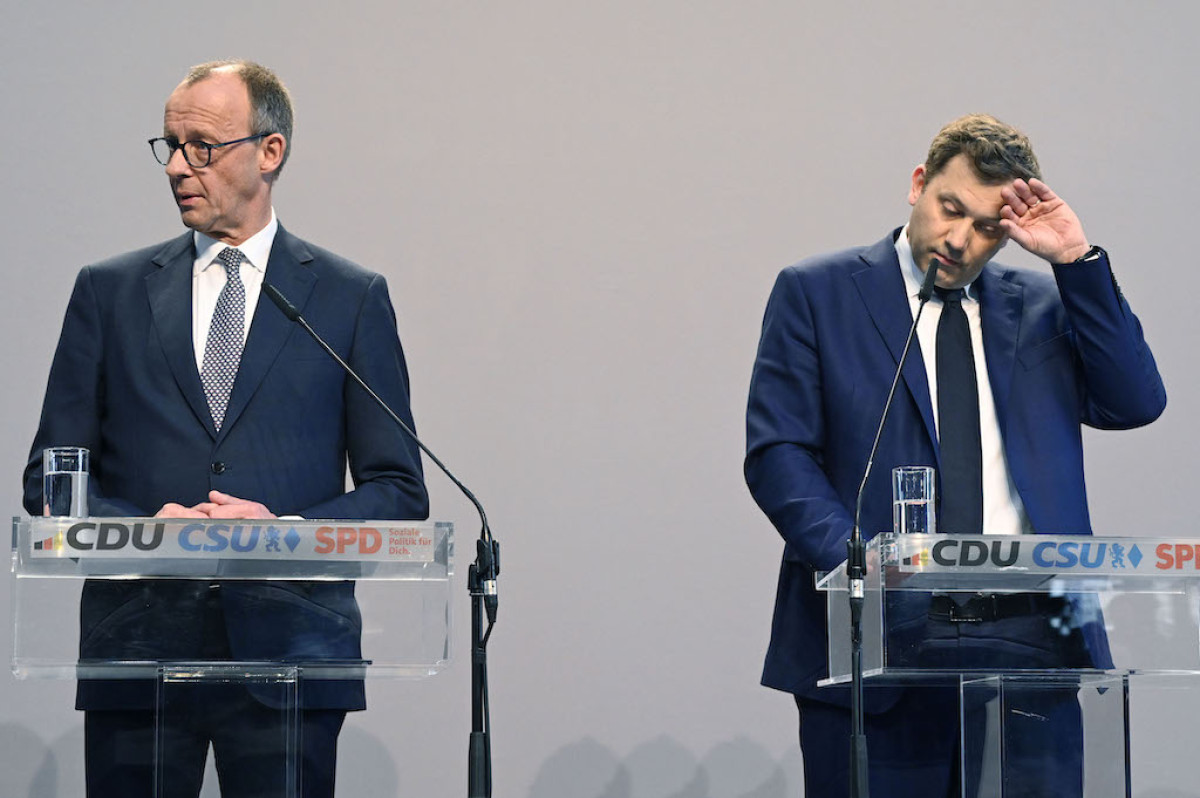
All this economic transformation clashes head-on with governmental paralysis. As political scientist Frank Decker accurately diagnoses, the Social Democrats have been in a deep identity crisis for more than twenty years. Trapped again as a minority partner in a “grand coalition,” the SPD cannot articulate its ideology against the orthodoxy of Friedrich Merz’s CDU. The result is a government blocked by distrust, unable to offer a clear horizon to a society that is deeply pessimistic.
“With a radical right close to 30%, the traditional ‘cordons sanitaires’ demand arithmetic coalitions that are increasingly forced, which only serves to reinforce the AfD’s anti-establishment discourse.”
If the tensions in Parliament are immense, the street numbers are equally troubling. The traditional Sonntagsfrage (Sunday question) paints a bleak picture for the establishment and explains the center’s sense of panic.
According to the latest data from pollster INSA (May 2026), AfD not only consolidates its lead but surges to 29% in voting intention. The wear of governing in an industrial crisis erodes the coalition: the CDU falls to 22% and the SPD languishes at 12%. Together, they barely represent one third of the electorate.
With a radical right hovering near 30%, the traditional “cordons sanitaires” demand arithmetic coalitions that are increasingly forced, which ultimately does nothing but feed AfD’s anti-system discourse by eroding real alternation.
Rumors of Government Crisis?
This situation has unleashed a political storm in Berlin. As reported last week by the German outlet Table Media, internal tensions have pushed the coalition relationship to an almost absolute limit and created inner strain within the CDU with a faction beginning to contemplate the possibility of replacing Chancellor Merz. In other parts of the CDU, a openly radical “way of thinking” is circulating: force the SPD out of government, install Friedrich Merz at the head of a minority administration, and open the door to tolerating or seeking targeted agreements with the AfD if governance so requires. This would spell the definitive break of the Brandmauer, the historic institutional firewall against the radical right.
“With a government buckling, rumors of alliances with the extremes or a possible replacement of Merz and an AfD capitalizing on discontent, Berlin becomes a problem for the European Union.”
Germany is undergoing one of the most painful metamorphoses in its modern history. Abandoning austerity dogmas and injecting massive public spending confirm that the state has taken the reins to save its industry. Yet capital alone cannot buy back the lost competitiveness against China or restore social peace at home. With a government buckling, rumors of alliances with the extremes that once seemed impossible, and an AfD capitalizing on discontent, Berlin projects its instability onto the European Union.
BONUS. In Spain, some might read this as an unprecedented opportunity to reindustrialize, attracting green capital fleeing Germany’s rising costs, but beware: we are also faced with the constant threat that a turn toward economic nationalism in Germany could shatter the single market. We need a European Germany, not a German Europe. The best way to avoid past mistakes is to anchor a unified Germany in a far deeper project of European integration.
