
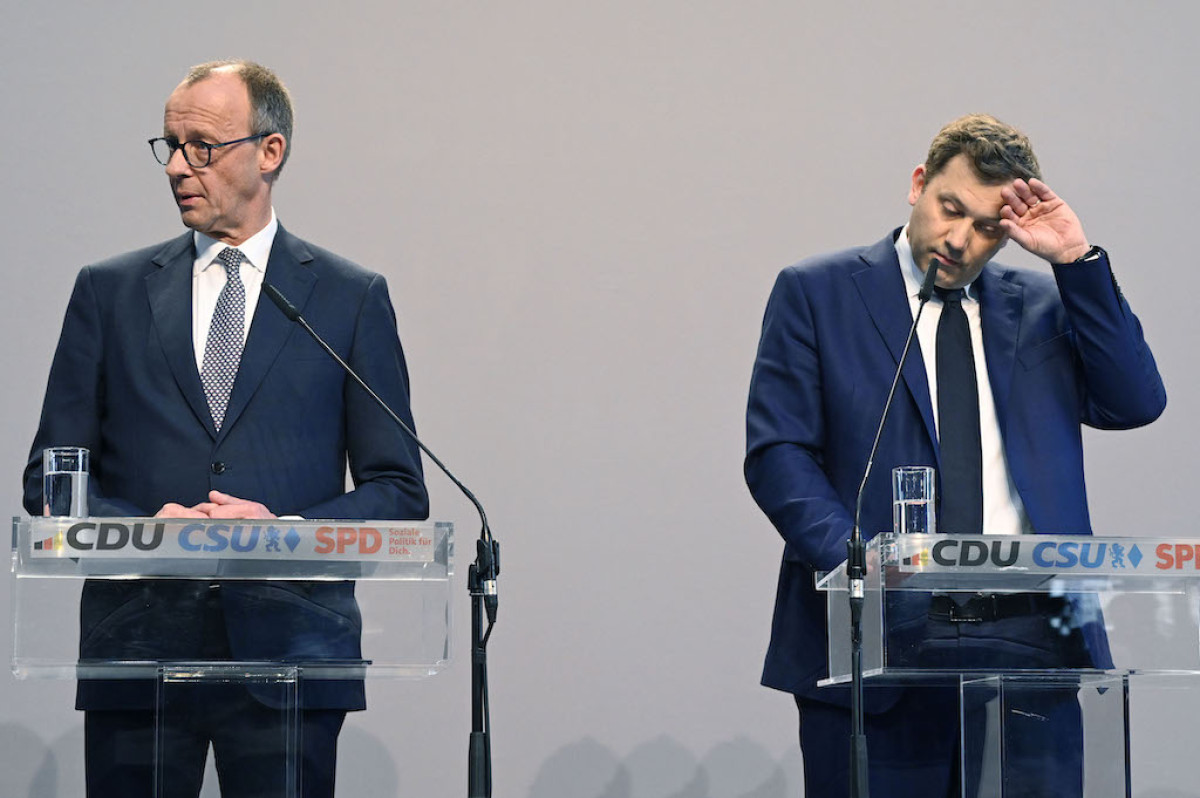
The origins of this piece trace back to Berlin in December 2024
Today’s article begins in Berlin in December 2024, when I first spoke with Wolfgang Schmidt, the head of Olaf Scholz’s Chancellery. That interview—now appearing as a prescience of Germany’s current polycrisis—found Schmidt describing social cuts demanded by the liberal coalition as “unacceptable.” He also pressed for relaxing debt constraints to unlock greater public investment, and he issued a sharp warning to the European People’s Party against courting the far right to form a governing majority.
A short time later, I sat down with the Saarland state Minister of the Economy, who recounted firsthand the inside story of the grand institutional maneuver that ultimately rescued the federal budget.
He outlined how a consortium of leading economists—Clemens Fuest, Michael Hüther, Moritz Schularick, and Jens Südekum—persuaded Friedrich Merz’s CDU and Lars Klingbeil’s SPD that constitutional reform had to be moved forward with alacrity, citing overwhelming mathematical and geopolitical urgency: the economy had stagnated, infrastructure had suffered decades of neglect, and defense investment could not be postponed. To complicate matters, the freshly elected Bundestag would lack the two-thirds majority needed without support from extreme parties (the AfD and Die Linke).
Thus, championed from Saarland’s federal podium by Minister-President Anke Rehlinger, the debt brake reform was approved in extremis by the outgoing Parliament, unlocking a €500 billion fund and shielding all military expenditures above 1% of GDP by a simple majority vote.
“Fiscal expansion is now in full swing, and defense spending is rising dramatically”
Today, in June 2026, Germany’s political, industrial, and fiscal landscape looks back on that moment as the prelude to a rapid and painful transformation. Looking at the latest macroeconomic numbers, the shift from rhetoric to reality is no political mirage: public spending has surged, and defense outlays are climbing steeply.
This awakening of public expenditure didn’t come from a grand, long-term strategy but as a lifeline thrown into a perfect storm. Three of the country’s historic underpinnings—cheap Russian energy, the American security umbrella, and privileged access to the Chinese market—have crumbled, leaving Germany in the midst of a deep-seated structural crisis.
China Shock 2.0
Merz has misdiagnosed his country’s ailments by fixating on energy prices and Europe’s suffocating bureaucracy. Yet, as several recent analyses suggest, the true structural challenge is Germany’s erosion of external competitiveness relative to China.
Unlike in earlier decades, Germany’s export model isn’t contending with a rising economy eager to absorb foreign technology, but with a dominant industrial power that commands global demand, fueled by massive subsidies and an unparalleled scale of production. China now dominates entire strategic sectors such as electric vehicles, threatening hundreds of thousands of German export-related jobs.
X-ray of expenditures
To confront this existential threat, Germany has opened the spending taps wide. The April fiscal data, compiled by Niklas Garnadt, senior European economist for Germany at Goldman Sachs, illustrates this new approach. Federal outlays in April reached €45.8 billion—well above the €42.2 billion forecast and €8 billion higher than April 2025.
The breakdown shows capital injections arriving on several fronts at once:
- Main budget: April spending reached €38.6 billion, about €300 million above expectations. Social expenditure and investment both exceeded projections.
- Accelerated rearmament: the extra-budgetary military fund totaled €1.2 billion in April, slightly above the €1 billion expected. Defense outlays this year have risen by 34%, reaching €7 billion so far.
- Infrastructure and climate fund: disbursements stood at €6.1 billion, comfortably above forecasts.
“German federal spending in April reached €45.8 billion—well above forecasts of €42.2 billion, and €8 billion above the amount spent in April 2025.”
The impact of this sizable injection from state coffers is overwhelming. As of April, the cumulative deficit stood at €63.6 billion, or €36.2 billion higher than a year earlier. Data supports the forecast of a meaningful fiscal expansion in 2026, with a boost of roughly 0.6 percentage points to growth.
The “minister of investment” and the challenge of execution
The pivot toward a more expansive fiscal stance carries a clear political dimension. When he took office last year, Finance Minister Lars Klingbeil pledged to be the “minister of investment,” and the 2026 budget delivers on that pledge, earmarking around €127 billion (about 2.8% of GDP) for federal investment, compared with €116 billion the year before. Transportation remains the principal recipient, accounting for roughly a third of all investment spend.
“Since 2020, actual investment has fallen far short of budgeted amounts, due to exasperatingly slow roll-outs”
In Germany, planning is not synonymous with execution. Since 2020, actual investment has lagged behind budgets, hindered by painfully slow roll-outs. To tackle this bureaucratic bottleneck, Parliament is debating the Future of Infrastructure Act, a measure designed to speed up planning and permit approvals.
Germany’s fears and Europe
The fear of deindustrialization has made Germany more defensive in Brussels, turning its attention to internal remedies. One clear example is Agenda 2026, a CDU/CSU report calling for sweeping deregulation of the European Union to boost competitiveness and ease the regulatory burden on firms. But such moves could also erode advances in social rights, equal pay, and environmental protections in the name of competitiveness.
Another timely example is the debate in Brussels over the Industrial Accelerator Act. Once Europe’s undisputed industrial locomotive, Germany now struggles after the loss of cheap Russian gas. If a chemical giant like BASF or a steel producer like ThyssenKrupp notices energy costs in Spain are consistently 30% to 40% lower than in Germany, this accelerator won’t spur German industry’s recovery but rather its relocation to the Mediterranean. On the other hand, Germany could wield its ‘fiscal bazooka’ to inject life into its industries in distress. The risk is evident: the Industrial Accelerator Act could end up financing internal offshoring, where factories relocate not to the most efficient location, but to the country offering the juiciest package of state subsidies. In Brussels, this is labeled “cannibalization of the single market” under the banner of strategic autonomy.
Discontent: the CDU and SPD represent barely a third of the electorate
This economic transformation produces clear governmental stagnation. Political scientist Frank Decker is right to note that social democracy has suffered a long-running identity crisis for more than two decades. Trapped again as a junior partner in a “grand coalition,” the SPD cannot articulate its ideology alongside the orthodoxy of Friedrich Merz’s CDU. The result is a government plagued by mistrust and unable to chart a hopeful course for a deeply pessimistic society.
“With the radical right nearing 30%, any traditional ‘cordon sanitaire’ will require increasingly contrived and arithmetic pacts – thus eliminating real alternation and naturally feeding back into the AfD’s anti-system discourse”
While parliamentary tensions run high, the public mood is even more troubling. The latest INSA poll (May 2026) shows the AfD consolidating its lead at 29%, with the CDU at 22% and the SPD at 12%. Collectively, they account for barely a third of the electorate.
With the radical right approaching thirty percent, traditional cordons sanitaire will demand ever more contrived arithmetic pacts, thereby eroding real political alternation and feeding the AfD’s anti-system rhetoric.
Rumors of government crisis?
This situation has triggered a political storm in Berlin. As reported last week by the German Table Media outlet, internal tensions have driven coalition relations to near-breaking point.
Within the CDU’s most hard-line factions, an openly radical scenario is circulating: push out the SPD, place Merz at the helm of a minority government, and begin tolerating or pursuing specific agreements with the AfD if governing becomes necessary. That would mark the definite collapse of the longstanding Brandmauer—the fortress against the radical right.
“With a government fracturing, rumors of extreme alliances once deemed impossible, and the AfD capitalizing on discontent, Berlin is casting its instability toward the European Union.”
Germany is undergoing one of the most painful metamorphoses in its modern history. The abandonment of austerity dogma in favor of massive public spending signals that the State has seized the initiative to rescue its industry. Yet capital alone cannot buy social calm at home or compensate for the loss of competitiveness against China.
With its government fracturing, rumors of extreme alliances that once seemed unlikely, and the AfD capitalizing on discontent, Berlin is projecting its instability onto the European Union.
BONUS. Some in Spain may read all this as an extraordinary opportunity to reindustrialize and attract green capital fleeing from price pressures in Germany; but beware, because we likewise live under the constant threat that economic nationalism in Germany could tear the single market apart. We need a European Germany – not a German Europe. The surest way to avoid past mistakes is to anchor a united Germany within a far deeper project of European integration.
