
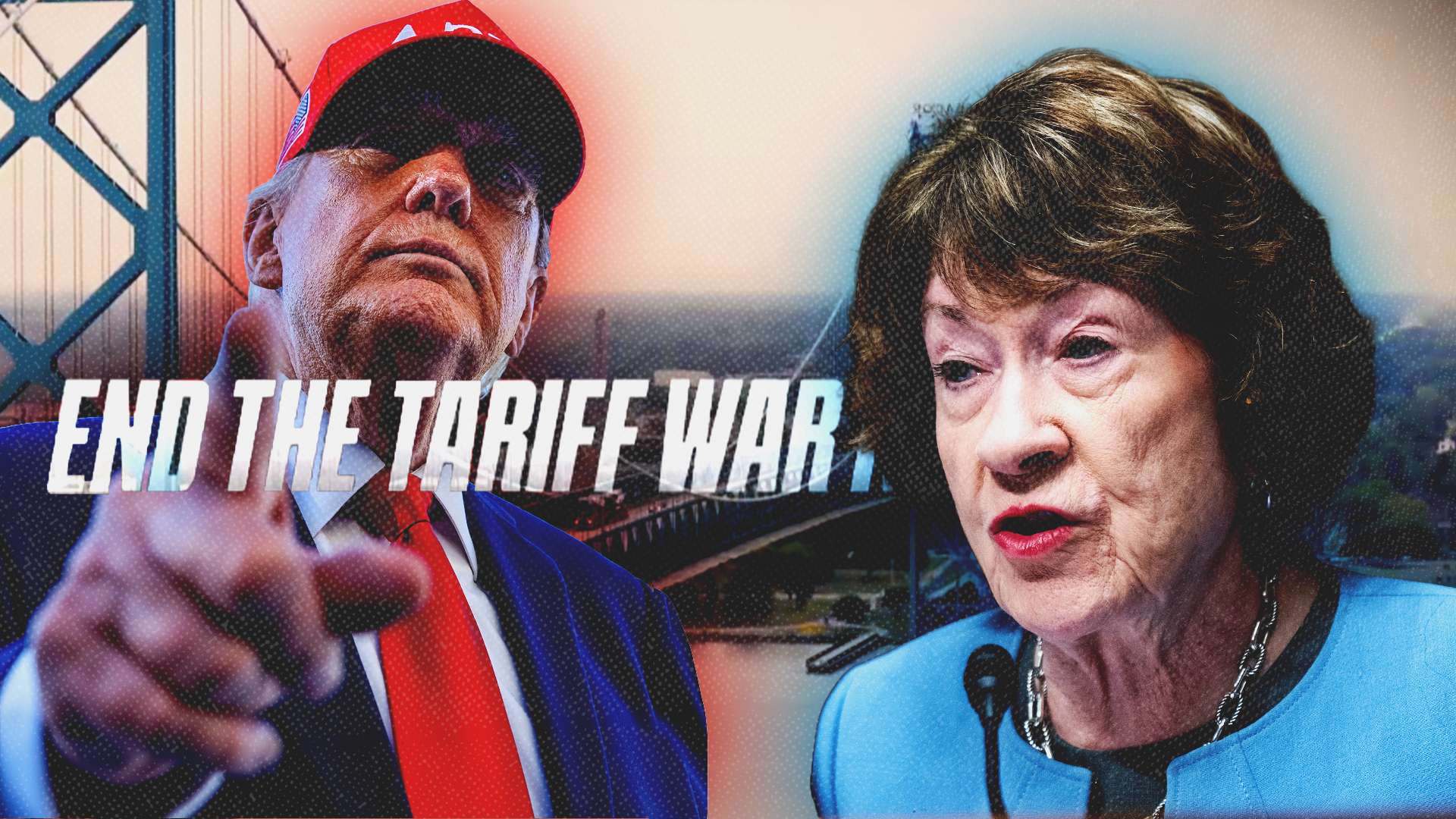
From Maine to Michigan, voters are growing weary of tariffs and the ongoing trade confrontations.
With the midterm elections looming in under a month, Republicans are finding it harder to shield themselves from the clear fallout of the Trump administration’s approach to trade—and some are openly challenging the tariff regime.
That sentiment is especially pronounced in states along the northern border, where commerce with Canada has long powered local economies. The president’s trade dispute with Canada—which features a 50 percent tariff on a broad range of Canadian goods, as well as a total ban on Canadian alcoholic beverages and dairy products—puts GOP candidates in an awkward light, forced to point to only narrow efforts to soften tariff hikes.
Consider Sen. Susan Collins (R–Maine). In a Tuesday debate, Collins clashed with her Democratic challenger—logger and former state legislator Troy Jackson—over tariffs. Collins noted she had successfully pushed the administration to carve out road salt and cement from tariffs on Canadian imports.
Jackson fired back. “What about everything else?” he pressed. “We can’t eat road salt.”
Collins: I managed to exempt road salt from the tariff list.
Jackson: What about everything else? We can’t eat road salt. With everything she’s doing on tariffs, there will be so many fewer people who can afford to drive that I’m not even sure the road… pic.twitter.com/67ZBrn0CV3
— Acyn (@Acyn) October 7, 2026
It’s the kind of moment consultants dream about—or dread. A sharp line that ties Collins to rising prices caused by Trump’s tariffs and to the Republicans’ guarded response. It’s no surprise the exchange has been circulating in the press this week.
In truth, Collins has been among the Senate’s more resistant voices on tariffs. She has repeatedly alerted the administration to how the tariffs affect Maine’s businesses and communities. She praised the Supreme Court’s ruling that blocked parts of Trump’s tariffs. She has voted for measures to undo tariffs, and she has sponsored bills to expand tariff exemptions.
If there were more Republican senators like Collins, then politicians like Collins probably wouldn’t be facing so much grilling over tariffs. In that scenario, Congress might have done its job and stood up to the administration’s reckless and costly trade wars.
Unfortunately for Collins, she operates in a reality where she must campaign for reelection among voters fed up with Trump’s trade policies. A Morning Consult poll conducted for the Cato Institute found that 74 percent of registered voters understand that tariffs have raised prices; majorities say tariffs amount to a tax on Americans and have weakened the U.S. economy.
The most alarming signal for Republicans heading into the midterms: 75 percent of registered voters in that survey said tariffs will influence their vote. Yikes.
Want to dismiss that poll as an outlier? The anti-tariff group We Pay The Tariffs has gathered 45 polls indicating that voters “hate tariffs.” That’s the environment Republicans confront in these elections.
The Trump administration remains reluctant to acknowledge reality. When asked this week about the role tariffs play in this electoral cycle, Transportation Secretary Sean Duffy said, “I don’t think that will come into play.” Why? Because this election centers on “cost of living issues.”
Q: What’s the political risk of tariffs ahead of the midterms?
Sean Duffy: I don’t think that will come into play in this election cycle. This is an election around the cost of living. Trump has been incredibly focused on that. pic.twitter.com/XCpaHYtZhj
— FactPost (@factpostnews) October 5, 2026
Note that Duffy’s point is precisely why tariffs matter: the cost-of-living pressure is partly driven by tariff-related price increases.
On the campaign trail, Republicans are taking heat as Democratic opponents spotlight the consequences of their party’s tariff stance. In Texas, Senate hopeful James Talarico has underscored how tariffs complicate even something as simple as serving free chips and salsa at restaurants. That might sound trivial, but it underscores a broader truth: higher costs on trade don’t merely push up prices; they erode prosperity at the margins and drag down living standards.
All of this could have unfolded differently. House Speaker Mike Johnson (R–La.) could have allowed votes on bills to block tariffs, rather than relying on procedural maneuvers to shield Trump’s trade priorities from congressional checks and balances.
Republicans could have heeded Sen. Rand Paul (R–Ky.), who stood on the Senate floor in October 2025, reminding colleagues that “taxation without representation is tyranny” as he backed a resolution to curb some of Trump’s tariffs. The measure passed, yet never reached a House floor vote, thanks to Johnson’s tactics.
“The reluctance of Republicans to serve as a check on Mr. Trump’s use of executive power under nearly any circumstance has strengthened the case for a Democratic majority in Congress to keep his authority in check,” wrote Phil Gramm and Don Boudreaux in The Wall Street Journal last month. They predicted “a Republican backlash against Mr. Trump’s tariff policies” after the midterms.
That backlash might be arriving sooner than expected. In Michigan, GOP Senate candidate Mike Rogers released a new ad this week urging an end to the “tariff war” with Canada and promising lower prices.
Prices are too high and Canada isn’t our enemy. We need to end the tariff war — now.
In the Senate, I’ll bring both parties together to lower costs and put Michigan families first. pic.twitter.com/D5DLkBBdpn
— Mike Rogers (@MikeRogersForMI) October 7, 2026
The spot is somewhat disingenuous, given Rogers has a long history of backing Trump’s tariffs and has previously labeled the Canada trade clash as “necessary.” He has also supported legislation that would grant presidents even more latitude to impose tariffs unilaterally.
Rogers stands in contrast to Collins. The Maine senator has attempted to push back against tariffs, though her efforts have been stymied by fellow Republicans. Rogers is trying to reinvent himself as a tariff critic in the closing phase of a race that may be slipping away.
If that strategy fails, Michigan Republicans will have only themselves to blame. After all, they could have backed a principled tariff skeptic and free-market advocate—former Rep. Justin Amash—for the Senate seat.
This is the predicament the GOP has created by backing Trump in three consecutive presidential campaigns, by standing by as his administration raised costs on American businesses and consumers without explicit congressional approval, and by ignoring the latest economic data and polling for the past two years.
Trump is asking midterm voters to treat him as if he were on the ballot. For many Republicans running this fall, that may be precisely the problem.
*CORRECTION: The article previously misstated the timing of Justin Amash’s Senate bid.
