
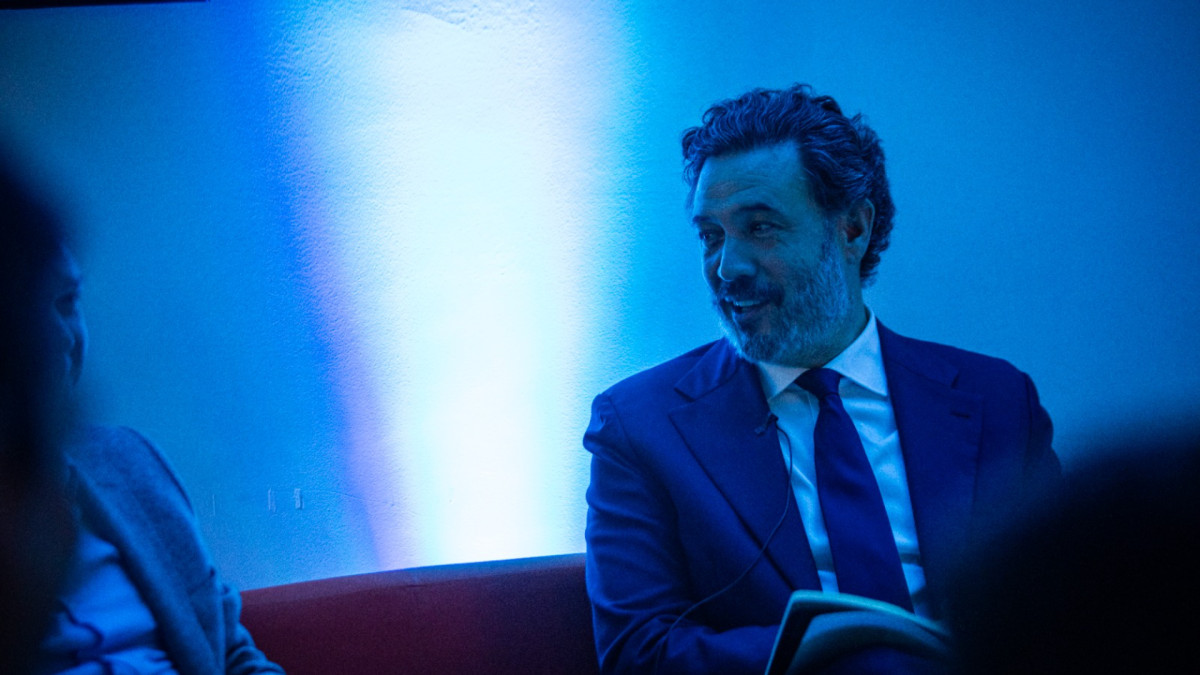
For Guillermo Mariscal, the recovery of an industrial policy capable of meeting the needs of companies requires, first and foremost, rebuilding the credibility of political action. During his participation in the Reindustrialization Symposium, promoted by beBartlet with Agenda Pública as media partner, the Popular Party deputy argued for the importance of restoring electoral programs based on rigorous diagnoses and concrete proposals, capable of giving citizens and businesses a recognizable outlook on the country’s economic future.
With the aim of the November 29 elections in view, Mariscal addressed the priorities that should guide the PP’s industrial policy, from the management of energy infrastructures to the review of mechanisms supporting mobility and energy efficiency. His approach rests on the conviction that Spain has sufficient resources and capabilities to occupy a leading industrial position in Europe, although he believes that exploitation is conditioned by regulatory difficulties, administrative slowness, and the lack of sustained political decisions over time.
Recuperar la credibilidad política y el diálogo con las empresas
“We need to recover maturity in political discourse.” Mariscal invoked this idea to describe what he sees as the deterioration of the public debate, marked by a growing confrontation that makes it difficult to discuss the country’s structural needs. In particular, he lamented the loss of relevance of electoral programs and of the intellectual substrate that should support political projects, a situation he considers especially harmful when tackling industrial transformations whose effects span multiple legislative terms.
The deputy also criticized the functioning of parliamentary debate, which he placed behind the level of discussion taking place in other areas of society. In response to this dynamic, he argued for the need to construct verifiable proposals, backed by data and transparent explanations, that allow restoring trust in institutions and embracing disagreements as part of the decision-making process.
“Mariscal reivindicó la necesidad de construir propuestas verificables, apoyadas en datos y explicaciones transparentes, que permitan recuperar la confianza en las instituciones”
Esta exigencia de madurez política debería extenderse, según explicó, a las relaciones entre las administraciones y el tejido empresarial. Mariscal animó a las compañías a intervenir con mayor determinación en la conversación pública, trasladando sus necesidades, cuestionando las decisiones que consideren equivocadas y planteando alternativas cuando las políticas adoptadas puedan perjudicar su actividad.
En su opinión, el diálogo entre el sector público y el privado debe construirse sobre una relación de confianza y responsabilidad compartida, en la que las empresas reconozcan también su contribución al bienestar social. La posibilidad de alcanzar acuerdos duraderos requiere que ambas partes puedan debatir con franqueza, incluso cuando existan posiciones enfrentadas, y que los responsables políticos sean capaces de escuchar las demandas empresariales sin renunciar a sus obligaciones con el conjunto de la ciudadanía.
The Popular deputy shares his view on how the country’s energy infrastructure should be developed.
Una gestión más eficiente de la red para desbloquear la inversión
The management of the electrical system occupied a central place among the industrial priorities outlined by Mariscal, who argued that the main Spanish energy challenge currently lies in making better use of available generation capacity and facilitating the development of new electricity-consuming projects.
Mariscal linked what he considers the grid’s deficiencies to the imbalance between the growth of electricity production and the evolution of consumption. In his view, Spain has developed substantial generation capacity without demand rising at the same pace, which is generating difficulties in making certain facilities profitable and fully seizing the opportunities for industrial attraction.
Therefore, he considered it a priority to promote the deployment of new consumers and strategic projects, rather than concentrating all efforts on further increasing generation capacity. This reorientation, he noted, should be accompanied by a review of administrative procedures and the management of grid access rights.
“El diputado vinculó lo que considera las deficiencias de la red con el desequilibrio existente entre el crecimiento de la producción eléctrica y la evolución del consumo”
Among the proposed measures he highlighted the establishment of a fast-track process for projects deemed strategic, with the aim of ensuring their electrical planning within a six-month timeframe. Mariscal also defended revising the capacity reservations for network access in order to verify which projects are truly viable and prevent existing allocations from hindering the connection of new industrial initiatives.
These proposals respond to a broader concern about the slow pace at which fundamental decisions for Spain’s competitiveness are taken. The deputy stressed that the regulatory framework and management procedures must adapt to real investment needs, especially in an international context in which other countries are advancing more rapidly in developing their industrial capacities.
The security of supply was another issue addressed during his intervention. After recalling the national blackout, Mariscal warned of the need to strengthen institutional accountability to prevent new incidents affecting towns and regions of Spain. In his view, the management of strategic infrastructures requires clear accountability mechanisms, since the absence of responsible parties in the face of potential faults weakens the confidence of businesses and citizens.
Movilidad y eficiencia energética con mayor protagonismo empresarial
The transition to new mobility models was another field in which Mariscal defended revising public policies. The deputy questioned whether the administrations should drive technological transformations without first guaranteeing the necessary conditions for citizens and businesses to adopt them, using the electric vehicle as an example of the difficulties that arise when political goals advance faster than the available infrastructures.
In relation to public subsidies, he proposed auditing accounts and evaluating existing support mechanisms, with the aim of ensuring a more efficient use of resources. His proposal is to orchestrate incentives toward equal opportunities in access to mobility, rather than focusing actions on direct subsidies for vehicle purchases.
Mariscal argued that a review of public spending can be compatible with boosting strategic sectors, provided that the measures contribute to stimulating the economy, facilitating the renewal of the vehicle fleet and promoting a transition accessible to all of society.
In terms of energy efficiency, he positively valued the operation of the Energy Saving Certificates (ESCs), which he identified as a useful instrument to advance decarbonization through private sector participation. According to him, this type of mechanism allows leveraging the investment and action capacity of companies, fostering improvements in energy consumption without transferring all responsibility for the transformation to the administrations.
“Mariscal planteó la necesidad de auditar las cuentas y evaluar los mecanismos de apoyo existentes, con el propósito de garantizar un uso más eficiente de los recursos”
This assessment aligns with his view of the role the State should play in strategic sectors. Mariscal defended a public intervention aimed at facilitating, supporting, and providing certainty to business activity, avoiding excessive oversight that limits companies’ autonomy or subordinates their decisions to political interests.

Guillermo Mariscal with Nacho Corredor (left) moments before the session.
Responsabilidad y estabilidad para una política industrial de largo plazo
The need to reinforce trust between institutions and businesses ran through all the proposals put forward by the Popular Party deputy, for whom industrial development requires a political culture capable of facing complex decisions and bearing their consequences.
Mariscal stressed that industrial policy must be formulated based on the country’s needs and not on the opportunistic interests of each government, especially when it concerns energy investments, infrastructures, or technological transformations that require planning horizons longer than a single legislative term.
In this context, he distinguished between political responsibility and assigning blame, noting that public officials must answer for their decisions and for the functioning of the strategic services under their remit, avoiding systematically transferring the consequences of problems to other actors.
“La política industrial debe formularse a partir de las necesidades del país y no de los intereses coyunturales de cada Gobierno”
His intervention outlined a direction for the industrial policy that the PP aspires to develop, based on a more agile administration, infrastructure management tailored to productive needs and a relationship of greater trust with the private sector. For Mariscal, Spain’s ability to harness its industrial advantages will depend on these priorities being translated into concrete decisions, sustained over time and backed by recognizable political responsibility.
En alianza con:

