
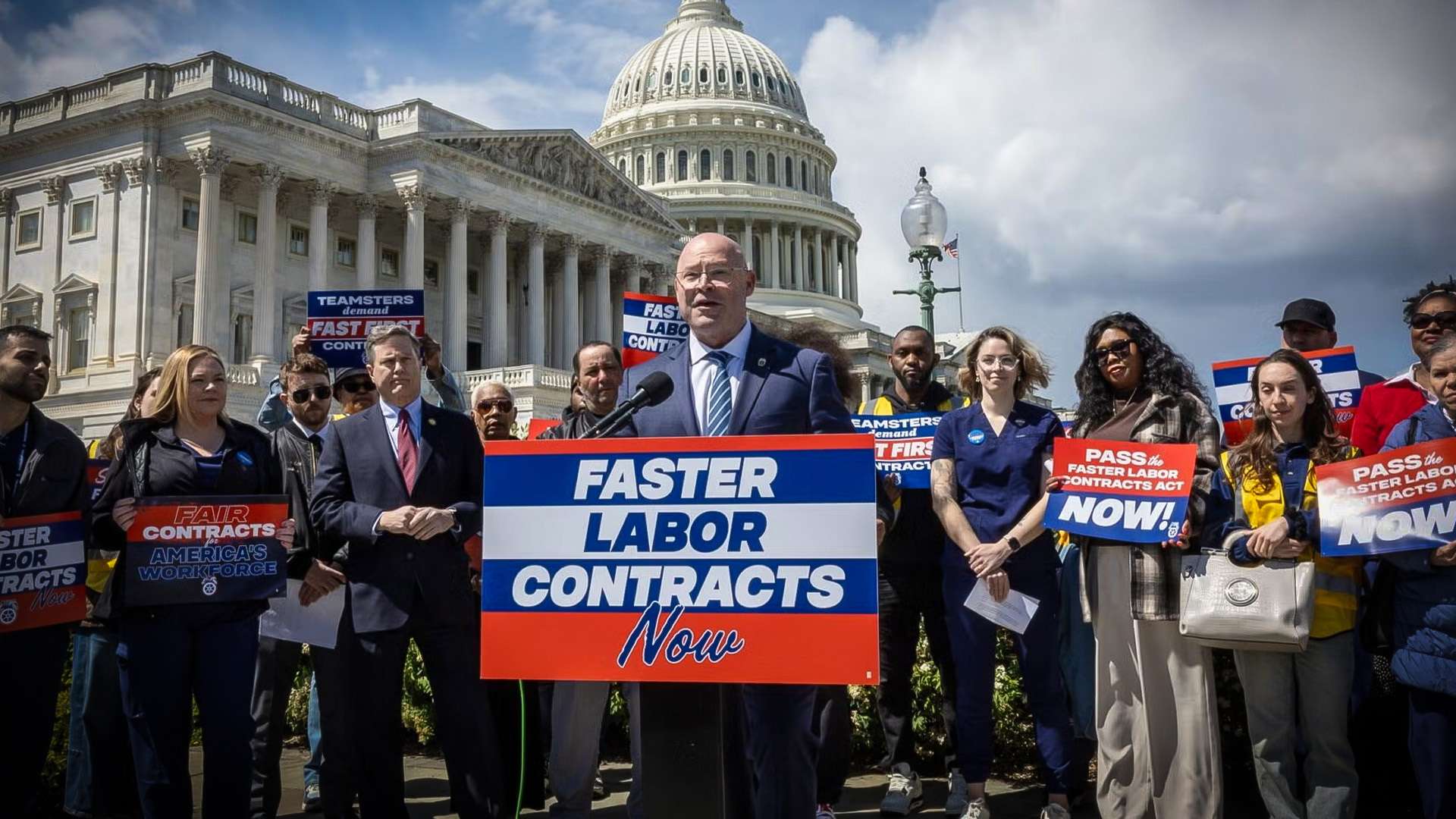
The GOP seeks to position itself as the party that champions workers. The Faster Labor Contracts Act isn’t the path to achieve that.
Over the past several years, observers have noted a shift on the political right toward embracing labor unions. During his reelection bid, President Donald Trump drew headlines by bypassing a presidential debate to meet with striking United Auto Workers in Michigan, while figures such as Vice President JD Vance and Senator Josh Hawley have drawn attention for backing organized labor. Perhaps most prominently, Teamsters President Sean O’Brien was spotlighted as a speaker at the GOP convention.
Yet up to now, any genuine legislation emerging from this pro-labor right has stalled in Congress. That may be poised to change.
A Hawley-backed measure, the Faster Labor Contracts Act (FLCA), appears to be gaining momentum and could soon clear the House of Representatives. Regrettably, the FLCA embodies a triple flaw in public policy: it is constitutionally problematic, would revive a bloated government agency, and would diminish the voices of both employers and workers.
Earlier in this Congress, Hawley introduced the FLCA in the Senate, alongside one other Republican senator and three Democratic senators; he has since added another Republican and ten more Democrats. A companion bill in the House has 99 cosponsors, 17 of whom are Republican.
The FLCA aims to speed up the process of labor negotiations once a union is recognized at a workplace. Unions often allege that companies deliberately drag their feet in negotiations, and the bill would seek to address this by requiring contract talks to begin within 10 days of a newly-recognized union filing a collective bargaining demand. The parties would then have 90 days to negotiate—followed by 30 days of mediation—before the issue would be handed off to a government-mandated arbitration process.
The arbitration would be overseen by a three-member panel. Each side would appoint one arbitrator of its choosing, but if the two sides cannot agree on a third member, the Federal Mediation and Conciliation Service would step in to make the appointment.
This government-directed arbitration panel would then possess the power to impose contract terms on both the business and the union involved. In short, the give-and-take of private bargaining would be removed from the hands of private actors—businesses and unions—and placed in the hands of a government-appointed panel.
To date, the FLCA has stalled in committees across both chambers. In the House, Speaker Mike Johnson (R–La.) has refused to bring the measure to the floor. However, last month a discharge petition was filed, potentially forcing a floor vote if a majority of representatives sign on. House Minority Leader Hakeem Jeffries (D–N.Y.) has stated that the petition will “soon” accumulate the votes needed, and pro-union Republicans in the House are even more confident.
“We’re still shaping the strategy, but it’s a question of when, not if,” said Rep. Brian Fitzpatrick (R–Pa.), a cosponsor, in remarks to a gathering of Pennsylvania Teamsters. “It will be brought to the floor and it will pass. That is a guarantee.”
Although the FLCA will face a tougher path in the Senate, it enjoys more Republican backing than would have seemed plausible in the recent past. Depending on the outcome of the 2026 midterms, it could soon be within reach of reaching President Donald Trump’s desk.
Both employers and employees should fear such a development. From a policy standpoint, it is ill-advised to transfer labor contract negotiations—an inherently voluntary back-and-forth between two private parties—into the hands of the government. Labor negotiations can take a long time for good reasons, given the complexity and the specificity of issues across different industries.
A Bloomberg Law analysis found that negotiations for initial union contracts in workplaces typically take about 409 days to conclude. Forcing this process into an unrealistically tight 120 days under the FLCA would likely sidestep genuine negotiation and compel terms from the outset.
Another troubling aspect of the FLCA is that it would revive a bloated federal agency that has long been cited as a symbol of government excess. The Federal Mediation and Conciliation Service, charged with overseeing the mandatory arbitration process under the FLCA, has been infamous for corruption and profligacy.
The agency’s nine-story office in Washington, D.C., reportedly housed private staff bathrooms, a full gym, and oil paintings of employees. One official at the agency allegedly listed his Iowa residence as his permanent home so that time spent in D.C. could be treated as a business trip and meal costs billed to the U.S. government.
Unsurprisingly, the agency became a target of the Department of Government Efficiency, which cut its staff by 93 percent and slashed its mediation workforce from roughly 100 employees to just five. Yet while the Trump administration has sought to wind down the agency, the FLCA would suddenly grant it enhanced powers to shape private-sector labor terms.
Perhaps the most troubling aspect of all is that the FLCA rests on significant constitutional flaws. By effectively empowering the government to dictate private contract terms, it creates a form of “state action.” Once state action is involved, protections such as freedom of speech and association could be invoked.
In the 2018 case Janus v. AFSCME, the Supreme Court held that forcing government workers to join a union without an opt-out violated their rights to free speech and association. Janus does not apply to private-sector unions because there is no state action involved. But under the FLCA, with its government-mandated arbitration, the equation could change due to the introduction of state action, potentially enabling First Amendment challenges to proceed.
It’s clear that the political right increasingly wants to be seen as pro-worker. There are legitimate and constructive policy avenues available to pursue that aim. But the Faster Labor Contracts Act is not one of them.
