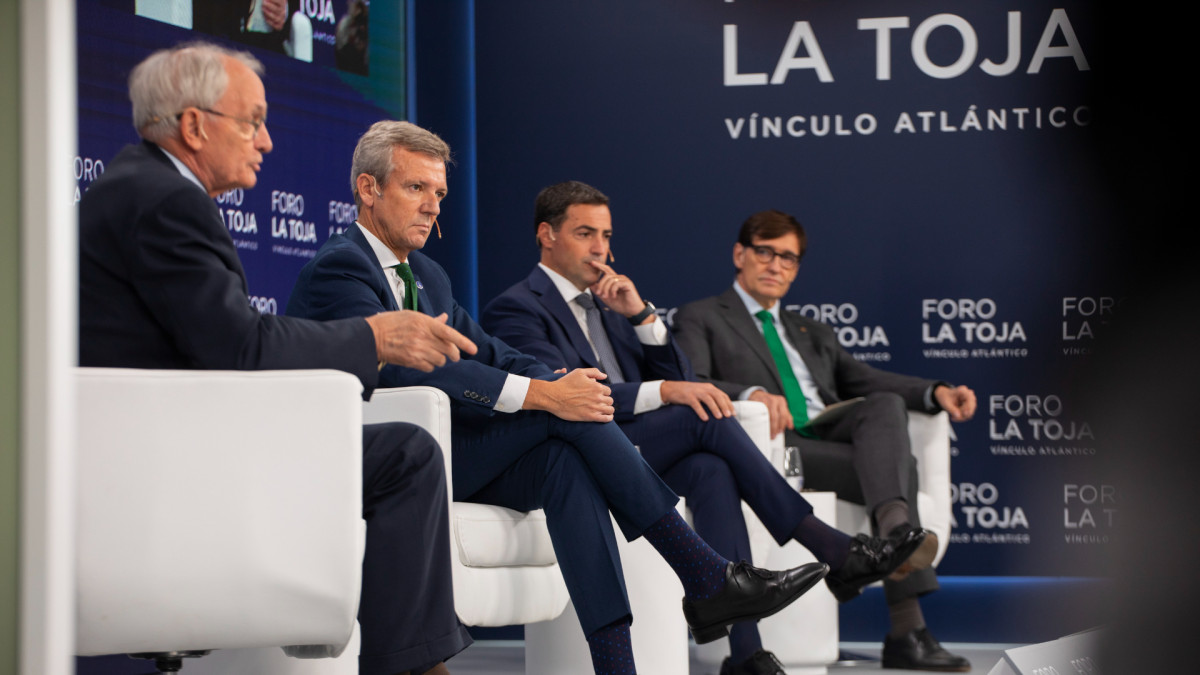
The debate on the economic articulation of the State brought to the La Toja Forum the top representatives of the three historical nationalities: the President of the Xunta de Galicia, Alfonso Rueda; the Lehendakari of the Basque Government, Imanol Pradales; and the President of the Generalitat of Catalonia, Salvador Illa. Under the moderation of the President of the Spanish Economic and Social Council (CES), Antón Costas, the panel on competitiveness and territorial cohesion sought to transcend financial discussion to address territorial prosperity as an indispensable pillar of democratic stability.
At the opening of the colloquium, Costas framed the debate by recalling that the future of liberal society and the welfare state is decided in the territory. Citing economist David Autor’s analyses of the drivers behind the rise of populism in the United States and the United Kingdom, he argued that setbacks in productivity and the presence of high-quality jobs in the regions constitute the breeding ground for political disaffection. Drawing on Franklin D. Roosevelt’s famous line — “the men in need are not free men” — and on Mario Draghi’s thesis on the non-negotiable nature of social protection in Europe, the moderator urged to connect industrial development with territorial equity.
“The future of liberal society and the welfare state is decided in the territory”
The joint image of Galicia, Euskadi and Catalunya projected an explicit message of institutional cooperation against the dynamics of polarization. As the speakers stressed, the three communities represent undeniable engines of the country as a whole: Euskadi and Catalunya account for a quarter of the national GDP, while Galicia and Catalunya together account for a third of Spanish exports.
Alfonso Rueda, Salvador Illa e Imanol Pradales, durante el Foro La Toja. Photo: Agenda Pública / Yanka Soto
Stability, Self-Government and Industrial Policy as Growth Drivers
In the regional diagnostic round, Alfonso Rueda asserted political and legal stability as the indispensable premise for sustaining economic growth. Galicia has maintained a convergence trajectory supported by the uninterrupted approval of its autonomous budgets since 2009. For the Galician president, the greatest future opportunities lie in the transition to green energies and the sustainable use of strategic minerals. He also highlighted as priority axes to meet the demand for vacancies in the productive fabric the issues of workforce absenteeism, dual vocational training, and the orderly attraction of return immigration — which has contributed close to 50,000 people to the community in recent years — and the associated challenges.
Meanwhile, Imanol Pradales emphasized that political stability in Euskadi has allowed twenty-two consecutive quarters of growth above 2% and unemployment at historic lows around 6%. The Lehendakari argued that “if we do not generate wealth, we cannot redistribute welfare,” placing the capacity for self-government and the continuity of industrial policies across four decades as the keystone of the Basque success. This strategy has facilitated the transformation of key sectors such as energy and technology, while maintaining high levels of social cohesion as measured by indicators of low inequality.
Salvador Illa detailed the Catalan Government’s roadmap to articulate what he defined as “shared prosperity,” aimed at generating wealth and distributing it socially and territorially. Illa structured his model around five strategic levers: accelerating renewable energies; achieving water autonomy through investments of 2.7 billion euros in treated water and desalination; boosting connectivity infrastructures — including the sustainable expansion of El Prat airport, the Mediterranean Corridor and the direct rail interconnection with Euskadi; integration into international circuits of research talent and business; and administrative simplification combined with the professionalization of public administration.
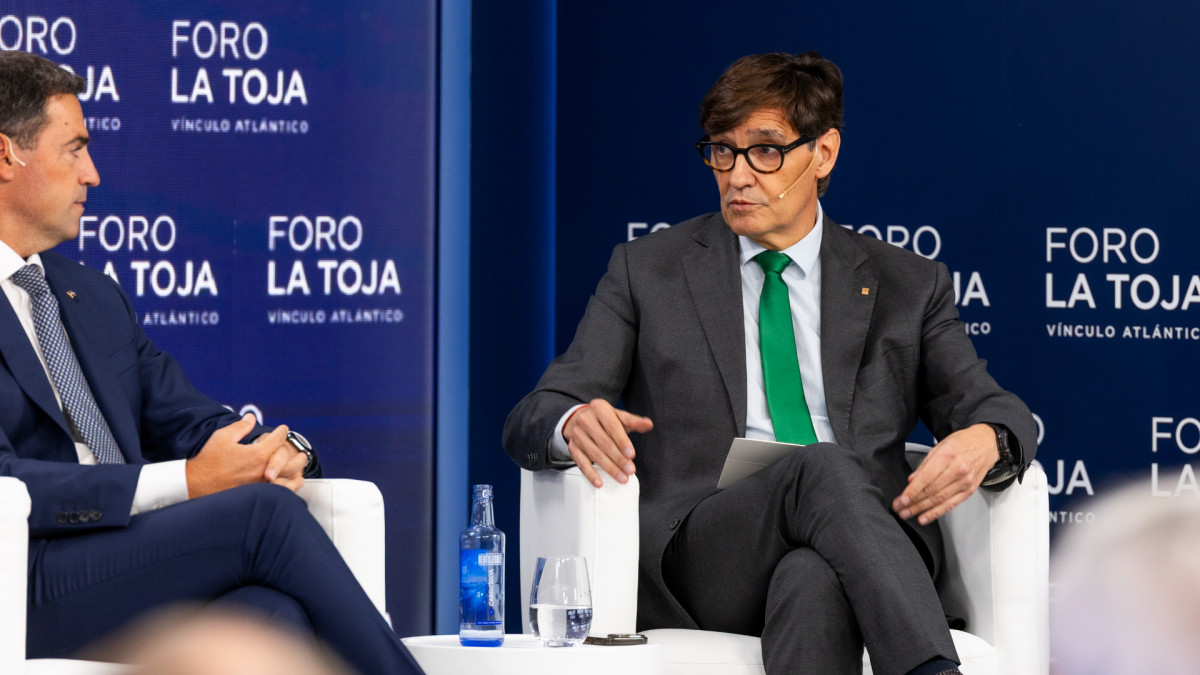
Salvador Illa outlines the Catalan Government’s roadmap to drive a “shared prosperity”. Photo: Agenda Pública / Yanka Soto
Housing as the Gordian Knot of Social Cohesion
Access to housing emerged as the main convergence point and concern of the round, recognized as a direct obstacle to increasing families’ disposable income, labor mobility, and retention of young talent. The three leaders agreed that the housing response requires intensive mobilization of public land, adequate financing, and the involvement of the private sector.
“The three leaders agreed that the housing response requires the intensive mobilization of public land, adequate financing and the involvement of the private sector”
Illa expressed deep disappointment at parliamentary blockages to residential initiatives, arguing that when the market fails to guarantee an essential good, public administrations have the obligation to intervene. Among the measures advanced in Catalonia, he highlighted the prioritization of land for residential use through the reconversion of tourist flats and the application of mechanisms such as the “shared purchase” contemplated in the Catalan Civil Code.
From the Basque experience, Pradales noted that Euskadi has the largest relative stock of protected public housing in the state (close to 8%, with a target of reaching 12% by 2032). He also announced the launch of a social residential fund for public-private collaboration endowed with public land for 75 years to promote 10,000 affordable rental homes aimed at middle classes.
In contrast to market interventions, Rueda argued for focusing efforts on the direct construction of public housing (4,000 units already under way in Galicia) and the leasing of land that promotes a secure legal environment for small property owners, warning that restrictive or punitive regulations risk reducing the supply of available rental housing.
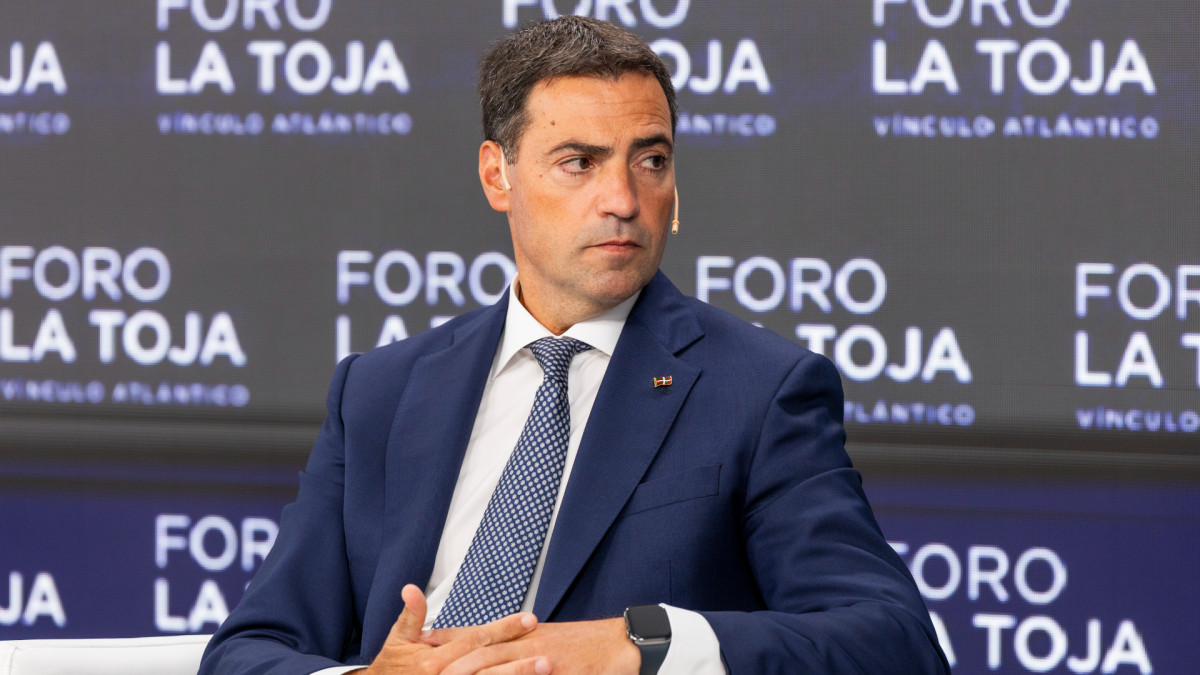
Imanol Pradales defends a more polycentric territorial model and criticizes Madrid’s resource concentration. Photo: Agenda Pública / Yanka Soto
The Core Debate: Madrid Centralization and the Financial Model
The final stretch of the colloquium brought to light the disagreements around the architecture of the State. Pradales expressed concern about a trend toward the centralization of political, economic and technological power around Madrid, recalling that nearly half of the foreign investment that Spain receives concentrates in the capital. The Lehendakari argued that this centralizing model is detrimental to territorial cohesion and advocated drawing inspiration from polycentric schemes such as those of Germany or Italy.
“The Lehendakari argued that this centralizing model is detrimental to territorial cohesion and urged looking to polycentric schemes such as those in Germany or Italy”
In the debate over regional financing, Illa defended the proposal for a new Catalan model, arguing that the current system is outdated. According to the Catalan leader, the reform would entail the transfer of 21,000 million euros from the General State Administration to the common regime communities to sustain health and education services and reduce per-capita funding gaps without creating privileges or harming any territory.
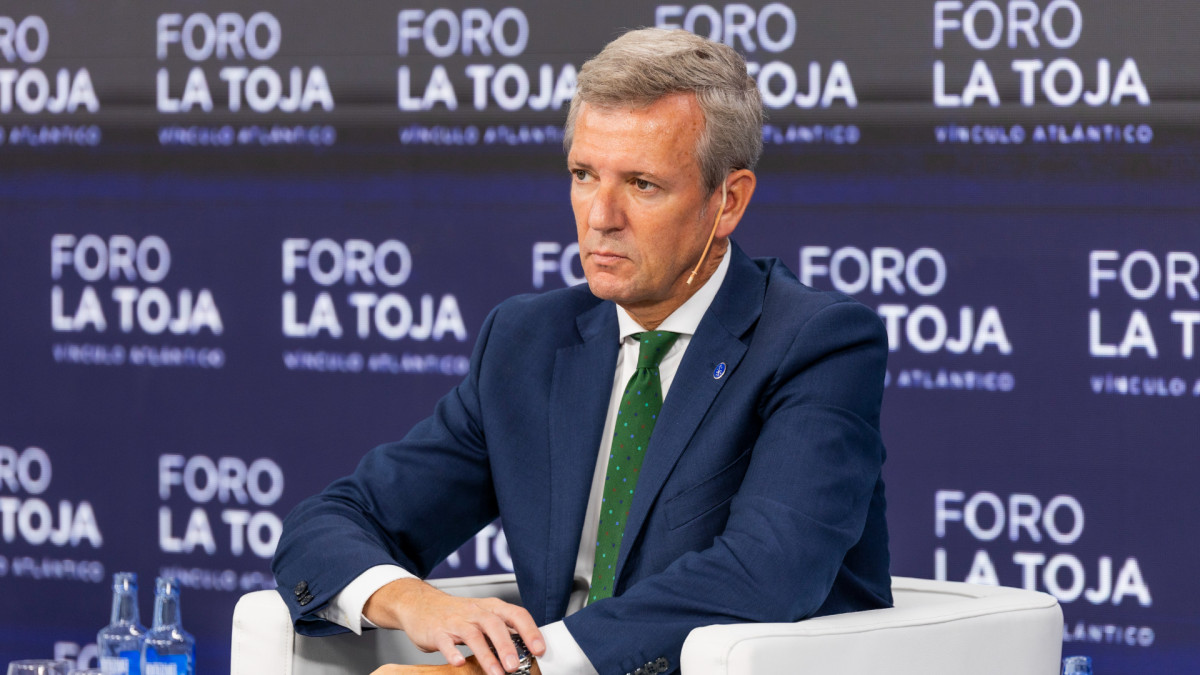
The President of the Xunta explained that restrictive or punitive regulations risk reducing the supply of available rental housing. Photo: Agenda Pública / Yanka Soto
In the face of this bilateral approach, Rueda rejected singular allocations and called for a multilateral agreement in which all autonomous communities participate. The Galician president warned that the proposed allocation criteria place Galicia among the regions worst funded in the distribution of new resources, and insisted that any reform must guarantee equal access to public services regardless of residence.
The meeting concluded by noting that, beyond legitimate partisan nuances and regional models, constant dialogue between the autonomous governments constitutes the best guarantee to combine economic competitiveness with the country’s social cohesion.
In partnership with