
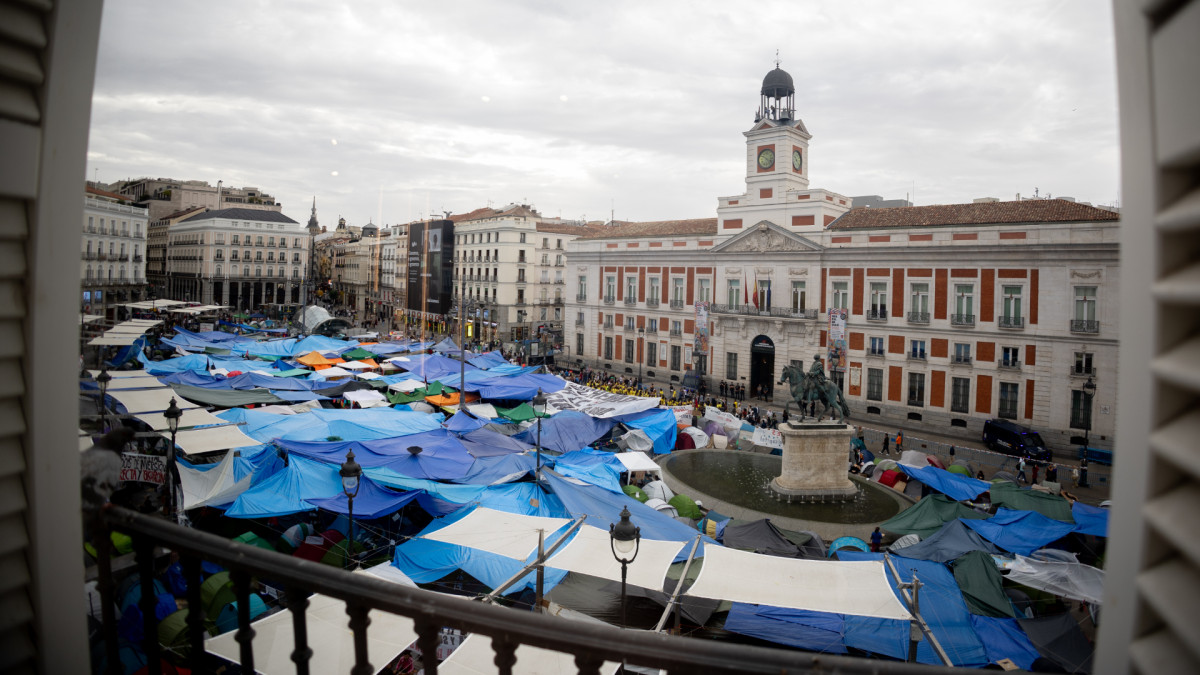
On September 23, Maricarmen, 87 years old, was evicted from the Madrid home where she had lived for the last seventy years. Three days later, the Tenant Union’s demonstration between Sol and the Congress, which drew 25,000 people according to the Government’s delegation and 300,000 according to the organizers, ended with a camp-out in Puerta del Sol that continues, while Maricarmen will be able to return to her home.
Puerta del Sol has the air of an explosion, but it shouldn’t be a surprise. The discontent over housing had been expanding for three years for everyone to see. At least, the data make that clear. In September 2023, housing appeared in 6.4% of responses to the CIS’s question about Spain’s main problems; by May 2026 it reached 48.8%, its historical peak. Today it still heads the list of problems that worry citizens the most and nearly doubles immigration (37.5% vs. 19.7%), although immigration tends to attract much more political and media noise, even though what has happened in September is not the concern itself, but its form and expression, having found in Maricarmen a face and in Sol a square in which to express it.
“In September 2023, housing appeared in 6.4% of responses to the CIS question about Spain’s main problems; by May 2026 it reached 48.8%, its historical peak”
Nevertheless, housing and immigration remain not equivalent. Crossed by vote recall, they draw two different maps of the country. Housing is a material problem present across all electorates; while immigration is configured as an identity problem concentrated on the right bloc and activated and amplified by the agenda. Between both shores sits the PP voter, who in September cites them at exactly the same percentage. How the tension between public agenda and media attention on these two issues is resolved will say a lot about the coming electoral cycle.
Two curves, two logics
The two lines tell two types of problems with different dynamics. Housing grows by accumulation: it rises, retreats for a few months and rises again, supported by each previous step, because it feeds on everyday experiences (rent, lease renewal, the price of owner-occupied housing). This experience does not depend on headlines or shifts in the political or media agenda. Immigration, on the other hand, behaves like an agenda-driven issue. For example, the summer of the cayucos in the Canary Islands and the right’s fight over the distribution of migrant minors pushed it to 30.4% in September 2024. Having lost the focus, three months later it had returned to 13.1%.
The September barometer, the first after the Ceuta events, confirms a different behavior. A first-order border crisis has not caused migration concern to rise, which falls by almost four points, but rather the blame placed on politicians and the Government, which translates into a record high for the series at 18.8%. It is an indication that immigration functions less and less as a standalone problem and more as ammunition for the right against the Government. The drop in housing in that CIS barometer should not be read as relief either, since the fieldwork was conducted between September 1 and 4, three weeks before Maricarmen’s eviction.
Housing: everyone suffers, few prioritize
Housing grows across all electorates at once and is configured as a country-wide problem (not tied to a partisan or ideological bloc). The trajectories rise in parallel: higher among Sumar and the PSOE, lower among the PP and Vox, but with a similar ascent. Even among Santiago Abascal’s voters, the electorate least receptive to naming housing as one of the main problems, one in four (26.5%) pointed to it in May.
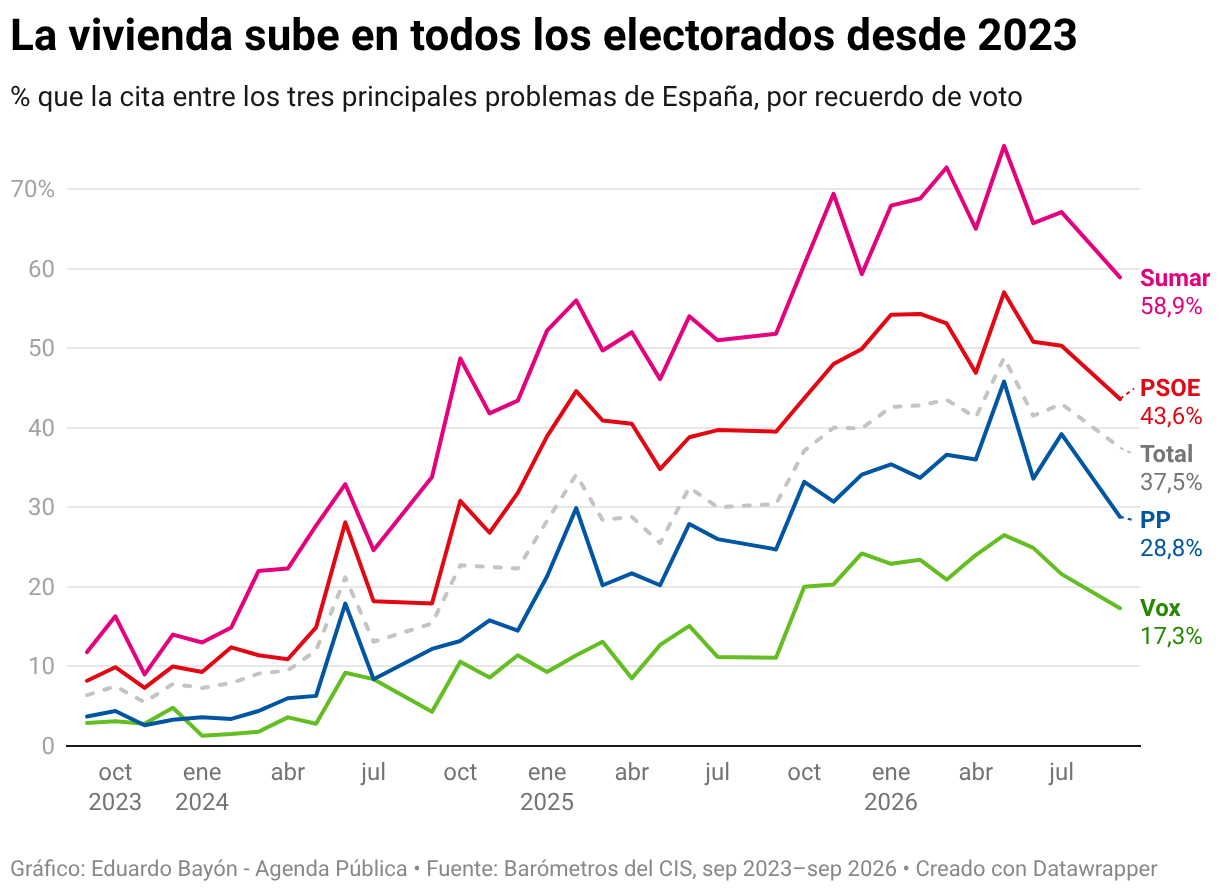
The difference is not whether housing is a concern or not, but how much weight it carries among each electorate. In this regard, as the first problem it is cited by 41.9% of Sumar voters, versus 9.1% of PP voters and 5.6% of Vox voters. For the left it is the main problem of the Spanish state; for the right, just another one on the list. That asymmetry is part of the explanation of why the opposition has not turned housing into its weapon against the Government.
Immigration: a problem with a partisan owner
With immigration the opposite occurs. There is no shared concern between the left and the right electorate: in Vox it is the dominant concern across the entire series, and in Sumar it barely exists. In the last six months, the electorate that mentions it most does so almost nine times more than the one that mentions it least; for housing, the ratio is three to one. This is what is called topical ownership: Vox has made immigration its banner and the axis of its identity, and the concern of its voters rises and falls in step with how the party pushes it onto the agenda.
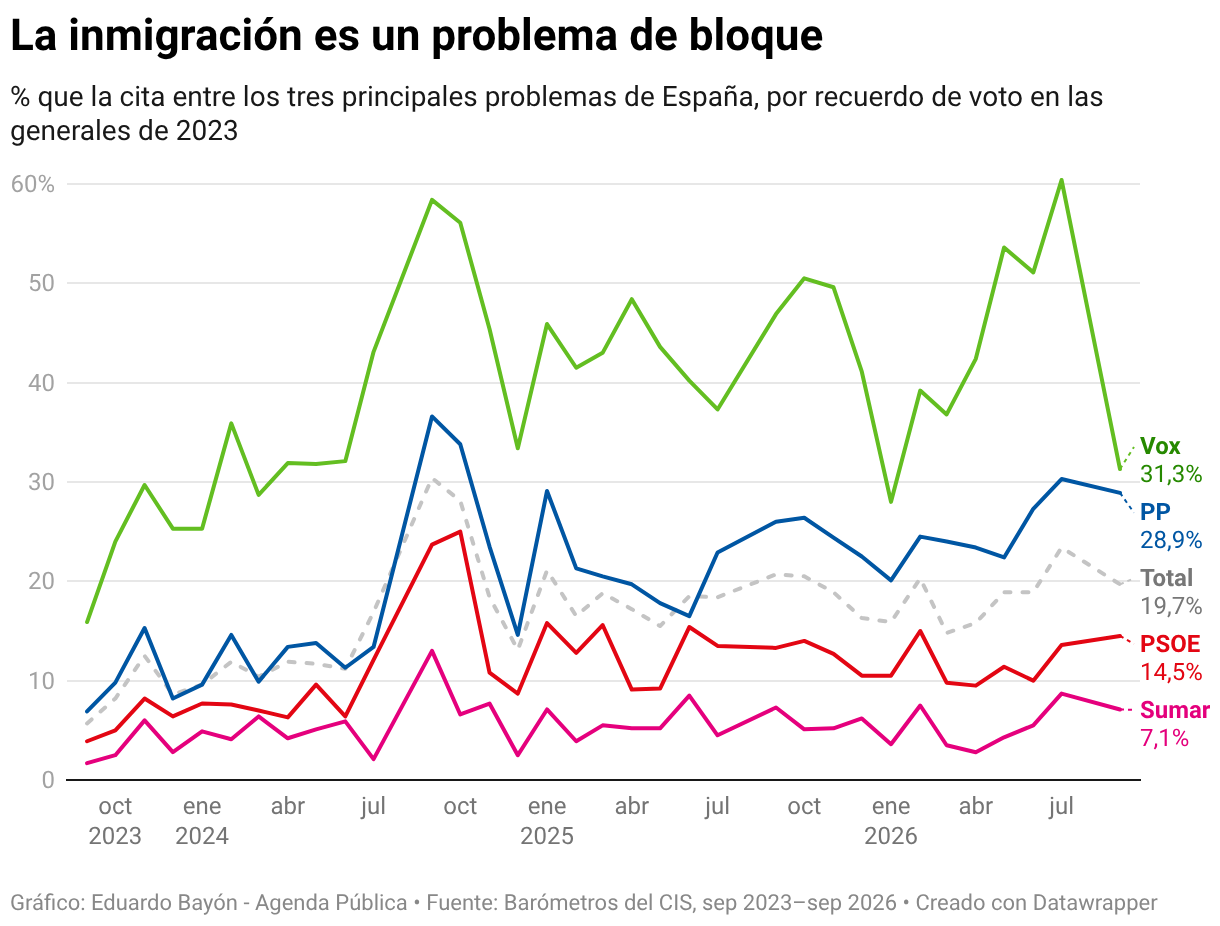
That is why what happens after Ceuta is relevant. Among Vox voters, mention of immigration falls from 60.4% in July to 31.3% in September, while mentions of the Government as a problem rise to 52.4%. It is not disinterest in immigration, but a reframing. Instead of being processed as a migratory problem, Ceuta has been experienced as a test of the Executive’s lack of response.
The hinge of the mainstream electorate
The PP electorate has traversed the two agendas in three years. During 2024 it looked very much like Vox: immigration worried it more than housing, and in that year’s migratory summer it tripled it. From 2025 it moved closer to the pattern of PSOE voters, until May housing pulled ahead by more than twenty points as one of Spain’s main problems (45.8% vs 22.4%).
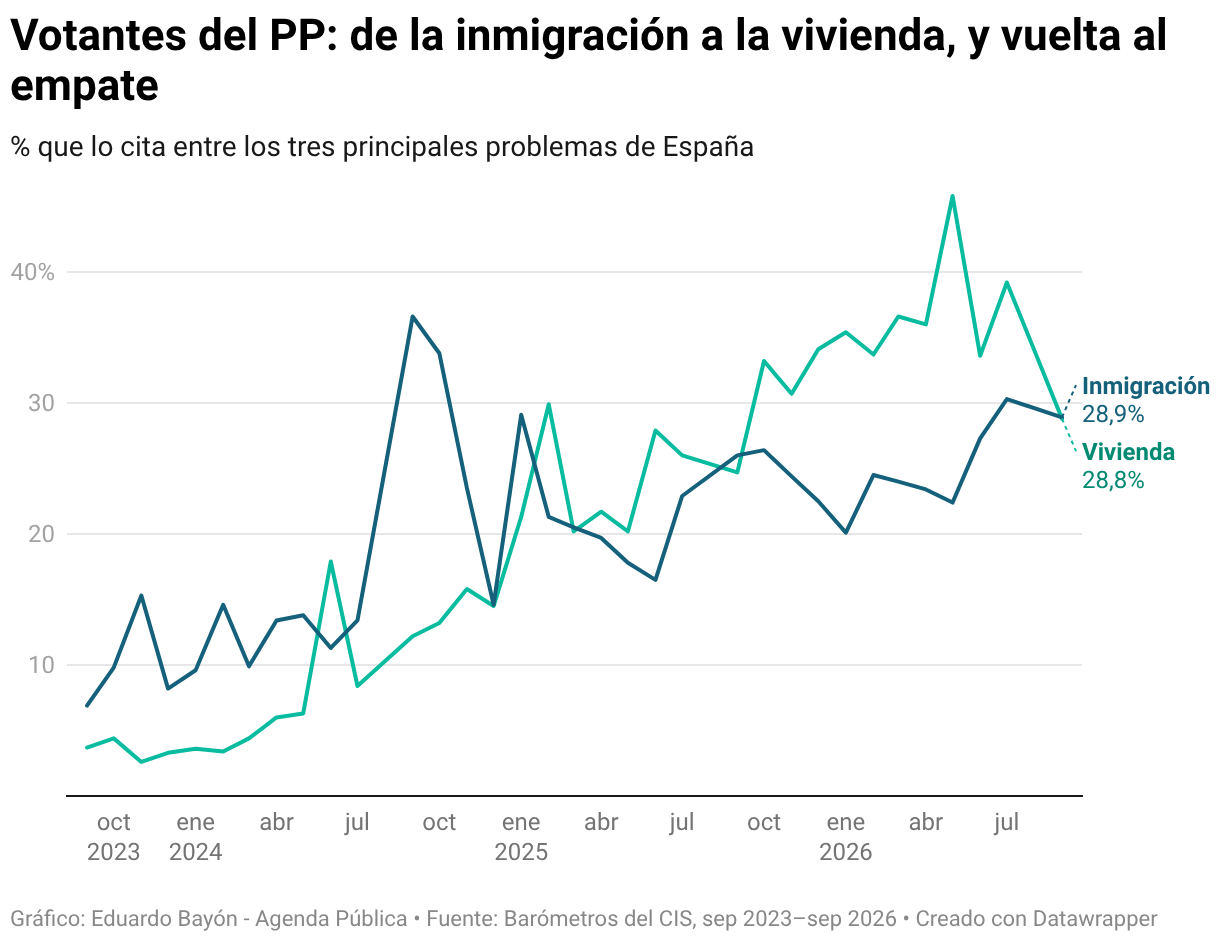
In September that difference disappears: 28.8% housing, 28.9% immigration. At the same time, the Government’s blame among its voters nearly doubles, from 23.1% to 43.3%. This thus reveals a voter under cross-pressures, who shares with the left, to a large extent, the material concern and with Vox the identity one. Which agenda dominates him largely shapes Alberto Núñez Feijóo’s strategy: competing for the center with a moderate housing message or taking away Vox’s ground on immigration. Ceuta pushed public conversation in one direction; Sol pushes it in the other.
What is lived and what is observed
The CIS question about the problem that personally affects each person adds the most useful distinction in the series, the one that shows the difference between egotropic and sociotropic concerns. Housing sits among the top concerns. It is experienced firsthand, and those who cite it as their own problem have gone from 8.8% to 27.9% in the last three years. Immigration is among the second. 19.7% place it among Spain’s main problems, but only 12.6% feel it as their own. In other words, it is a perception largely shaped by what the media and parties say.
“Housing sits among the top concerns. It is lived personally, and those who cite it as their own problem have risen from 8.8% to 27.9% in the last three years”
There lies the key to the Sol encampment. A problem that almost three out of ten citizens experience as their own does not need major intermediaries to mobilize. In this case, a symbolic story in which to identify with suffices: Maricarmen is what many fear could happen to them in the short or medium term. The Vox voters, once again, are the exception, as they are the only ones in whom immigration is perceived more as a personal problem than a national problem. When their voter thinks today about Spain’s problems, they name the Government.
A problem without an owner
Housing is the country’s primary concern and, above all, the left’s primary concern: in the last six months two-thirds of Sumar voters and half of PSOE voters mention it. That puts the Government in a difficult position. It responds to the problem without anyone recognizing the solution, and the right has not capitalized on it because those who suffer among its voters do so without ranking it. That vacuum is what Sol has come to fill. That is why the protest targets the various regional and local administrations. Also the Progressive Coalition Government, which they require to channel the demands into policies. A response that the Executive has issued through two decrees.
Immigration, by contrast, has a partisan owner, but is volatile. It lives on agenda spikes and alarmist headlines. After Ceuta, the right-wing electorate has expressed it more as a reproach to the Executive and politics in general than as a migrant concern. For Vox it is a tactical advantage, for the PP a strategic risk, since immigration dissolves into a general discontent that the far-right can capitalize on more easily.
