
One day before the United States midterm elections, which will serve as a barometer for the Trump administration, and after the results of the parliamentary elections held in Israel were known, with a record representation of Arab parties and the possibility of forming an anti-Netanyahu government if the elections are not repeated, one thing is clear: the situation in the Middle East and the Gulf influences and will influence voters just as it has influenced the markets. Also in Europe.
“The situation in the Middle East and the Gulf influences and will influence voters as much as it has influenced markets”
If in recent years European institutions and citizens have tried to respond, through multilateralism and the defense of international law, to Israel’s disproportionate response to the terrorist attacks of October 7, the genocide and the rebuilding of Gaza, since February 28 this year unilateral attacks by the United States and Israel against Iran, without the approval of the United Nations Security Council, have opened another front of concern. Their price has been paid by civilians — also victims of the Iranian regime, which we have condemned —, with their own lives, and by citizens, with the impact of the war on their economy. None of the ceasefire agreements nor of the negotiations has so far unlocked the Strait of Hormuz, through which passed a fifth of the world’s oil consumption and a third of fertilizers before the war. Only since then the European Union has paid more than €100 billion extra for energy imports, without receiving more in return. This situation has been aggravated, more so, with a new front: the Houthi offensive.
Houthi Offensive
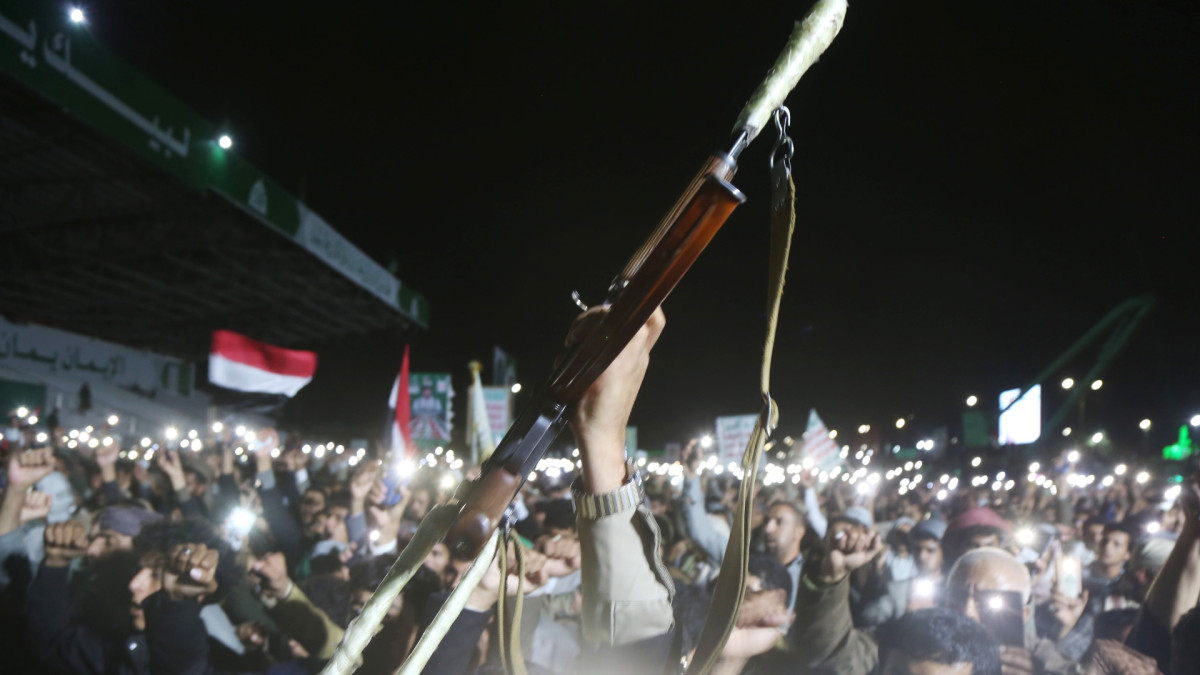
From last July, Yemen has faced a dangerous escalation that also directly hits Saudi Arabia. Yemen is divided between the Houthis — an armed militia backed by Iran, a country with which they feel kinship because their religious confession, Zaidi, is close to Shia Islam — on one side, and the internationally recognized government, whose provisional capital is Aden since the capture of Sana’a, on the other. The country has suffered the Houthis’ advance along the western coast, where they have taken control of Bab el-Mandeb, the strait that had become the main export route for Saudi crude oil via the Red Sea as an alternative to Hormuz. The territorial occupation offensive has reactivated the world’s largest humanitarian crisis, with 1,574 deaths, more than 6,939 wounded and 200,000 displaced since the start of the escalation. Moreover, it endangers fertilizer trade and the food security of millions of people.
“The offensive of territorial occupation has reactivated the world’s largest humanitarian crisis, with 1,574 deaths, more than 6,939 wounded and 200,000 displaced since the start of the escalation”
Saudi Arabia, for its part, has also suffered missile and drone attacks by the pro-Iran militia against its critical infrastructure, such as Aramco’s oil facilities, against residential areas and even against its holy cities, Mecca and Medina. Among the most serious attacks is the one carried out against Riyadh’s King Khalid International Airport on October 10, which caused 13 deaths, among Saudis and foreigners, and hundreds of injuries. In short, the Houthis have declared Saudi airspace a zone of operations and have imposed a naval blockade on the kingdom through attacks against Saudi oil tankers in the Red Sea. Thus, Saudi Arabia faces an unprecedented situation, in which its security is at risk to the point that Netanyahu has offered to help defend it. The kingdom has rejected that offer, in a context where it remains opposed to signing the Abraham Accords without recognizing a Palestinian state. The United States, for its part, has condemned the attacks and ordered the withdrawal of its diplomatic staff while studying a possible intervention against the Houthis — in any case, after the midterm elections.
And Europe, what does it say?
The European External Action Service and the high representative Kaja Kallas have expressed solidarity with Saudi Arabia and Yemen and have called to expand the maritime operation ASPIDES at the latest Foreign Affairs Council on October 12. An initiative that we also support. The attacks have led to the postponement of the second summit between the Gulf Cooperation Council (GCC) and the EU, scheduled for October 24 in Riyadh, while negotiations on strategic partnership agreements and free trade agreements between the European Union and the Gulf countries continue, so the situation is likely to keep delaying these two milestones.
From our side, in the European Parliament we have sought to go a step further with the approval, by a majority, of the Resolution on the escalation of the Houthi attacks and their implications for regional security, proposed by the Group of the Socialist and Democrats, of which I was the negotiator. In the text, in addition to condemning the Houthi attacks on Gulf countries and Israel and the humanitarian and commercial situation that results from them, we explicitly request the Council to include the Houthis in the European Union’s list of terrorist organizations, of which they are not yet part. To move forward, this proposal would require the formal request of a Member State or that of Kaja Kallas herself to obtain unanimous Council support. With this measure, one of the pro-Iran proxies with the greatest current power, whose coordination is essential for Hezbollah’s action in Lebanon, would be weakened.
“We explicitly request the Council to include the Houthis in the European Union’s list of terrorist organizations, of which they are not yet part”
Furthermore, the text delves into the need to strengthen cooperation and diplomacy in defense and maritime security with Gulf countries, to push measures addressing the energy impact in Europe and to guarantee our humanitarian aid and accountability for violations of international humanitarian law committed in the region. Finally, and as has become customary, we call for the publication of the Strategy for the Middle East, a commitment included in the European Commission’s Work Programme for 2026 that still has not seen the light “due to the situation in Iran,” in the words of the high representative.
The Parliament has always been ahead of the measures the Commission was to implement for the region and has acted in accordance with international law and the demands of the citizenry: we call for the inclusion of the Islamic Revolutionary Guard Corps in the EU’s terrorist list — subsequently approved —, we demand sanctions on Israeli settlers — subsequently approved for violent settlers —, the suspension of the Association Agreement with Israel and the cessation of trade in products from occupied Palestinian territories, in line with our stance on a two-state solution, and the activation of the Blocking Statute to shield the International Criminal Court from Trump’s sanctions; these last three measures are still under consideration.
Even with the limitations that may exist in the EU regarding external action and given the competences that fall to the member states, we must lead firm positions in today’s geopolitics. Otherwise, our capacity will be merely reactive and we will bear reputational and economic costs that neither the citizens nor Europeanism can afford. As happens whenever the Middle East is aflame and others set the pace.
