

The expansion of paternity leave in Spain was one of the flagship reforms in equality in recent years. Between 2017 and 2021, the leave rose from four to sixteen weeks, fully matching maternity leave, being non-transferable and paid at one hundred percent. The reform was swift, ambitious, and enjoyed broad political consensus. The expectation was clear: if fathers could devote the same amount of time as mothers to early caregiving, women would find it easier to maintain their labor attachment and re-enter the workforce sooner and on better terms. However, the question that remains is whether this measure, by itself, has been able to reduce the motherhood penalty in the labor market.
“Many women experience interruptions or reductions in their employment after the birth of a child: unpaid leaves, reductions in working hours, or temporary exits from the labor market”
The motherhood penalty in the labor market is a well-documented and persistent phenomenon in Spain. Many women experience interruptions or reductions in their employment after the birth of a child: unpaid leaves, reductions in working hours, or temporary exits from the labor market are part of reconciliation strategies that, while necessary, carry a clear cost on their career trajectories. The data show that mothers’ incomes fall 11% in the year following birth and up to 28% ten years later. Among fathers, by contrast, there is usually no deterioration in their employment after the arrival of a child, and it may even improve. In this context, the expansion of paternity leave was presented as a tool capable of balancing responsibilities and mitigating these inequalities.
To examine whether this objective has been achieved, our study analyzes a survey conducted with mothers in heterosexual couples whose children were born between 2018 and 2022, a period in which several paternity-leave regimes coexisted. This allows comparing what happened to mothers exposed to short leaves and what happened to those whose partners enjoyed the full sixteen weeks.
The analysis shows that the equalization of leave durations has not, in general terms, reduced the motherhood penalty. The expansion has not accelerated mothers’ return to work nor increased the likelihood that they do so on a full-time basis. Nor has it altered the subjective perception of having sacrificed more career advancement than their partners, a sentiment expressed by around two-thirds of mothers (Figure 1). The distribution among full-time, part-time, or non-employment remains practically the same before and after the reform. This suggests that, despite the progress represented by formal equality in the duration of leave, the underlying structure of inequality these policies target remains very strong.
Figure 1. Estimated probabilities that mothers perceive having sacrificed more of their career advancement than their partners, comparing the different periods of paternity-leave expansion. Note: results adjusted for differences in families’ socioeconomic and employment situations. The secondary axis shows a histogram with the percentage of mothers in each cohort according to the length of paternity leave.
However, the study does not conclude that the reform lacks effects. Rather, it reveals that these effects are concentrated in a specific group of families: those in which the incomes of the mother and father are similar. In this segment, which represents roughly a fifth of the sample, significant changes are observed after the extension of the leave. Mothers in these couples increase their probability of returning to work before six months and have greater chances of doing so full-time after the leave extension (Figure 2, panel B). In addition, they attribute a more significant role to the father’s support in their ability to resume professional activity, something that scarcely occurred when the leave was four weeks.
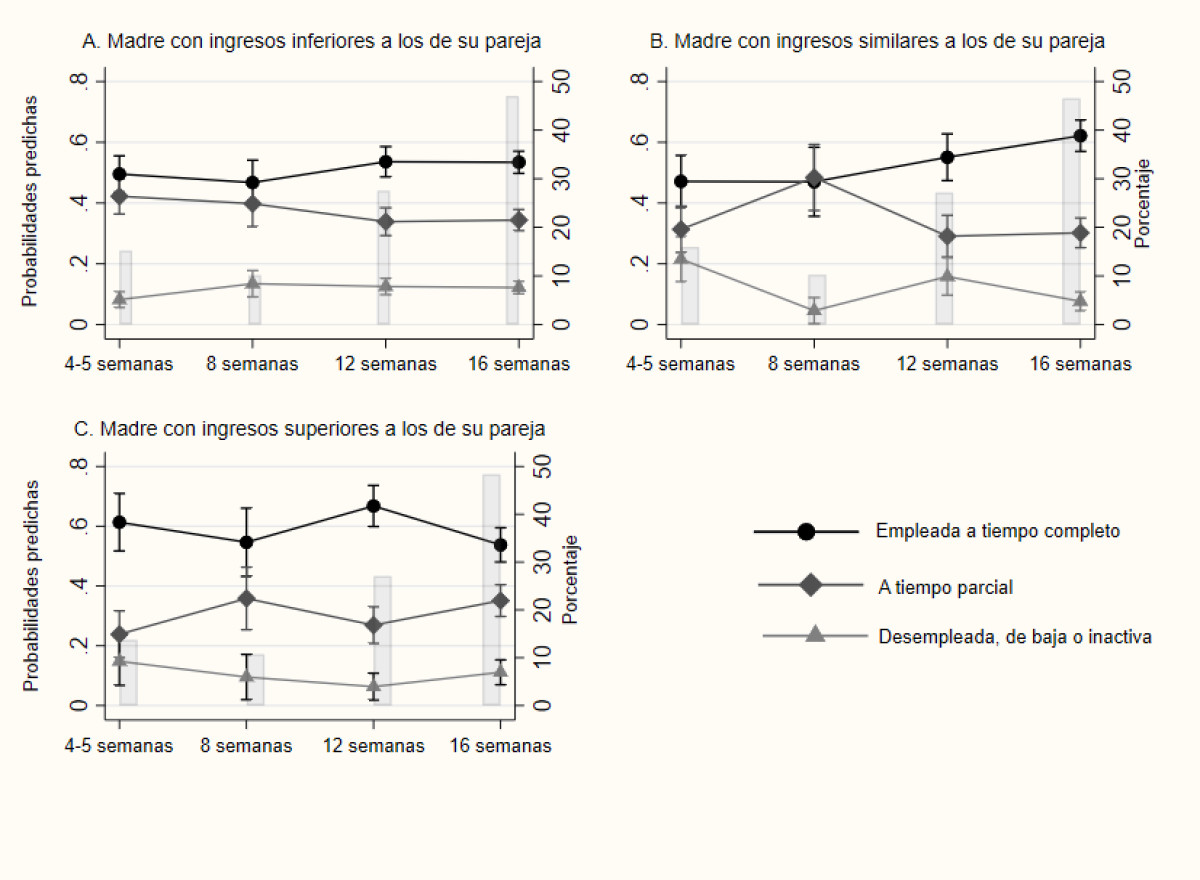
Figure 2. Estimated probabilities of mothers’ employment status (full-time, part-time, or not employed) across the different periods of paternity-leave expansion. Note: results adjusted to account for differences in families’ socioeconomic and employment conditions. The secondary axis shows a histogram with the percentage of mothers in each cohort according to the duration of paternity leave.
This pattern suggests that the extension of the leave works especially well in households where there was already some equality: greater balance in domestic decisions, similar valuation of both partners’ employment, and less pressure for the mother to bear most of the caregiving. In these contexts, the reform seems to act as a reinforcement of already-present egalitarian dynamics.
“The extension of the leave works especially well in households where there was already some equality: greater balance in domestic decisions, similar valuation of employment”
For the rest of the families, the measure has not produced noticeable changes. Among mothers who earn less than their partners —the majority— no improvements are observed either at the moment of returning to employment or in working hours (Figure 2, panel A). Among those who earn more, there is a somewhat earlier return to work, though not an increase in full-time hours, which was already high before the reform (panel C). This indicates that economic inequalities within the couple play a decisive role in how responsibilities are distributed and how each member adjusts their employment after the birth of a child.
There is another aspect that helps explain why the reform’s effects are so constrained. In Spain, the sixteen-week maternity leave is among the shortest in Europe. Once exhausted, many women continue to be the ones who handle daily caregiving, which drives them to rely on unpaid leaves or reductions of working hours, with the economic and professional consequences that this entails. The most recent data show that in 2021 and 2022 around 14.6% of mothers used a leave of absence to care for underage children, compared with only 1% of fathers. Even in 2023, when paternity leave was fully equalized, the number of leaves requested by women increased by 10%. The reform of paternity leave, however ambitious, cannot fully compensate for the fact that many mothers are compelled to undertake periods of unpaid caregiving that directly impact their careers.
“Expanding paternity leave is an important step, but insufficient, to reduce the motherhood penalty”
All of this indicates that expanding paternity leave is an important step, but insufficient, to reduce the motherhood penalty. Formal equality advances; real equality, far less so. To transform the situation effectively, broader policies are required: longer maternity leaves or new paid leave in the early years, accessible and universal education and childcare services, and more stable, better-paid jobs for women. Without these transformations, family decisions will continue to be conditioned by economic inequalities that cause mothers to bear the labor cost of caregiving.
In short, the extension of paternity leave is a meaningful and necessary advance, but its impact depends on the economic and equality conditions within the home. Where that equality was already present, the reform helped. Where it was not, its effects were much more limited. The policy acts, but it does so on uneven ground, and that greatly conditions what it can achieve. Only when these structural inequalities are addressed comprehensively can the motherhood penalty in Spain be substantially reduced.
Based on: Marinova, Dani; Bellón-Jiménez, Pedro Manuel (2025). “Paternity Leave and the Motherhood Penalty: How Within-Couple Inequality Conditions Policy Impact”. Social Policy & Administration. https://doi.org/10.1111/spol.7003
