
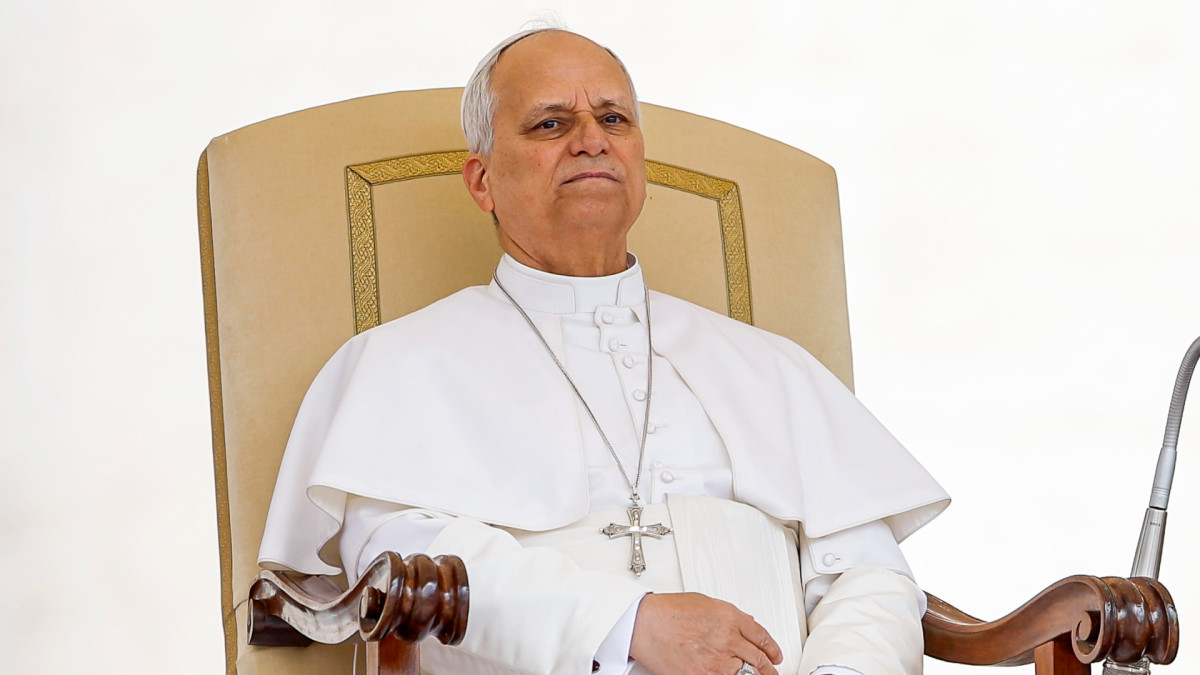
An apocryphal anecdote from the Potsdam Conference of 1945 has it that Josef Stalin asked Winston Churchill: “How many divisions does the Pope have?” The Pope Pius XII allegedly replied: “My son Joseph will discover it when he tries to reach heaven.”
After falling into obscurity, this story resurfaced in the 1980s, when a pope of Polish origin, John Paul II, became one of the most significant challenges to the ideology sustaining the Soviet Union and its satellite empire in Central and Eastern Europe. A regime that called itself a “popular democracy” was not such, and when millions of people attended the Pope’s visits to Communist-ruled Poland, it seemed to disprove the Kremlin’s great lie.
“There are striking parallels, among them the need for radical reforms or a fundamental reconsideration of the country’s political leadership”
Rumors then circulated that Soviet intelligence services were behind a 1991 assassination attempt on the Pope in St. Peter’s Square. By the end of the decade, the satellite empire had collapsed and, two years later, so too did the Soviet Union. The last leader of the USSR, Mikhail Gorbachev, could not push reforms with sufficient speed.
Although the challenges facing the United States today are very different, there are striking parallels, among them the need for radical reforms or a fundamental reconsideration of the country’s political leadership.
After all, the current American leadership is clearly adrift in international affairs. In February 2025, the president Donald Trump seized a meeting in the Oval Office to chide the Ukrainian president, Volodymyr Zelenskiy, ridiculing him by saying he did not have the cards to defeat Russia. Yet, precisely a year later, the United States started a war with Iran that it could not finish, and Ukraine is the one with the cards the U.S. needs: a deep knowledge of drone technologies and counter-drone tactics.
Just as the Soviet Union in the 1980s, the United States fears being outpaced economically and technologically. Trump speaks continually of decadence and of an internal “bloodbath,” and he likes to quote the famous remark by Saudi Crown Prince Mohammed bin Salman that the U.S. was a “dead country” before he came to the White House. The MAGA movement promises a national renaissance, but his administration has repeatedly been reminded how much the American economy relies on Chinese supplies.
“The seeds have been sown for an epic conflict between a universal religion and a belligerently assertive state”
Then there is the spiritual crisis. In the Soviet Union, it manifested as a spiritual vacuum—the void that the message of John Paul II could fill—while in the United States there is plenty of “religion,” but one that has been instrumentalized for aggressive nationalism. The seeds of an epic conflict between a universal religion and a belligerently assertive state have been sown. The predecessor of Pope Leo XIV, Pope Francis, used his final Easter message to warn against ethnic nationalism, and that same message still resonates clearly from the Vatican in 2026.
Recall Easter Sunday this year, when Trump demanded Iran open the Strait of Hormuz, “or they will live in hell — YOU WILL SEE! Praise be to Allah—”. He then escalated the confrontation by threatening that “tonight an entire civilization will die, never to return.” A week later, Trump posted an AI-generated image depicting him as Jesus, standing before military scenes and a horned demon. He later claimed he thought the image portrayed him as a doctor, and he shared another image of himself being embraced by Jesus.
The ensuing social-media storm was as predictable as it was inevitable. Like John Paul II, Pope Leo XIV avoided direct denunciation, though he left little doubt about his stance: “Woe to those who manipulate religion and the very name of God for their own military, economic, and political gain, dragging the sacred into darkness and filth.” In response to this clear papal condemnation of the Trump administration’s grave threats, Vice President J. D. Vance, newly converted to Catholicism, urged Leo to “be careful” when speaking about theological matters.
Of course, Christian nationalism—praying for one’s own side in a “just war” or believing that one’s own people are God’s people—has been widespread across long stretches of history. It has always rested on a flawed vision of international conflict as a “clash of civilizations,” and Trump has merely offered an extreme caricature of this perspective.
“Leo felt the obligation to criticize the glorification of violence and war by Christian nationalism”
But that does not alter the fact that his administration remains fundamentally at odds with Christian doctrine. When Leo stepped in, he articulated a version of globalism with ethical foundations, distinct from the amoral approach favored by most contemporary proponents of globalization. His vision reaches back at least to 1945, at the moment of Stalin’s supposed cynical remark about the power of religion. And just as his Polish predecessor criticized the spiritual vacuum of communism, Leo felt compelled to critique the glorification of violence and war by Christian nationalism.
In January 2004, after the US-led invasion of Iraq, John Paul II stressed that peace was not only possible but necessary to fulfill the fundamental Christian obligation toward one’s neighbor. While he did not advocate pacifism, he urged us to strive for a world governed by multilateral institutions, in which force could be applied only under the umbrella of international law. That was the objective in 1945, when humanity embarked on a deep renewal of the international legal order.
Is it providential that an Eastern European pope corrects an abuse of Eastern Europe and that an American pope today denounces an American abuse? For now, only God knows.
© Project Syndicate, 2026.
