
Montgomery County applies steep markups to alcohol sold to private retailers, charges nothing to its own stores, and conducts inspections of the businesses it competes with.
A bottle of Kendall-Jackson Vintners Reserve Chardonnay sells for $9.97 at Total Wine’s outlet in Friendship Heights, Washington, D.C. Just beyond the D.C. border in Montgomery County, the same bottle carries an $11.75 price tag for Arash Tafakor, who runs two wine-and-beer shops, to stock. Like many local merchants, Tafakor attributes this price gap to his government.
Maryland, unlike its northern and southern neighbors, is not a control state; residents may buy alcohol from privately operated stores, and wholesalers can purchase products at market rates. That freedom ends in Montgomery County, where local law requires retailers and restaurants to source their beer, wine, and spirits from the county, which also runs its own stores and regulates licensing and inspection of rival businesses.
Montgomery County stands alone in the United States as the only county with a full monopoly over the wholesale distribution of beer, wine, and spirits. This framework traces back to the end of Prohibition, when Maryland lawmakers established a liquor control board to oversee licensing and distribution. Nearly a century later, the county’s control board—rebranded as Alcohol Beverage Services (ABS) in 2019—has expanded to operate twenty-seven of its own stores. The original aim was to regulate what the state regarded as a potentially dangerous substance, but in recent years, “they made it into a business,” Tafakor tells Reason.
The county applies markups ranging from 5 to 35 percent on wine, 23 to 60 percent on beer, and 29 to 90 percent on kegs above what it pays distributors, according to records Tafakor obtained through a Maryland Public Information Act request. County-operated stores are exempt from that markup, enabling them to sell to consumers for far less than private shops and, in some cases, even less than what private retailers charge. Last December, the county billed private stores like Tafakor’s $226.50 per bottle of Dom Pérignon. On its website, it was selling the same bottle to consumers for only $217.59. “This practice is common by the county stores during the holiday season to attract more customers,” Tafakor says.
If private stores want a product that the county doesn’t already distribute, they have to wait for the county to approve the sale, which Tafakor says can take two to eight weeks, if it gets done at all. Meanwhile, ABS stores and stores outside Montgomery County can obtain those products in under a day. In addition to their lower prices and first dibs on new products, ABS stores are also the only off-premise sites that can sell spirits. “It’s nearly impossible to compete with these stores,” Tafakor says.
The government’s control over the industry has been lucrative for Montgomery County. According to an ABS staff report, Montgomery County’s alcohol business raked in $31.3 million in net profit in FY2024; however, this wasn’t because it ran a successful enterprise. The report shows ABS stores lost more than $3.9 million that year, while their wholesale division profited nearly $50 million.
Tafakor estimates the county’s inventory markups cost his two stores around $1.1 million in FY2025—and his stores accounted for just 2.23 percent of the county’s wholesale sales that year, according to the county’s financial disclosures.
“Essentially, they own 30 percent of our store,” he says. “I don’t have the basic freedom that everybody else is entitled to outside of Montgomery County in Virginia [which is a control state for spirits], D.C., and Maryland, because I am forced to buy through the county.”
On top of that, Tafakor’s stores are also subject to inspections from the County Board of License Commissioners, which was folded into the ABS in 2007, and is now responsible for regulating the same businesses it competes with. “They’re supposed to visit us every quarter. I had an inspector that was coming in nonstop, harassing me,” Tafakor says. The inspector would show up claiming he was “in the neighborhood,” then “snoop around…looking for stuff.” Even making remarks like “the mouse catches the cheese once in a while.”
The county’s dual role as a retailer and enforcement arm raises obvious conflict of interest concerns, which some county leaders have acknowledged.
In 2015, Fred Silverman, then a member of the county’s Board of License Commissioners, wrote a memo to the County Council’s Alcohol Policy Ad Hoc Committee warning the county about the system’s economic harms and questionable legality. Silverman argued that the county made a “mistake” by stripping the board of its independence. He also said the county is “operating outside the law.”
After Tafakor filed a complaint over the county’s pricing schemes, Maryland’s Alcohol, Tobacco, and Cannabis Commission investigated and found that county stores paid no markup on their inventory. According to Tafakor, ABS officials justify this practice by telling state officials that their stores aren’t retailers but “extensions of the county warehouse,” so products can be transferred without a markup. The county has a point: even if stores did pay the same markup, they would merely be transferring money between the county’s retail and wholesale divisions. The retailer’s balance sheet wouldn’t be pretty, but the county’s bottom line would stay the same.
In a March letter to the ABS director, Kathie Durbin, the commission said the practice “effectively gives the appearance of price discrimination” and suggested the county charge its own stores “the same markup applied to private retailers.”
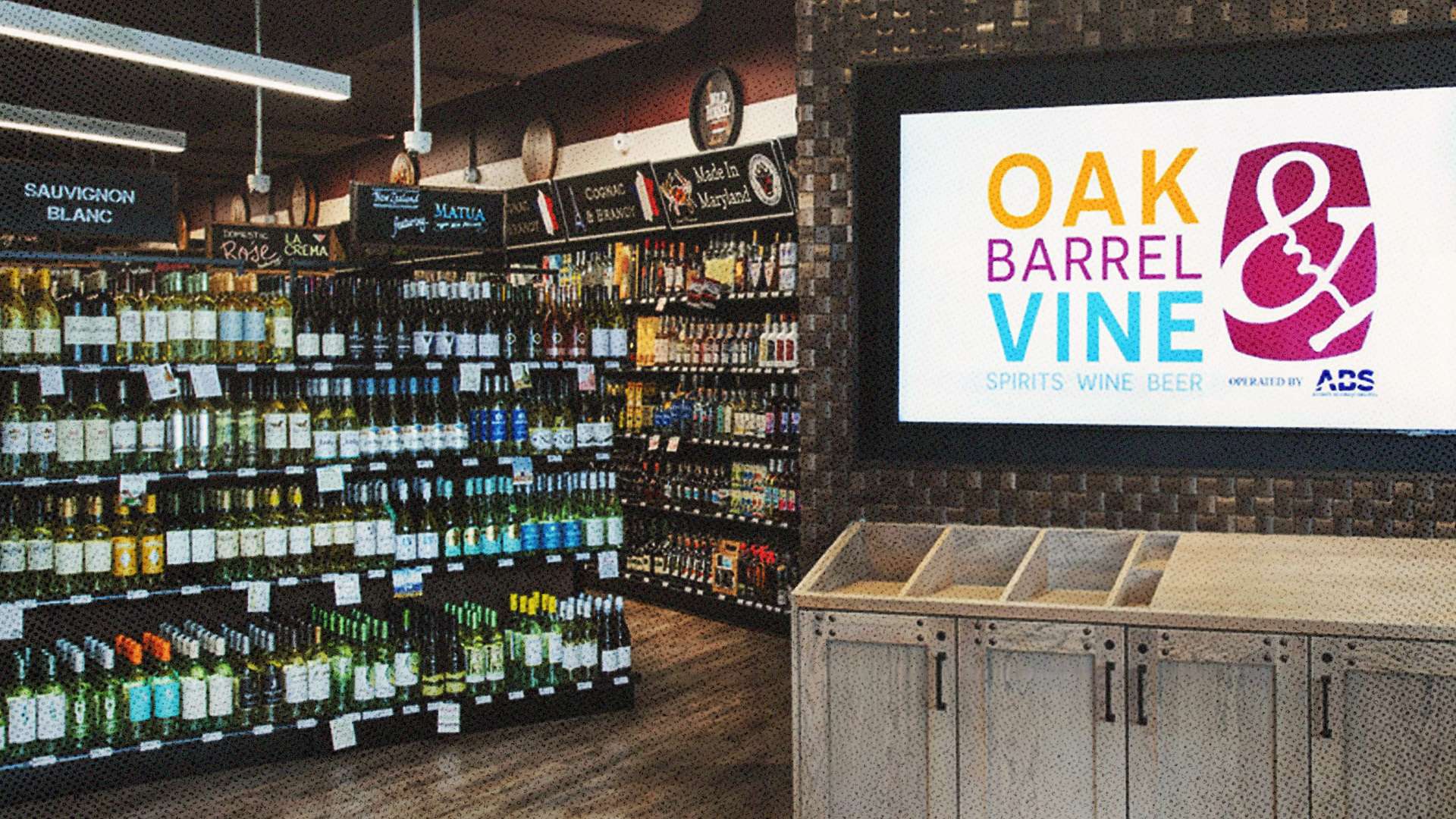
In 2016, businesses and consumers pushed back against the county’s system, with many suggesting the alcohol business be privatized. County Council member Marc Elrich outlined an alternative solution. “I would make it so the customer wouldn’t know whether they were in a private liquor store or a county liquor store,” he told Bethesda Magazine. “I basically would make this a system that you would think is a private system and keep the revenue,” and that’s exactly what they did. In 2021, the county began rebranding its “Montgomery County Liquor & Wine” stores to “Oak Barrel & Vine,” giving them the look of a private retailer. Their stores run ads, offer promotional discounts, and host wine tastings.
The Montgomery County ABS was not available for comment at the time of publication.
Small businesses aren’t the only ones paying the price for Montgomery County’s policies; consumers feel it too. “Not only has it hurt us personally, [but] it’s hurt the growth of the small businesses in Montgomery County. It’s killing them.” Tafakor says, “Restaurateurs, they don’t open in Montgomery County. They open in Frederick, they open in Virginia, they open up in D.C. where they don’t have to go through this.”
