
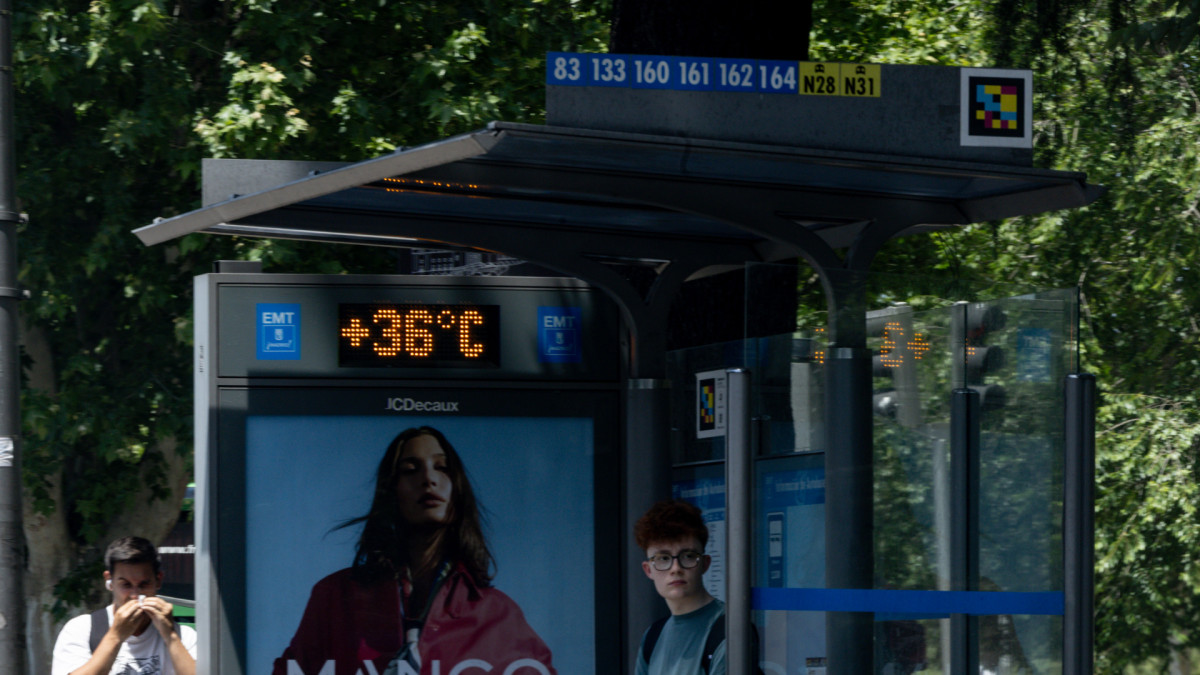
Spain and a large part of Europe are currently experiencing an episode of unusually early heat this week. Temperatures hovering near 40 °C, well above what is typical for this time of year, and a May that is beginning to look too much like July from a few years ago.
The latest report on the State of the Climate in Europe, produced by Copernicus and the World Meteorological Organization, leaves no room for doubt: Europe is the fastest-warming continent, and 2025 has confirmed it once again. What appears this week to be an anomaly is, in fact, an increasingly clear sign of the current climate reality that we already live in.
“The problem is that our cities, our homes and our public policies are not prepared for this present”
And the data from Spain confirm this with brutal precision. The summer of 2025 left almost 4,000 heat-related deaths, according to MoMo, the system of the Carlos III Health Institute, 88% more than the previous year, with the first victims already in May. Spain is today the second country in Europe with the most deaths from extreme temperatures. And the heat arrives earlier and earlier. But the problem is not only the timing. The problem is that our cities, our homes, and our public policies are not prepared for this present, and far from ready for the future that is already upon us.
Around 80% of the Spanish population lives in urban environments, and our cities are particularly vulnerable: asphalt, concrete, sparse vegetation, and high building density create urban heat islands where temperatures can be between 10 °C and 15 °C higher than in peripheral areas. Madrid is, according to an Arup study, one of the most intense critical points in Europe.
In that context, one in three Spanish households cannot keep their home at a sufficiently cool temperature. Among vulnerable households, one in two. Access to habitable temperatures is not a luxury nor a matter of comfort: it is a public health necessity that we continue to treat as secondary.
“Living with extreme temperatures means poor sleep, more illness, a worse quality of life and taking risks that should not depend on postal code or income level”
Energy poverty is, today, more than the inability to heat a home in winter. In a country increasingly exposed to these extreme temperatures, it also means not being able to shield oneself from heat in spring and summer. This means poor sleep, more illness, a worse quality of life and taking risks that should not depend on postal code or income level.
Scientific evidence clearly points to where to begin: reducing the demand for refrigeration from the source. Likewise, cities must be cooled from the root, for instance through renaturalization, increasing tree cover, creating shade, replacing impermeable surfaces with soils capable of absorbing water and heat, or transforming urban space so that it no longer behaves like a heat trap.
Trees, through shade and evapotranspiration, can reduce air temperatures by 2 °C to 5 °C and surface temperatures by 10 °C to 12 °C during a heatwave. In Paris, turning asphalt school courtyards into green spaces reduced soil temperatures by about 7 °C. In an extreme heat wave, that difference can save lives.
That is why the response must follow a clear hierarchy: first, urban renaturalization; then, efficient rehabilitation of the built environment; next, collective systems and district networks; and always, efficient climate-control technologies, properly installed and integrated into that context. This is the central proposal of the report Cooling the Present, Living in the Future, published by the Platform for the Decarbonization of Heat and Cold.
While Spain is trying to catch its breath in these historically hot spring days, two concrete instruments converge in the calendar that could alter the trajectory. Neither of them can keep waiting.
The first is the Social Climate Plan, recently published by the Government. Spain has been allocated about 9,000 million euros for the 2026-2032 period through the European Climate Social Fund, to offset the impact of ETS2—the European emissions trading system that extends to buildings and transport—on vulnerable households and those most exposed to rising fossil-fuel costs.
“A well-renovated building not only consumes less energy: it also protects its inhabitants from January’s cold and May’s heat”
But the Social Climate Plan cannot be limited to cushioning a future price increase. In Spain it should also be read as a climate-habitat policy: funding energy-efficient renovations, replacing fossil-fuel equipment, supporting renewable solutions, and affordable heating and cooling systems for those who need them most. Because a well-installed heat pump not only heats in winter. It also cools in summer. And a well-renovated building not only uses less energy: it also protects its inhabitants from January’s cold and May’s heat. In a country where one in two vulnerable households cannot keep their home at a sufficiently cool temperature, that is not a technical detail. It is a public health issue.
The plan, supported by several organizations within the Alliance for Housing Renovation Leaving No One Behind, the ECODES working group on vulnerability and poverty in transport, and the Alliance for a Climate Social Plan that is fair for users and vulnerable micro-enterprises in transport, hits the mark by placing energy rehabilitation at the core —with almost 4.7 billion allocated to the buildings sector, 52% of the plan’s funds— and by recognizing that safeguarding the thermal well-being of vulnerable households should be a priority. For renovation to also serve as climate adaptation policy, the plan should incorporate explicit territorial criteria: prioritizing the hottest-exposed areas and the most vulnerable neighborhoods with the greatest thermal risk.
On top of this, there is a pre-existing structural problem: Spain may have a solid Social Climate Plan on the table, but without transposing ETS2 in Congress, European money will not reach households. The ball is in the legislative chamber.
We cannot afford to have the diagnosis, the plan and the available European resources, yet block the tool that makes delivering them to those who need them most possible. Transposing ETS2 is not just another technical discussion. It is the condition for the Climate Social Fund to become renovation, efficient equipment, habitable homes and real protection against cold and heat.
“Each month of delay is a municipality that cannot plan, a vulnerable neighborhood that still lacks a thermal risk map, another heatwave arriving without strategy”
The second instrument has not yet started. The Energy Efficiency Directive requires municipalities with more than 45,000 inhabitants to develop local heating and cooling plans. It is the first mandate in Spanish regulatory history to recognize urban cooling as a public responsibility. But the royal decree that must implement this mandate has not yet been published. Without it, municipalities cannot begin, or they begin blind. Each month of delay is a municipality that cannot plan, a vulnerable neighborhood that still lacks a thermal risk map, another heatwave arriving without strategy.
Although they are two opportunities with two different actors, the urgency is similar: Congress must transpose so that European money reaches the households that need it most; the Government must publish the royal decree so municipalities can begin to act. With temperatures of summer in full May, neither decision can keep waiting.
Millions of people endure heat at home because they cannot pay the electricity bill, because they live in poorly insulated buildings or because their neighborhoods lack shade. But the answer cannot be to push every household to solve it alone, with more electricity consumption, a crisis that is urban, social and climatic.
“A city that can only be inhabited in summer if you can pay for air conditioning is not a city prepared for climate change”
A city that can only be inhabited in summer if you can pay for air conditioning is not a city prepared for climate change. Far from that, it is a city that expels people. It expels them from the streets, from the squares, from rest, from health and, often, from their own homes. Cooling the present is a political obligation, and the window to act is open now.
