

In all reports, technical reports and lists of recommendations on entrepreneurship and new technologies written in Europe (and Spain), the main conclusion is the same: we know how to create knowledge and launch new startups, but compared with the United States and China we are unable to create real technological champions.
The causes of this phenomenon are multiple, and its main consequences are evident to everyone: dependence on technology from an increasingly unstable and unpredictable ally, a lack of control over corporate decisions that affect large parts of our economy, and the loss of large flows of capital that cross the Atlantic instead of generating jobs and taxes in Europe.
A paradigmatic case of the problem, and at the same time one of the main hopes for its solution, lies in deeptech startups, companies with highly advanced technologies that are not common or accessible to other firms. As they are R&D-intensive and with long timelines for technology and product development, the deeptech sector perhaps best reflects Europe’s difficulties in scaling its startup ventures.
“We know how to create knowledge and launch new ‘startups’, but compared to the United States and China we are unable to create real technological champions”
But, on the other hand, they are also the best opportunity to challenge American big tech. Much of the reason their market position is so solid and overwhelming is due to the so-called “network effects,” which mean that dominating one market (for example, internet searches) leads a company to win others (internet browsers, email, video streaming, etc.) and to keep consumers because the “cost” of leaving that company’s bubble is too high.
However, new companies with disruptive technologies (deeptech) can offer a technological edge large enough to overcome the inertia of network effects. This is what is happening, for example, to the European automotive sector, outpaced by the innovation (and generous state aid) of Chinese electric cars.
Therefore, promoting the development of deeptech startups should be a cornerstone of Spanish and European industrial policy. And, in particular, platform companies offer a number of important advantages for the balanced and innovation-based development of the Spanish economy.
Technology and diversification: the platform company
In contrast to a deeptech startup built around a single product or technology, a startup or platform company (by analogy with a technological platform that enables multiple applications from a single technology) is one that has managed to diversify its range of products and services to reach multiple sectors or applications.
Platform companies can be classified into several types. Pure platform ones are those that, during the development of their main product, naturally develop a series of related technologies that could be marketed separately if there is need or market interest.
Meanwhile, vertical integrator types are the ones that become platform companies by occupying more links in their value chain starting from their initial product, whose strong competitiveness and profitability give them the financial muscle to undertake the development of technologies in the other links of the value chain. Finally, a pure diversifier is a platform company mature enough and financially successful to diversify into products and sectors unrelated to its initial activity.
In Figure 1 one can see a map (not exhaustive) with some of the main platform companies in Spain, at various stages of maturity. Thus, almost all of these companies are not yet truly platform companies, having a single product on the market or in development, but their track record and size give them a high likelihood of becoming platforms in the future.
Figure 1: Location and typology of some platform companies and Spanish candidates for platform status
The selected companies are merely illustrative and not an exhaustive map. Source: own elaboration.
For example, the Donostian Multiverse Computing currently only markets its compressed AI models, but in the future it is highly likely to vertically integrate up its value chain, developing AI chips or entirely proprietary AI models (currently it only improves third-party models), or downward, developing AI applications (like the well-known ChatGPT) based on its compressed models. For instance, the company has already received €12.7 million for the development of advanced microchips.
On the other hand, Qilimanjaro is a pure platform company, since it develops quantum computers that include both the hardware (the computer) and the quantum software, as well as cloud access. While the company currently only markets its technologies as a single package, in the future it could sell separately its hardware, software, and even its connection and management technology for quantum computers in the cloud.
Finally, Arquimea is a pure diversifier. Originally present only in the space sector, since then it has entered many other areas such as aerospace, defense, robotics, digital and quantum technologies, etc. Meanwhile, the rocket maker PLD Space is mainly a vertical integrator, but it could also market some of its current technologies separately as a pure platform, illustrating how borders between these categories can sometimes be blurred.
“The Donostia-based Multiverse Computing has already received €12.7 million for the development of advanced microchips”
The commercial diversification of platform companies has a number of beneficial effects. The first, and most obvious, is that by having more products, their total revenues increase, gaining market volume and increasing the size of the company. Secondly, the platform company becomes more resilient to sales downturns in one or more of its niches, stabilizing the company’s future.
Furthermore, as they are high-technical-complexity and large-scale enterprises, they will tend toward territorial diversification. The need for infrastructures, varied and specialized industrial environments and ecosystems, and their demand for highly skilled and specialized personnel obliges them to set up offices across the territory.
This last point is particularly important for public policy. Like many other countries, Spain faces a problem of excessive regional concentration of innovative activity and startups (in Madrid and Barcelona, and to a lesser extent in the Basque Country and Valencia), coupled with the problem (more specific to Spain) of depopulation in many inland areas.
By creating offices spread across different points of the territory, platform companies generate geographically diverse employment, and act as anchor employers for suppliers that set up in those new locations. Moreover, one of the main indicators of a mature startup ecosystem is the multiplier effect of successful startups: founders of new successful startups tend to come from successful startups of the previous generation. Thus, the territorial diversification of platform companies decentralizes across the country the next generation of technological innovation.
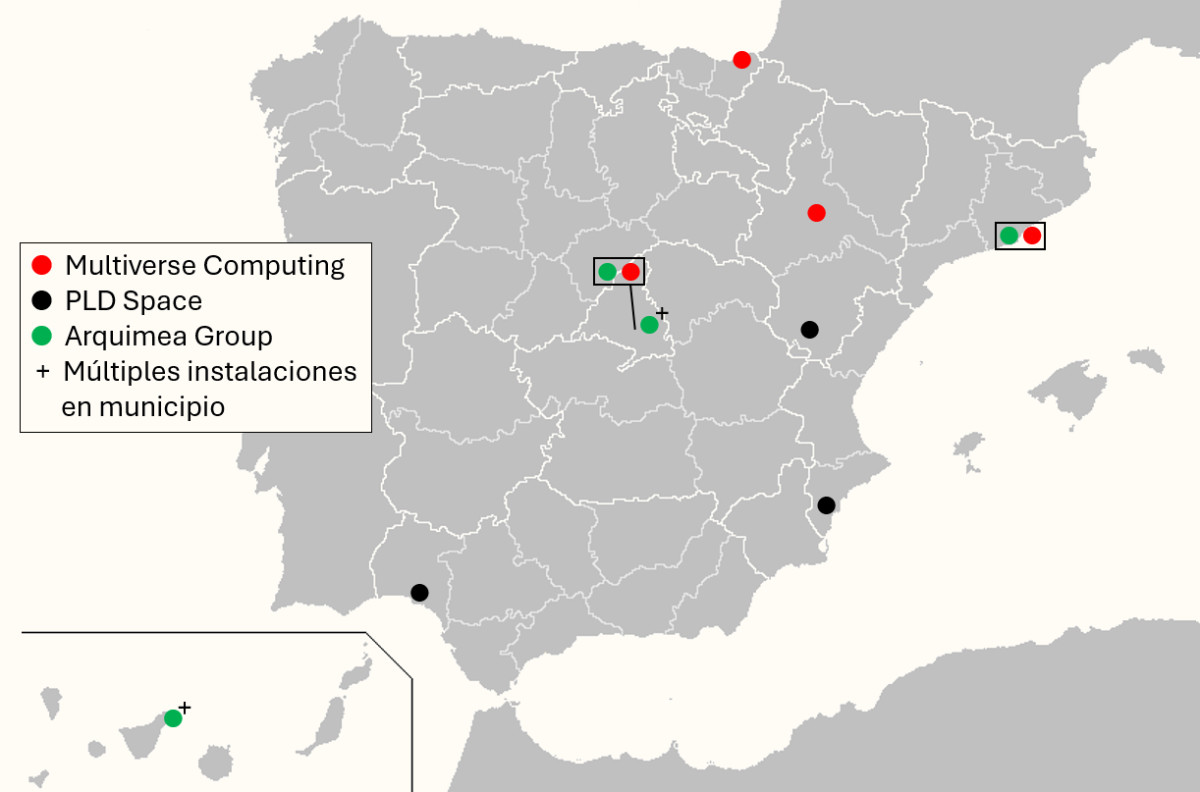
The figure 2 shows, as an example, the territorial dispersion in Spain of Multiverse Computing, PLD Space and Arquimea Group. While Multiverse Computing (from its head office in Donostia-San Sebastián) has opened offices in Zaragoza, Barcelona and Madrid to access more specialized talent in quantum computing and advanced AI, PLD Space keeps its main facilities in Elche (Alicante), but has rocket engine testing infrastructure at the industrial facilities of Teruel Airport and its launch facility at the El Arenosillo site in Moguer (Huelva).
Figure 2: Locations of the installations in Spain of Multiverse Computing, PLD Space and Arquimea Group
Source: company websites.
But perhaps the best example is the Arquimea Group’s impact in the Canary Islands. Since arriving there through prior research collaboration, and drawn by tax incentives for R&D, Arquimea has built its main R&D center there, the Arquimea Research Centre.
This R&D center, with nearly one hundred researchers, has led since 2020 to the founding of four startups of the Arquimea Group, in addition to local public-private initiatives such as the CanarySat communications satellite operator or the QCircle quantum technologies research center. All of this with the support of Kaudal, Arquimea’s private R&D financing specialist (from Santa Cruz de Tenerife).
