
In the winter of 2011, Joe Biden (then vice president of the United States) visited Vladimir Putin in the Kremlin. Biden stepped up to his host and commented: “Mr. Prime Minister, I am looking you in the eyes and I don’t think you have a soul.” Putin smiled and replied: “We understand each other.” The scene passed almost unnoticed at the time, relegated to the realm of a personal anecdote. Yet today it reflects a truth about contemporary international politics: two leaders, representing different political orders, acknowledge with a minimal gesture that they share a common understanding of how power actually works, beyond rituals, joint declarations, and the language of rules.
“When today vital interests clash with international law, it is capabilities, not principles, that determine the outcome”
Seven years later, when Putin orders a large-scale invasion of Ukraine (the very country Biden had sought to bring closer to the West for years), the moral judgment of the American fades to the background. What prevails is the blunt calculation of the Russian: when vital interests clash with international law, it is capabilities, not principles, that determine the outcome.
This realization is the starting point for understanding the world that is emerging. The international community did not consciously tilt toward a realist turn. What is happening is that, as the scaffolding that contained the logic of power weakens, international politics returns to its oldest motions.
The Kindleberger Problem: When No One Pays for Order
The fundamental problem we face is not that Russia or China violate the rules. It is something more structural: the United States is no longer willing to pay the price to sustain the order it created, but no other actor can or wants to replace it. Charles Kindleberger warned that the Great Depression was partly caused by the absence of leadership after Britain’s decline. America could have, but chose not to. Britain wanted to, but could no longer. The question, therefore, is whether we are reproducing that dynamic.
Some global public goods (open markets, secure trade routes, stable currencies) can only exist if a preeminent power provides them on a sustained basis and is willing to bear the costs. Washington withdraws selectively, Beijing lacks the capacity to offer universal goods (its Belt and Road is selective, not global) and Europe remains divided. Data from the Elcano Royal Institute illustrate the fragmentation: China records its first absolute decline in global presence in 2024; the United States grows, but not enough to reverse the fragmented multipolar system, where the BRICS already account for 27% of world GDP.
What emerges is a system without a hegemonic power, not a hegemonic succession: public goods are underprovided and each actor tries to free-ride or, worse, buck-pass.
Buck-passing: the Forgotten Strategy that Explains Europe
John Mearsheimer identified that, in the face of threats, states, besides balancing (balancing), can shift the cost to a third party (buck-passing): cultivate cordial relations with the aggressor, keep distance from the one who should contain it, and let that third party bear the costs. If the aggressor and the balancer end up in a costly war, the one who passed the baton emerges strengthened without paying the price.
European conduct toward Ukraine between 2014 and 2022 contains unmistakable elements of buck-passing. After Crimea, the response was symbolic: limited sanctions, exclusion from the G8, rhetorical condemnations. Germany kept Nord Stream 2 until weeks before the full invasion, and France pursued resets with Moscow. Meanwhile, Ukraine, marginally assisted, would bear Russia’s pressure without Europe having to rearm or break lucrative commercial ties.
“As Europe tries to balance against Russia, it aims to pass the baton to the United States in the Indo-Pacific against China”
The 2022 invasion shattered that strategy by showing that the buck-catcher (the one who receives the baton: Ukraine) could not do it alone. Europe was forced late into balancing: defense spending rose from 343 billion euros in 2024 to a projected 381 billion in 2025 (about an 11% increase in one year), yet it remains insufficient for genuine autonomy. Reaching 3.5% of GDP by 2035 would require 635 billion euros annually, almost double.
Thus, while Europe tries to balance against Russia, it seeks to pass the baton to the United States in the Indo-Pacific against China. And Washington flips the logic: it demands that Europe shoulder its neighborhood while focusing on Asia. The result is cyclical: everyone tries to pass the baton, no one wants to be the buck-catcher, increasing the risk that threats grow unchecked until they become uncontrollable.
Hirschman’s Paradox
Albert Hirschman argued that , when members of an organization perceive that the quality of what they receive is deteriorating, they basically have two avenues: exit (exit) or raise their voices to try to correct it (voice). Yet only when the option to leave is credible does that voice have bargaining leverage. If there is no real possibility of leaving, protest erodes and what remains is not genuine loyalty but loyalty forced by the absence of alternatives.
Applied to geopolitics, power does not reside solely in inflicting damage: it lies, above all, in the capacity to leave the relationship at a cost lower than the adversary’s. The United States’ control of the global financial system (between 80% and 90% in key segments, for example, SWIFT) gives a disproportionate advantage: it can exclude adversaries at relatively low cost to itself, while those excluded suffer catastrophic costs.
“Europe does not have a strong voice in Washington not because it argues poorly, but because it lacks a credible exit option: it cannot guarantee its security without the American nuclear umbrella”
The Elcano Institute’s recent work quantifies this asymmetry: the United States could inflict losses of 5.8% of GDP on China and 8.6% on the EU, while its own vulnerability remains around 3%. If China retaliates, the impact worsens dramatically from -5.8% to -8.8%, while the additional cost to Washington is marginal (from -0.5% to -0.9%). The more robust balance is coercive hegemony: the United States confronts selectively, China cooperates defensively, Europe seeks neutrality.
Hirschman argued that the effectiveness of raising one’s voice depends on the credibility of the exit. Europe does not have a strong voice in Washington not because it argues badly, but because it lacks a credible exit option: it cannot guarantee its security without the American nuclear umbrella and it cannot fully diversify its critical technology. Until it builds sufficient autonomous capacities, its voice will remain structurally weak.
China has spent two decades building exit options: CIPS as an alternative to SWIFT, yuan internationalization, domestic semiconductors, BeiDou in place of GPS. Not because it despises Western institutions. The reason is that it understands Hirschman’s logic: only those who can leave have real bargaining power.
When Exit Becomes Collective
The three preceding mechanisms (the hegemonic power’s abdication of order, buck-passing, and the race to build exit options) are not only reconfiguring the international economy; they are altering, in an integral way, the very architecture of the world system. When no one is willing to pay for the costs of global public goods, everyone seeks for someone else to contain threats and each actor invests in reducing its dependency on others, the outcome extends beyond reduced trade: it is a world made up of semi-autonomous power spheres that begin to think, plan, and securitize in bloc terms.
Economically, that logic translates into friendshoring, standards wars in technology, duplication of financial infrastructures, and segmented supply chains, but its effects go beyond the material. Politically, it raises the value of explicit loyalties and narrows the space for ambiguity: international organizations become forums of alignment rather than deliberation, the Global South nations stop being “non-aligned” to become arenas of structural competition where every investment decision, vote, or treaty is read as a signal of affiliation to one bloc or another.
“The configuration of an international system fundamentally depends on its members sharing a minimal shared vision of what kind of world to build and which rules will govern it”
In terms of security, fragmentation reinforces regional power-balancing logic: each power consolidates its neighborhood (the United States in the Western Hemisphere and the Indo-Pacific, China in Asia and the Indian Ocean, Russia in the post-Soviet space, the EU in its immediate perimeter) while tightening its tolerance for external interference. Normatively, the result is a pluralism of partial orders: no longer is there a single code of reference (the “liberal international order”), but rather multiple sets of norms, narratives, and legitimate authorities that coexist, overlap, and sometimes contradict one another.
The configuration of an international system fundamentally depends on its members sharing a minimal, common vision of what kind of world to build and what rules will govern it. But when that shared intention tears apart, when calculations of power spill beyond the system’s margins and overwhelm it, something irreversible happens: actors change their view of how to see the world. More than a shift in ideology, it is a reconfiguration of the very perception of possibility. Realism is not to blame. It is merely the symptom.
The true malaise is that the international system, as a collective project capable of containing the logic of power, has collapsed under the weight of its own contradictions: it promises equality of rights to states that are deeply unequal in capability; offers universal norms to actors who never shared the foundational act; builds sophisticated devices of cooperation on a terrain that has returned to an anarchic state. It does not stem from a lack of will to understand one another, but will alone is no longer enough. When the scaffolding gives way, actors do not lament; they seize the rubble to construct a shelter.
Anarchy Does Not Disappear, It Is Remembered
Morgenthau reminded us that politics is governed by “objective laws” rooted in human nature. Waltz argued that the engine of conflict is not the psychology of leaders but the anarchic structure of the system. They agreed on something deeper: in the absence of an authority capable of guaranteeing compliance with agreements, uncertainty becomes structural and pushes states to seek security on their own.
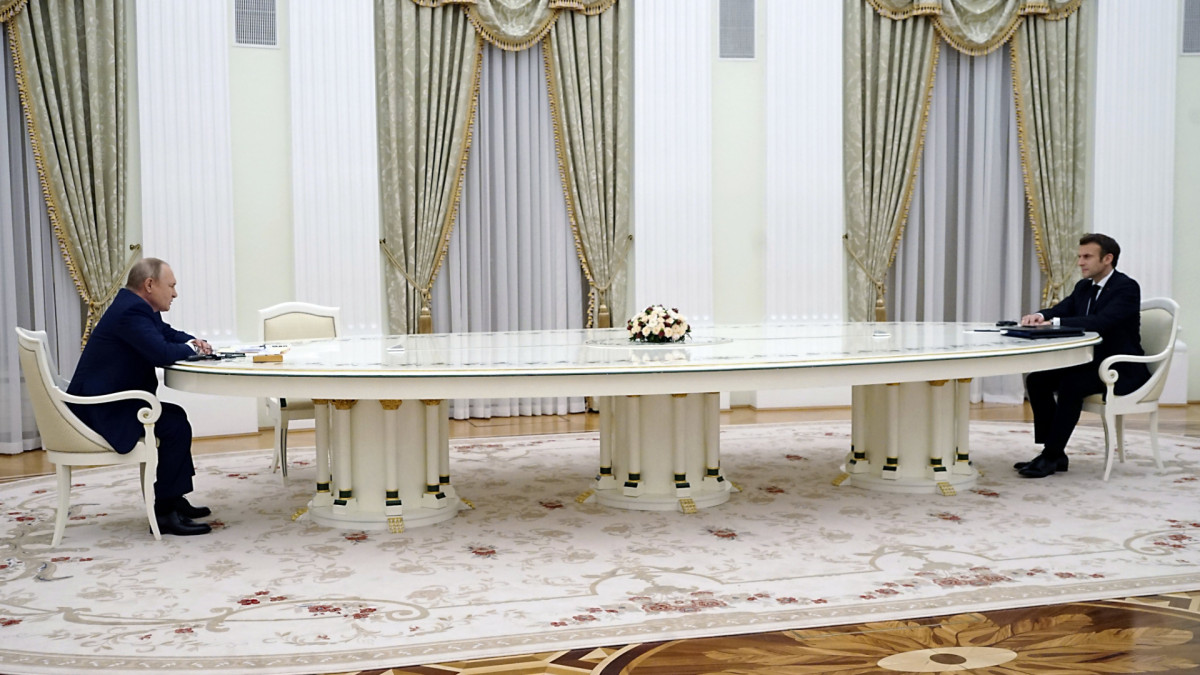
The choreography of recent years fits into that framework. In February 2022, Emmanuel Macron travels to Moscow to try to extract from Putin a commitment that would avoid invasion. The enduring image is not a negotiation between equals: it is a six-meter white table, with the two leaders at opposite ends. Official explanations speak of sanitary protocols. The symbolism, however, is transparent: the physical distance stage-manages the political distance. Two weeks later, Russian battle tanks cross the border. The table had already spoken what diplomatic language still resisted pronouncing. Interests were incompatible and the resolution would come through force, not agreement.
“Below the normative discourses, international politics remains organized around perceptions of threat, calculations of capabilities, and the search for advantage”
The decline of the liberal order does not render cooperation meaningless, but it forces us to ask under what institutional conditions it endures when the scaffolding that supported it—the primacy of a single power, the belief in the irreversibility of globalization—has faded. The world has not “voted” for realism: it has re-encountered it as exceptional conditions that allowed it to be tempered have vanished.
When Biden tells Putin that he sees no soul in his eyes and receives a response of we understand each other, both describe that beneath normative discourses, international politics remains organized around perceptions of threat, calculations of capabilities, and the search for advantage.
Perhaps the real realist shift is less a change in preference than an exercise in intellectual honesty. Recognizing that the logic of power has returned to the center of the board does not require praising it or resigning to it. But it does demand abandoning the comfort of thinking that rules alone suffice to contain it. In a world where hierarchy weakens and anarchy is remembered, the task is something more modest and at the same time more challenging: to build institutions sturdy enough to withstand power’s pressure, without ever forgetting that if they fail, what remains is not a normative vacuum. It is the old and enduring grammar of force.
