
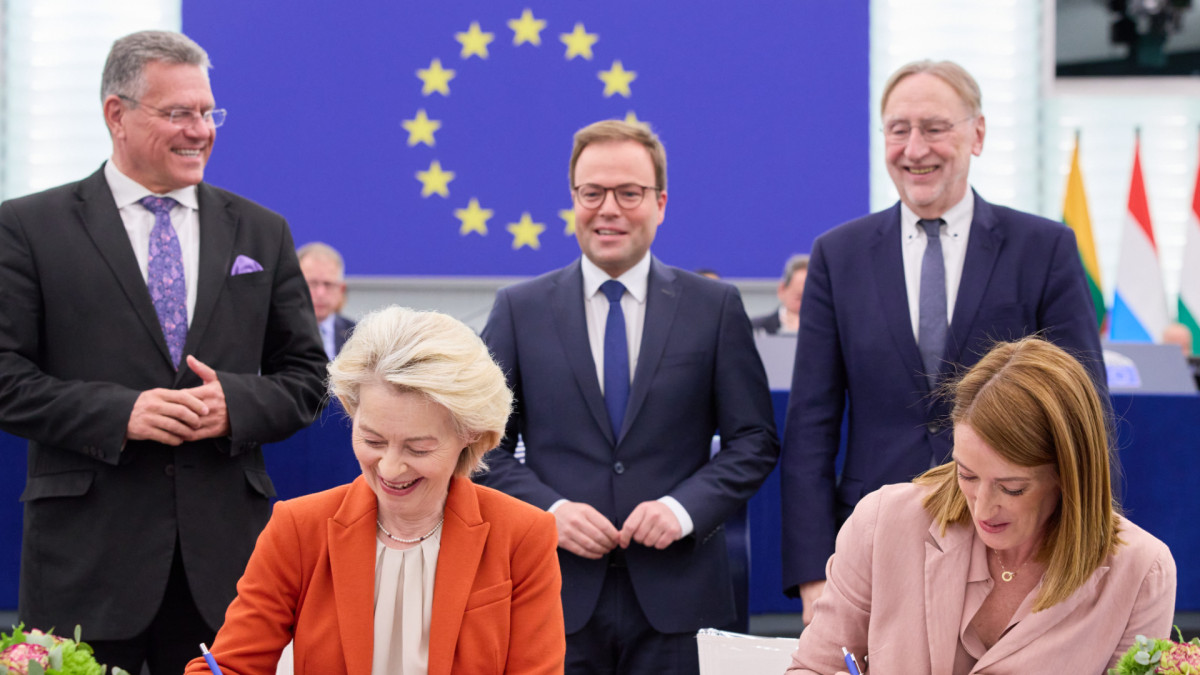
The debate over the transatlantic trade crisis faces, broadly speaking, two streams of thought in Brussels: those who believe that there is a need to prioritize an agreement, even if it is not optimal, because it guarantees stability, a sector that has clearly dominated the debate since Donald Trump’s return to the White House in 2025, and those who believe that no pact can offer that certainty with the current U.S. administration and that the only way to achieve any kind of balance is through a show of force. The most complex aspect of the issue is that both positions are reinforced by exactly the same events.
When last week Trump, the President of the United States, announced new 25% tariffs on European vehicles in an effort to increase pressure on European partners, in addition to punishing German Chancellor Friedrich Merz for showing criticism of his operation against Iran, both sides felt legitimized. The first argued that, until the trade deal is fully closed, the EU would remain subjected to this kind of threats, while the latter argued that their positions were strengthened because no agreement, at least not without many safeguard clauses, can guarantee an end to the threats.
“The EU eliminates trade duties on American goods in exchange for Washington’s commitment not to exceed the ceiling on tariffs for European products”
This Wednesday was a key date: negotiators from the Council —representing the Member States—, from the European Commission and from the European Parliament were scheduled to meet to try, if not to close a deal regarding the so‑called Turnberry agreement, at least to bring positions closer and leave it almost ready to be concluded. The text generally establishes tariffs of 15% on European exports, while the EU removes trade duties on American industrial goods. In return, that level of tariffs on European products represents a ceiling that Washington commits not to exceed.
The trilogue, known in EU jargon as the “trilogue,” ended after many hours without an agreement. The next meeting is scheduled for May 19. The European Parliament is, for the moment, bearing the pressure from the European Commission, from Berlin and from other capitals to close a quick deal, largely thanks to the fact that there are other delegations within the Council who also believe more time is needed and want to avoid rushing.
The agreement was justified at the time as a delicate balance between geopolitical realism, trust —nonexistent between the EU and the US in trade matters at the moment—, predictability and competitive advantage. In those terms the Union has read this pact as closed in July between Ursula von der Leyen, President of the European Commission, and Trump, while he played golf in Scotland. The agreement was viewed by many, especially in the European Parliament, as a humiliation.
“The EU paid a toll in tariffs in exchange for Washington remaining committed to the transatlantic bond”
Von der Leyen’s team worked to explain the agreement through those coordinates. But the pillars on which it built its stance have been weakened or collapsed. The first signal from her circle was that it was an economic concession in geopolitical terms. The EU paid a tariff toll in exchange for Washington remaining committed to the transatlantic link and for backing Ukraine against Russia. Since then, the U.S. administration has sought to force Kyiv to accept a peace plan dictated from Moscow and Trump has threatened to pull the United States out of NATO due to the lack of support from transatlantic partners for his operation against Iran, about which he did not inform the Alliance. Not to mention the fact that he toyed with the idea of using military force to seize part of the territory of an ally such as Denmark.
Trust and predictability have continued to be undermined since August 2025 with incidents such as the Greenland affair, but also with periodic threats of tariff increases against various EU member states for political reasons. Regarding the comparative advantage, it is true that the agreement allows the EU tariff levels comparable to those of Japan or South Korea, and somewhat worse than those of the United Kingdom (10%), which does not have a trade surplus in goods like its European partners do. But the key to this issue is that, for that argument to hold, the European Commission must be very demanding in ensuring that the Turnberry 15% ceiling is observed. And while Maroš Šefčovič, the Trade Commissioner, notes that Washington promises to comply with those conditions, there is no evidence that the White House is aligning with its stated word.
“Bernd Lange defends an activation clause, which prevents the EU from having to meet its part until the U.S. is doing the same”
Bernd Lange, a German Social Democratic MEP, chairman of the parliamentary Trade Committee and the negotiator for the European Parliament, attended Wednesday’s meeting more convinced than ever that Trump is unpredictable and that the EU must protect itself. Therefore, he defended the three main clauses that the MEPs introduced into the text through amendments. The first, an activation clause, which prevents the EU from having to fulfill its part until the U.S. is doing its part; the second, an expiry clause, which states that the agreement will expire in March 2028 unless new legislation is adopted to extend it; and a safeguard clause so that the Commission assesses whether the U.S. is meeting its commitments and suspends Washington’s trade advantages in case of violation of the agreement terms.
The meeting has allowed some positions to move closer, but it widens the gap between the two “sides” on the main issue. Šefčovič and the countries most exposed to commercial chaos argue that delaying the agreement could lead Washington to lose patience and move ahead with additional tariffs. A definitive demonstration that not having the Turnberry agreement in place generates commercial chaos. For Lange and some other member states, if that happens, it will be the ultimate demonstration that one cannot trust the word of the U.S. administration. The same event, radically different readings. And from this, a European consensus must emerge.
