
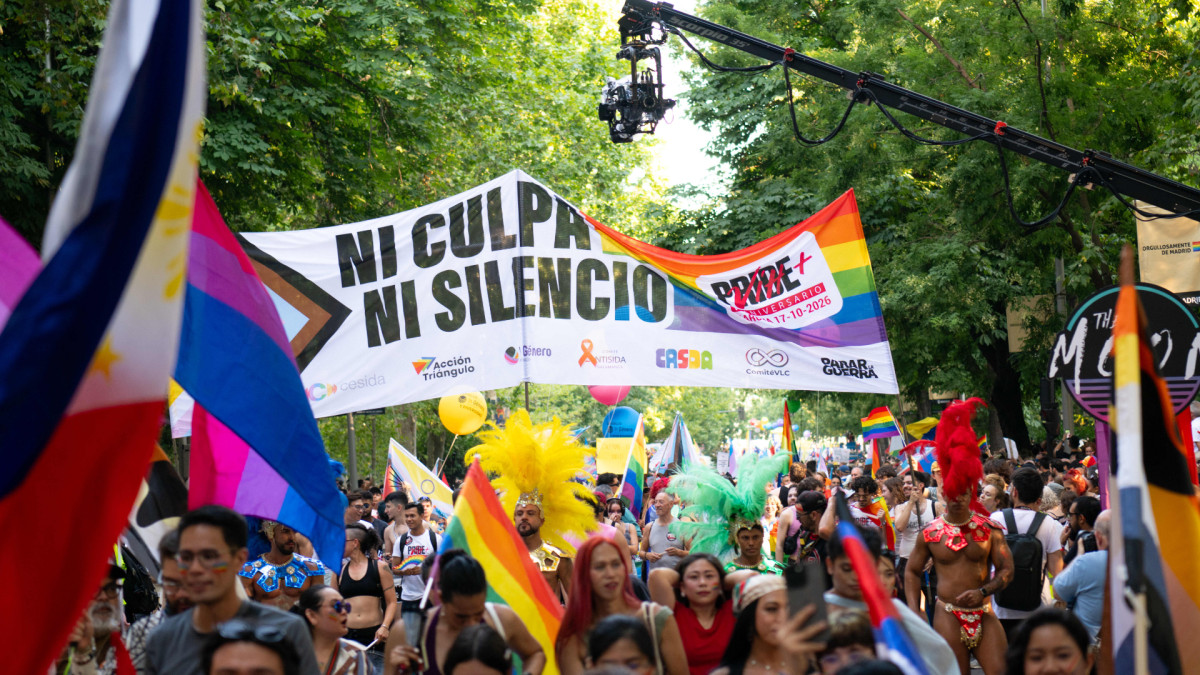
After the Pride March took place on Saturday, July 4, in which hundreds of thousands of people took to the streets of Madrid to affirm something as elemental as the right to live openly with our sexual orientation or gender identity, it is worth looking back to recall what happened the week before. Specifically, on June 25, in the Congress of Deputies, the Organic Law Proposal that amends the Penal Code to criminalize conversion therapies—practices aimed at changing, suppressing, eliminating, or denying sexual orientation, gender identity, or gender expression—was approved, and it must now continue its process in the Senate.
The first point to highlight in this regard is that, despite what some critical voices have claimed, we are not dealing here with a mere symbolic issue that is being pressed in the middle of a cultural battle. On the contrary, what is at stake is something much more significant and practical: to determine whether the Spanish legal order should deploy its strongest tool—criminal sanctions—to confront extremely brutal practices whose ultimate aim is, in the end, to deny certain people the right to be who they are or to feel as they do.
“What is at stake is to determine whether the Spanish legal order should deploy the strongest response at its disposal (the criminal sanction) to confront exceptionally brutal practices.”
For a little over three years now, Spanish law already provides for a penalty for such conduct, albeit only within the administrative sphere. Law 4/2023, of February 28, on real and effective equality for transgender people and on guaranteeing the rights of LGBTI people, indeed classified the promotion or practice of the so‑called conversion therapies as a very serious administrative offense, regardless of the consent given by the affected person. The reform currently under consideration intends to take a further step: given their gravity, certain behaviors should not only incur administrative penalties but also criminal penalties.
As this reform passed through the Congress, its processing left a bittersweet taste. Despite enjoying the majority support of the Chamber, two notable parliamentary groups did not vote in its favor. The Vox parliamentary group, as expected, positioned itself unanimously against it, a stance consistent with its political line that has opposed the advances in recent years toward recognizing the dignity of LGBT+ people. And more troubling, the Popular Party (PP) group also did so, but this time in unanimous abstention: even though it acknowledged that these practices are unacceptable and injure fundamental rights, it preferred to hide behind technical legislative objections to avoid voting for the reform. Such objections, though worth hearing—as criminal law demands precision, exhaustiveness, and respect for the principle of legality—cannot, however, justify abstention once it is admitted that what is at stake is nothing less than elevating the legal protection of the dignity of certain people who, by virtue of their sexual orientation or gender identity, should under no circumstances be subjected to practices that can cause irreparable psychological (and even physical) harm. Let us go step by step.
“The PP has preferred to hide behind legislative-technical objections to avoid voting in favor of the reform.”
Conversion therapies are not therapies. They do not cure any illness because there is no illness to cure. Their premise—that sexual orientation, gender identity, or gender expression constitute an “error” to be corrected—reduces a person to a mere object liable to “normalization” according to a particular moral, religious, or cultural ideal. And it is precisely this that reveals their flagrant incompatibility with the Constitution.
Often people who invoke human dignity are accused of appealing to an indeterminate concept, useful for justifying any conclusion. I have argued on other occasions (here) that the Spanish Constitutional Court has contributed to that drift by turning dignity into a remarkably expansive and vague category. For this reason, it is worth distinguishing those cases where appealing to dignity is debatable from those—like the present one—in which human dignity provides a sure constitutional answer to deny the viability of acts that threaten it.
In this case, there is no need to “discover” a new fundamental right or to reinterpret the Constitution evolutionarily to conclude that these practices are incompatible with Article 10.1 of the Spanish Constitution. It is enough to recall the classical (Kantian) conception of human dignity: the one that prevents treating a person merely as a means to satisfy another’s beliefs or as an object to be corrected to fit a given normality. Constitutional jurisprudence has repeatedly stated that respect for human dignity excludes any form of objectification or instrumentalization of the person. It is hardly a clearer example of instrumentalization than a practice aimed at “convincing” someone that they will only be fully accepted if they stop being who they are or stop feeling as they feel.
“The Constitutional Court has repeatedly stated that respect for human dignity excludes any form of objectification or instrumentalization of the person.”
Moreover, this is not merely a whim of Spanish lawmakers. There is a growing consensus across the field of international human rights law. In 2020, the UN special rapporteur on protection from violence and discrimination based on sexual orientation and gender identity concluded that conversion therapies are intrinsically discriminatory practices and, in many cases, amount to cruel, inhuman, or degrading treatment, and he called for a global ban. European institutions have followed suit. The Council of Europe’s Human Rights Commissioner has stated that “there is nothing to cure” and has urged states to prohibit these practices as incompatible with the rights guaranteed by the European Convention on Human Rights. More recently, the Council of Europe’s Parliamentary Assembly has asked all member States to adopt effective prohibitions on conversion therapies, precisely because they rest on denying the equal dignity of LGBT+ people.
Nationally, it is true that the Constitutional Court has not yet ruled specifically on these practices, but everything suggests that, if it did so, it would encounter serious difficulties in deeming them compatible with Article 10.1 of the CE. Because those who perform them are not providing a legitimate form of psychological or spiritual accompaniment; instead, they activate psychosocial pressure mechanisms designed to compel a person to renounce essential elements of their personality. Therefore, criminalization of these practices is a fully compatible option with a constitutionally sound understanding of human dignity.
“The Constitutional Court would have serious difficulties in finding conversion therapies compatible with Article 10.1 of the CE.”
Returning to the parliamentary moment, as noted, the Popular Party abstained from voting in the Congress in favor of the law’s approval, thereby arriving late at one of those historic moments when constitutionalism confronts the expansion of freedom and equality for individuals. It happened in 1981 with divorce (back then, the Partido Popular was still Alianza Popular), when it voted against the law that made it possible, arguing that it would break the “indivisibility” of the family; it happened in 2005 with same-sex marriage, whose constitutionality was denied on the grounds that it “denaturalized” the institution of marriage; it happened in 2021 with the regulation of euthanasia, similarly challenged before the Constitutional Court on the grounds that it violated the right to life, and it is now happening again, in 2026, when, recognizing the gravity of conversion therapies, it is unable to back the criminal response against those who practice them. It is, indeed, deeply worrying to observe that the PP persists in a political line that rejects the possibility of undertaking legal reforms aimed at broadening or reinforcing rights linked to personal autonomy and to the equal dignity of historically vulnerable groups.
Perhaps this is a constant in democratic constitutionalism: the grand advances of human dignity always meet initial resistance. It happened with gender equality, with the abolition of discrimination based on sexual orientation or gender identity, with same-sex marriage, and with other reforms that now form part of the constitutional landscape. It is not uncommon for those who hide behind the banner of “legal prudence” to block a decision like the one at hand only to find, years later, that what they feared (or opposed) did not entail a breach of the constitutional order but rather represented a way to develop it in line with the demands that follow from human dignity. A political party that legitimately aspires to lead the Government of this country ought to have made this clear.
