
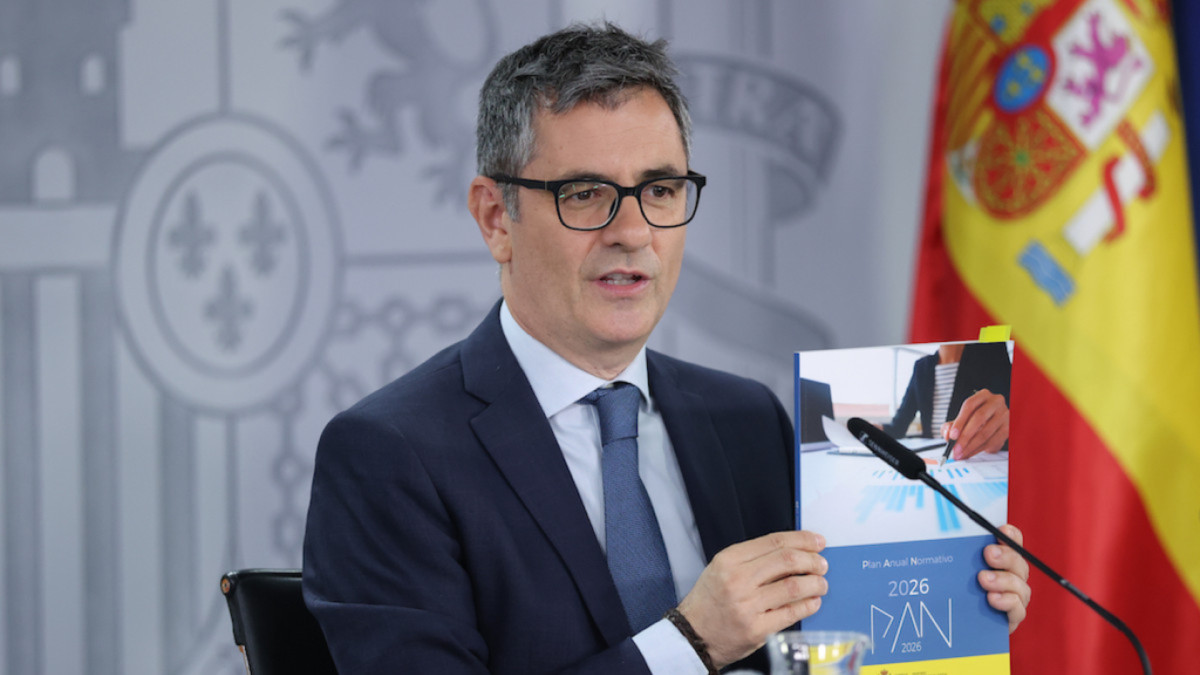
Across Europe, advanced democracies have mechanisms to announce what they intend to do. In the United Kingdom, the monarch reads the King’s Speech to set the legislative agenda; in France, the General Secretariat publishes its strict Programme de travail; and in Brussels, the European Commission lays out its Work Programme every autumn. In Spain, this exercise in transparency is called the Annual Regulatory Plan. In fact, it has become one of the most revealing tools of how the Spanish Executive understands power today, even though it often goes largely unnoticed in Spanish public debate and in media analysis.
Its origin lies in the last term of Mariano Rajoy, who, with the reform of the Government Act in 2015, introduced the obligation to plan legislative production and the mechanism was developed in 2017, before being formally launched with the PAN in 2018. Law 40/2015 and, above all, Law 39/2015 on Administrative Procedure introduced a new regulatory philosophy inspired by the ‘better regulation’ principles promoted by the Organisation for Economic Co-operation and Development (OECD) and the European Commission: more planning, more ex ante evaluation, and more transparency about which norms the Executive intends to approve. It is, then, a formal obligation of the Executive. Since then, the PAN has functioned as an annual legislative road map that the Government must approve and publish.
“What was born (the Annual Regulatory Plan) as a technical instrument of regulatory predictability has ended up evolving into something more political”
The idea was twofold. On one hand, to give predictability to businesses, administrations, and citizens about the Government’s regulatory agenda. On the other hand, to curb legislative improvisation and to force ministries to justify both new rules and their economic and administrative impact. But what began as a technical tool for regulatory predictability has evolved into something more political: a way to order priorities, coordinate ministries, and project governmental capacity even in fragile parliamentary contexts like the current Spanish government.
In this sense, the Annual Regulatory Plan 2026, a 95-page document freshly produced at the Moncloa palace, is much more than an OECD paperwork exercise. With a total of 179 regulatory proposals (10 organic laws, 38 laws, and 131 Royal Decrees), it is the map of what is sought to be perceived as the continuity of the left-wing coalition of President Pedro Sánchez for a year that promises to be difficult and very likely the last PAN since the general elections will take place in 2027.
This is Spain’s political autopsy for 2026, where European standards collide with the blunt national political reality and the geopolitical situation.
The “extraordinary and urgent necessity” permanent
The first thing that catches the eye in the plan is that, in a document designed for technical planning, the Government justifies in its introduction why its agenda has been altered by “unforeseen events”.
“Is Sánchez preparing the ground to justify future legislative deadlocks, or does he consider that we are in a global geopolitical situation that will demand extraordinary and urgent legislation?”
Moncloa cites directly being forced to operate on the basis of emergency legislation (royal decree-laws) after two serious railway accidents occurred in January in Adamuz (Córdoba) and Gelida (Barcelona), followed by meteorological disasters that affected Andalusia and Extremadura. But they do not stop at national borders; the Government explicitly points to the crisis in the Middle East, mentioning the military operation launched by the United States and Israel against Iran on February 28, 2026, and underscoring its effects: widespread falls in international stock markets, rising prices, disruption of air traffic, and impacts in the Strait of Hormuz. All of this forced the adoption of emergency legislation during the first quarter.
The question, then, is whether Sánchez is laying the groundwork to justify future legislative bottlenecks or whether he believes we are in a global geopolitical situation that will require extraordinary and urgent legislation.
The End of NextGen and Brussels’ Weight
During the last five years, the president has possessed a superpower: the Recovery, Transformation and Resilience Plan (PRTR) financed by the EU. Those billions acted as a powerful political lubricant and, above all, have been the “budgets” that Sánchez has neither presented nor approved due to a lack of majority.
That era is over. Five years after its approval, the normative effort to execute the PRTR has already been undertaken, though experts warn that effects may last two to three more years. Of the 179 total initiatives planned by the Government, only five Royal Decrees are linked to the PRTR.
“Without the European money to sweeten reforms or appease partners, the coalition will have to govern without buffers”
Nevertheless, the Brussels machinery continues to set the pace: 61 initiatives (representing 34.08% of the total) aim to transpose European Union law into the Spanish legal order. Spain is one of the countries that transposes EU directives more slowly.
Without the European checkbook to sweeten reforms or placate partners, the coalition will have to govern without buffers.
The Government’s Narrative Defense
The core power hub of the president lies in the Ministry for the Presidency, Justice and Relations with the Cortes, which leads the activity with twenty regulatory proposals. In fact, Justice is the sector with the greatest regulatory incidence for 2026. At Moncloa, the policy czar Félix Bolaños has decided that the best defense against opposition and a critical press is a sweeping legislative counter-offensive:
1. Publicity and media: Under the premise of European adaptation, Spain will push the Public Sector Advertising Law. Its aim is to update the regulations to the transformation of the information landscape and to implement the European Regulation on the Freedom of the Media. In practice, it is Moncloa’s tool for public institutional funding of the media.
2. Fighting deepfakes: The Government will reform the Organic Law on the Protection of the Right to Honor. The objective is to protect citizens against phenomena such as the revelation of digital profiles or the use of images through technology (deepfakes or “ultrasuplantations”). It will also impose obligations on social networks to moderate content to facilitate the removal of those that infringe rights.
3. Fighting corruption: The socialist government aims to strip the opposition of the ethical banner through the Organic Law on Public Integrity. It is a massive reform with 84 measures that will alter up to 18 laws (six of them organic). The icing on the cake? The creation of a new independent public integrity agency.
The Necessary Concessions to the Coalition Partner
In the face of a budget shortage, only the left flank of the Government can be satisfied with ideological victories.
“Standout is a Company Democracy Law to foster more effective employee participation in their respective companies”
The Ministry of Labour and Social Economy pushes forward with 17 planned projects. It highlights a Company Democracy Law to boost worker participation in their companies. In practice, what we would call a left-leaning German-style measure is part of the heritage of a European—“Rhenish”—capitalism.
What will truly shake employers is the modification of the layoff law, which seeks to establish guarantees against terminations and to modify the compensation regime for unfair dismissal so that its deterrence and compensatory function is recovered.
If there is a zero-cost economic law and a niche ideological one, it is the law anticipated by the plan: the Law for the Protection of the Rights of Great Apes, even if it sounds unusual. A victory ideal for the ecologist base.
Regional Financing and the Political Key
Hidden in the budget policy section is probably the most complicated law of the entire legislature: the Organic Law for the modification of Organic Law 8/1980, of September 22, on Financing of the Autonomous Communities.
“Politically, Sánchez will try to turn regional financing into a political asset in his favor”
The official objective is to undertake an “update and reform” to make the regional financing system more efficient and fair. Politically, Sánchez will seek to turn this into a political asset in his favor. The Government will attempt to revise the distribution model for common-regime regions, offering a plan with more money for all territories, and given the likely opposition from most autonomous communities governed by the PP (and now many with Vox in government), the Government will hold the PP and Vox responsible for any lack of funds to manage public policies.
The 2026 Annual Regulatory Plan fully meets the standards demanded by the OECD and Europe. Administratively, it is an impeccably well-executed exercise in planning. But politically, it is the meticulously designed stance of resistance aimed at reaching the end of the term with a clear warning: if legislation cannot be passed, the government will push the concept of “extraordinary and urgent necessity” through royal decree-laws in a fragmented parliament capable of blocking parliamentary activity.
“Moncloa is prepared to use its (in)capacity to legislate as its main shield”
Facing a turbulent world, without the post-COVID financial cushion and with a hostile parliament, the Spanish Government is set to use its (in)capacity to legislate as its main shield. Whether shielding against digital defamation with AI, rewriting labor dismissal rules, or redesigning the distribution of regional funds, Moncloa has laid out its plan: in 2026 legislation will be one of the main battlegrounds. I have a plan, but they won’t let me implement it.
