
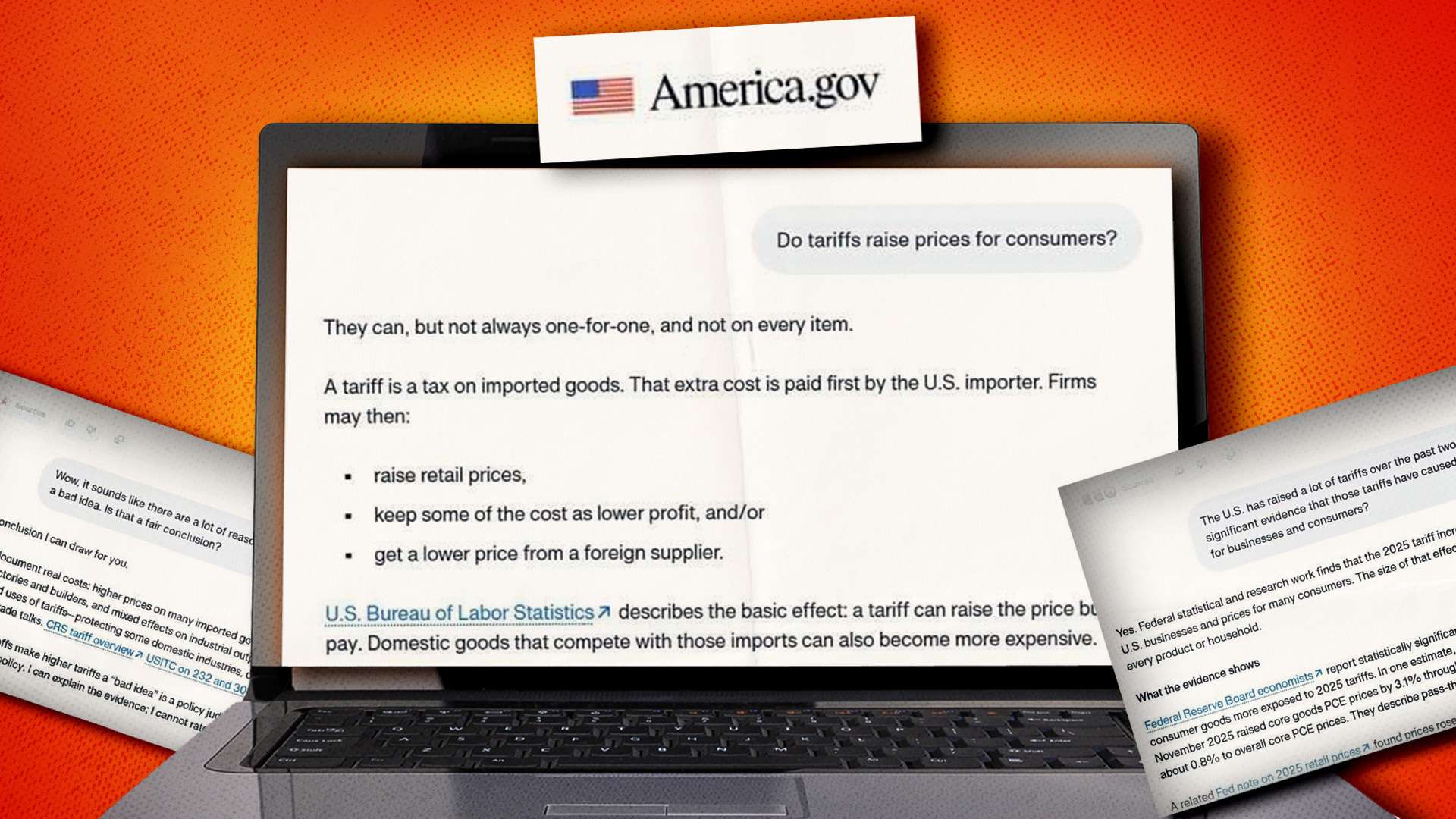
America.gov contends that tariffs have the potential to push up the amount buyers must pay, and domestically produced goods that compete with these imports can also end up more costly.
In the days following the White House’s rollout of its new AI chatbot, America.gov, reports emerged that the administration retooled the bot to stop rebutting some of the president’s more extravagant assertions—such as the results of the 2020 election.
Yet this hasn’t stopped the AI from speaking forthrightly about tariffs: they are taxes, they are borne by Americans, and they have helped lift prices across the economy.
“A tariff is a tax on imported goods. That extra cost is paid first by the U.S. importer,” America.gov told me on Friday morning when I asked it to explain who shoulders the cost of higher tariffs. Citing the U.S. Bureau of Labor Statistics, the AI noted that “a tariff can raise the price buyers pay. Domestic goods that compete with those imports can also become more expensive.”

That stance runs counter to some of the administration’s most common assertions. Trump has repeatedly—and falsely—claimed that tariffs are funded by foreign governments and foreign companies. The administration has lauded the recent news of a new steel plant in Iowa as proof that tariffs are reviving American manufacturing—an assertion that holds true only if one weighs the perceived gains while deliberately ignoring the costs.
Ask America.gov about how tariffs operate, and you’ll receive a markedly different—and more economically literate—explanation.
When I asked it whether higher tariffs would hurt domestic industries by raising input costs for factories and construction, it agreed. “They can, especially when the tariff affects materials” purchased by builders and plants, such as “steel, aluminum, parts, machinery.”
In other words, a substantial share of the goods targeted by tariffs are raw materials and intermediate products used to assemble other items.
The AI then directed me to several sources supporting that conclusion, including a Congressional Budget Office report it said “described tariffs as making capital goods more expensive and raising the cost of business investment.” The White House’s chatbot also highlighted a Federal Reserve study and a U.S. International Trade Commission study, both of which demonstrate how tariffs reduce manufacturing employment and output in downstream industries hit by higher costs.
The “bottom line,” it stated, was this: “Official evidence supports that tariffs on industrial inputs can reduce output in downstream manufacturing and raise costs for construction and factories that use those inputs.”
If only that “official evidence” could shape official policy.
When I asked whether tariffs could raise prices for consumers, America.gov offered another long list of government sources showing that they can. It pointed me to a Federal Reserve report that “found statistically significant increases in prices of consumer goods more exposed to tariffs,” as well as a Senate Budget Committee report on “tariffs as making consumer and capital goods more expensive.”
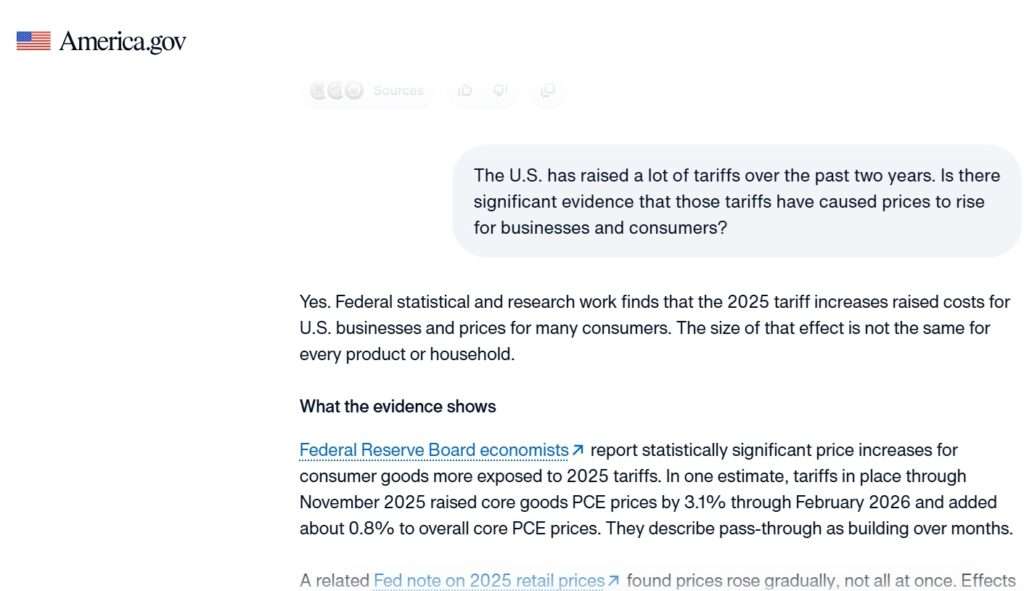
Once again, the takeaway was unmistakable: “Tariffs tend to put upward pressure on prices of tariffed imports and related U.S. goods.”
Yet one thing America.gov will not state is that tariffs are a poor policy choice. Even in the face of this evidence of substantial costs tied to the Trump administration’s tariff strategy, the White House’s chatbot remains loyal to its creators and stops short of drawing the obvious conclusion.
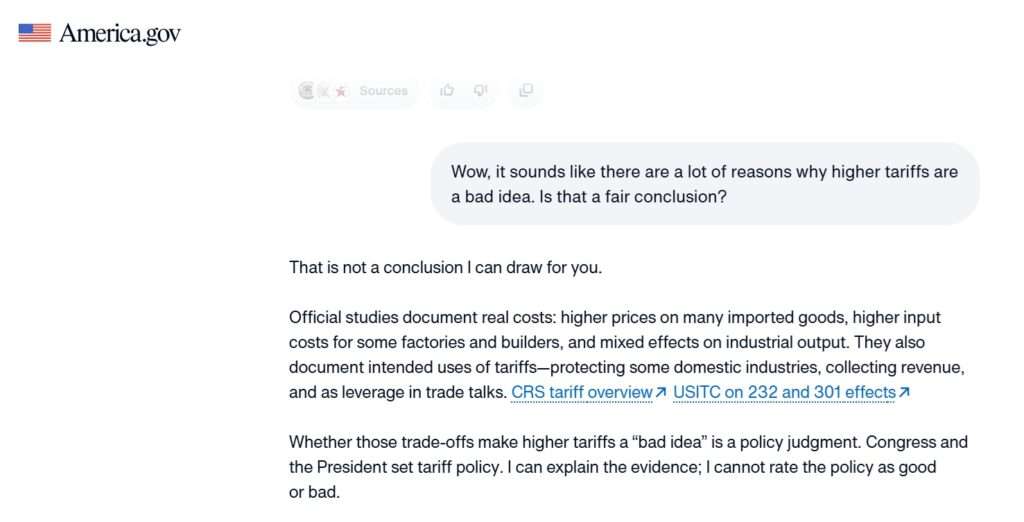
Reasonable as it may be, we’ll have to leave that assessment to people. But if recent polling is any indication—tariffs posted a negative 31 approval rating in a recent Economist/YouGov poll—there appears to be growing public frustration with the Trump administration’s drive to make everything more expensive.
Rather than continuing to push a misleading narrative that even the White House’s own “superintelligence” tool doesn’t fully buy, perhaps the administration should listen to the chatbot’s message: tariffs are driving up costs and harming the economy.
