
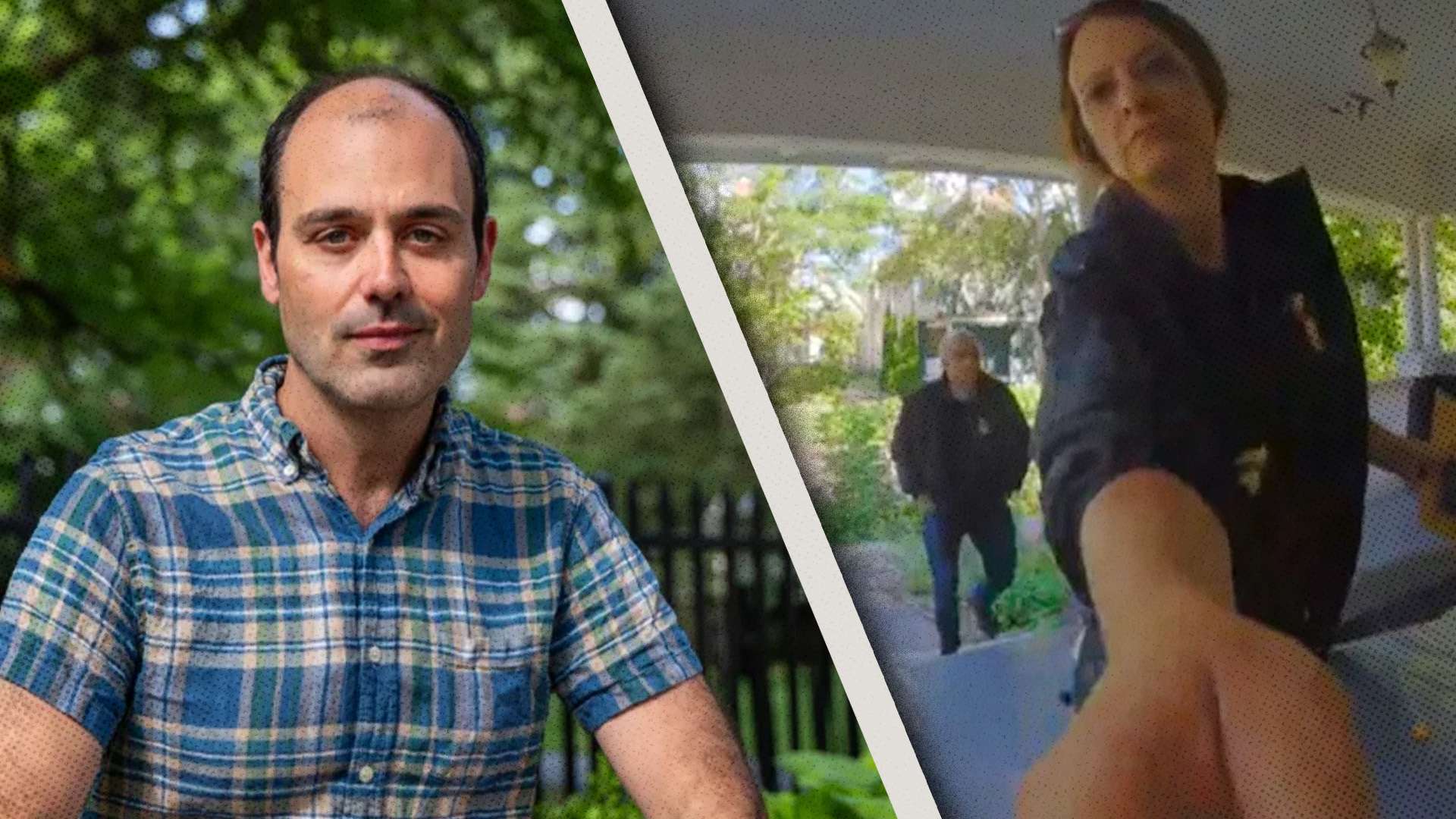
The agency’s attempt to intimidate David Streever is at the center of a First Amendment case.
In June, two investigators from the Department of Homeland Security (DHS) arrived at David Streever’s Rochester, New York home. He wasn’t there, so they left a note.
That note, framed as an official warning from Immigration and Customs Enforcement (ICE), sits at the heart of a First Amendment lawsuit that Streever filed last month, alleging that ICE agents scrutinized and threatened him because of his constitutionally protected criticism of their administrator. This month, the government responded to Streever’s suit, affirming his claims while attempting to refute them.
On January 26, two days after DHS agents fatally shot Minneapolis protester Alex Pretti, Streever sent an angry email to Todd Lyons, who was then the acting ICE director. Streever described Lyons as “a monstrous human being,” compared him to the genocidal Nazi official Reinhard Heydrich, and warned that Lyons would be haunted by “shame at your own pathetic weakness” in defending the Pretti shooting “until your last day on Earth.”
Streever’s assessment of Lyons was harsh, to say the least. But he did not utter anything that could reasonably be interpreted as a threat of violence.
Brent Goodwin, assistant director for investigations at ICE’s Office of Professional Responsibility (OPR), nevertheless contends that Streever’s email “had potential threatening undertones” and “potentially presented a safety concern.” Since “ICE OPR did not have any information about Mr. Streever when the email came in,” Goodwin states in an August 5 declaration, it “decided that an ICE investigation needed to be conducted.”
What unfolded next makes little sense if ICE’s investigators, who did not even attempt to contact Streever until five months after his email, were aiming to resolve a legitimate “safety concern.” But their actions are entirely understandable if they were attempting to intimidate a vocal ICE critic.
YOU MAY BE IN VIOLATION OF FEDERAL LAW, read the “WARNING NOTICE” that two agents left with Streever’s wife in Rochester on June 23. It cited two statutes, one addressing threats of violence against federal officials, and the other criminalizing the disclosure of “restricted personal information” about them with the intent to intimidate or incite violence.
Streever had not violated either law. Yet the notice stated that ICE had “reason to believe” his email to Lyons “may constitute a violation of Title 18 of the United States Code,” which encompasses more than 1,500 offenses.
The document urged Streever to “promptly remove and/or discontinue the aforementioned behavior.” It added that “receipt of this Notice will be taken into consideration, should you continue to be involved in any criminal activities described above.”
In addition to delivering the notice, DHS agents failed to intercept Streever at John F. Kennedy International Airport when he returned from a trip to Finland with his seven-year-old daughter on June 25. They also repeatedly attempted to contact him in person and by phone at the New York hotel where he stayed that night.
After that, Goodwin says, ICE gave up, closing the case on June 30 because “all investigative leads” had been “exhausted.” ICE did this even though its agents had never managed to interview Streever to determine “whether or not [he] presented a threat,” which Goodwin describes as the object of the investigation.
Seeking dismissal of Streever’s lawsuit, the government’s lawyers concede that his email to Lyons “put words to his disagreements with a current administration official.” In other words, they acknowledge he was investigated because of speech protected by the First Amendment.
Other ICE critics have faced similar treatment. The Wall Street Journal reports that the agency “has deployed a round-the-clock digital dragnet” that tracks online speech to identify additional targets.
ICE’s retaliatory campaign, Streever’s lawyers at the Foundation for Individual Rights and Expression warn, threatens the freedom to criticize police conduct without fear of arrest. Four decades ago, the Supreme Court described that ability as “one of the principal characteristics by which we distinguish a free nation from a police state.”
© Copyright 2026 by Creators Syndicate Inc.
