
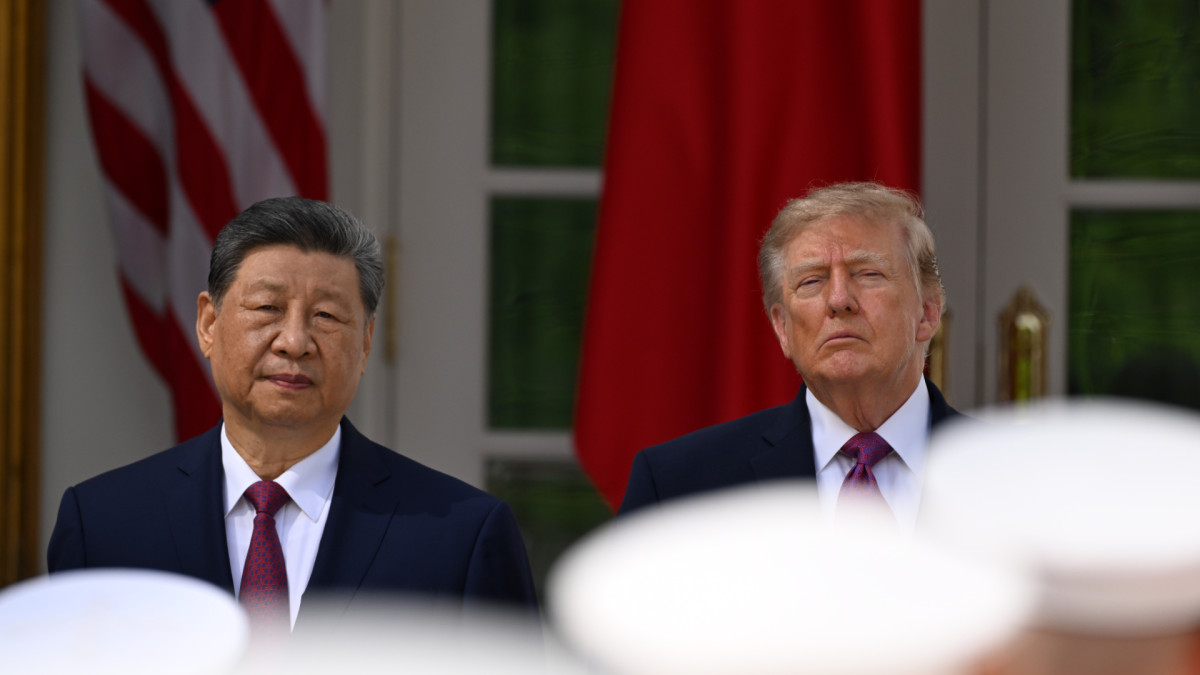
Donald Trump and Xi Jinping met again this Thursday in Washington to discuss trade, artificial intelligence, rare earths, Taiwan, and the wars in Ukraine and Iran. The Chinese leader returns to Washington a decade later at a moment of particular sensitivity. For Europe, perhaps the most important thing is what it means that the two great powers are learning to manage their rivalry directly, beyond the agreements they may reach.
The state visit comes barely four months after Trump’s trip to Beijing. Both last May and now, both governments seek to maintain the fragile stability of their relations and prevent economic and technological competition from once again tipping into a trade escalation.
“For Europe, perhaps the most important thing is what it means that the two great powers are learning to manage directly their rivalry, beyond the agreements they may reach”
Last week, at the Europe Future Forum held in Warsaw by Visegrad Insight and the Res Publica Foundation, Theresa Fallon, founder and director of the Centre for Russia Europe Asia Studies (CREAS) in Brussels, described with a striking comparison the threats Europeans face: “Russia is the storm and China is climate change.” The Polish digital outlet published this interview with Fallon yesterday, and Agenda Pública captures the main conclusions of the conversation.
Since February 2022, Europe has learned to regard Russia essentially as a security threat, although, according to Fallon, it has not yet completed that shift of perspective regarding China: “Europeans are accustomed to looking at China through an economic lens rather than a defense lens,” she explains. Revising that perception will be one of the most important strategic debates in Europe in the coming years.
Theresa Fallon at the Europe Future Forum in Warsaw. Photo: Visegrad Insight.
The relationship between Moscow and Beijing
For many, Russia’s invasion of Ukraine has accelerated this reassessment, making it increasingly difficult to analyze the challenges posed by Russia and China in isolation. Fallon argues that the relationship between both countries should carry much more weight in Europe’s assessment of Beijing. She recalls that, three weeks before the large-scale invasion, Xi Jinping and Vladimir Putin proclaimed their “no limits” partnership. Although Chinese authorities now use that expression less frequently, Fallon maintains that its substance endures.
In her view, without Chinese economic and industrial backing, Russia would have faced far greater difficulties sustaining its war against Ukraine for so long. China, in turn, benefits from that relationship and watches what Russia learns in a conflict that has become a gigantic military laboratory. In that learning, real actions with drones and missiles stand out, as do air defense or electronic warfare. Economically, other variables are included, such as industrial adaptation or sanctions evasion.
The more weakened Russia emerges from the war, the greater its dependence on Beijing. Putin is becoming Xi’s “little brother,” Fallon notes. In this sense, a weaker Russia could offer China access to the Arctic, technology, and its years of battlefield experience.
“The more weakened Russia emerges from the war, the greater its dependence on Beijing”
The convergence of the two BRICS members directly affects Europe and makes it insufficient to study them in separate compartments. While their interests do not align in every area and their relationship does not constitute a NATO-like alliance, the alignment is serious. Europe must bear that in mind as it dedicates enormous resources to reducing its energy dependence on Russia and discovers new dependencies with China.
The second China shock is already here
Fallon speaks of a “China shock 2.0,” a second China shock. Ursula von der Leyen addressed this issue in her recent State of the Union address: the European trade deficit with China runs at roughly a billion euros per day. Europe’s dependence on that country exceeds 80% in certain critical raw materials and reaches 90% in some rare earths.
The weakness of Chinese demand, combined with stronger export pressures, presents Europe with a more persistent problem than the direct impact of U.S. tariffs, according to an analysis published on September 23 by the European Commission’s Directorate-General for Economic and Financial Affairs.
“The weakness of Chinese demand, combined with stronger export pressures, presents Europe with a more persistent problem than the direct impact of U.S. tariffs”
Fallon has warned for years about these dependencies. More than a decade ago, Beijing identified sectors in which it intended to achieve dominant positions, including electric vehicles, batteries, semiconductors, biotechnology, robotics, and the aerospace industry. Europe was aware of that strategy, and Fallon reproaches the Twenty-Seven for their slow preparation.
The energy transition is part of the problem. Europe aims to move away from fossil fuels, but a substantial portion of the technologies needed depend on Chinese supply chains. CREAS director cites solar panels as a clear example: by accelerating the transition, Europeans may end up replacing one strategic dependency with another, she explains.
Moreover, she reminds us that China is far more integrated into the European economy than Russia. That high level of integration makes reducing the risks of the China relationship — the de-risking — far more complicated than decoupling from Russia.
The European margin in the Trump-Xi negotiating context
Trump and Xi are trying to manage from the White House a relationship of strategic rivalry and economic interdependence. Among the central issues of the meeting are the extension to January 2027 of the Busan trade truce, rare earths, artificial intelligence, and Taiwan.
For Beijing, Fallon argues, the very act of holding the meeting constitutes part of the success: China wants to demonstrate that the two major powers can manage directly the principal international problems. That bilateral negotiation can shrink Europe’s space. Some agreements could directly affect their commercial interests, technological restrictions, supply chains, or, of course, the relationship with Russia.
“China wants to show that the two great powers can directly manage the main international issues”
However, it is wise not to interpret this as a strategic rapprochement between the United States and China. The two countries continue to compete in virtually every sector that will determine the future distribution of power, and they need mechanisms to prevent that competition from spiraling out of control. Europe also needs its own tools to manage it.
A crisis in Asia would also affect European security
Fallon warns of a possibility often absent from the European debate on China: the consequences for Europe of a serious crisis in Asia. The United States has been progressively shifting attention and resources toward the Indo-Pacific for more than a decade. A crisis in the Taiwan Strait could dramatically accelerate that process and force Europeans to assume a much greater security responsibility while Washington concentrates its military capabilities in Asia. In that scenario, Europe would face a security problem linked to China even if it did not participate directly in the conflict.
“Europe would face a security problem tied to China even if it did not participate directly in the conflict”
According to Fallon, a member of the Security Cooperation Council in Asia-Pacific (CSCAP), that possibility requires increasing Europe’s defense industrial capacity and the production of artillery, missiles, and air defense systems, in addition to protecting digital infrastructures and reducing the vulnerabilities of supply chains.
The Ukraine war has made evident the impossibility of separating military security from economic security. A European missile contains minerals, electronic components, and technologies drawn from global supply chains, and for this reason a defense policy that ignores these industrial dependencies will be incomplete.
Europe’s distinct priorities
Europe’s threat perceptions have long been conditioned by geography. Warsaw’s concern was directed at Moscow, while Berlin watched its markets. In Paris, the priority was strategic autonomy, and in the Mediterranean countries, the focus was on the Sahel and North Africa.
The relationship with China pushes these perspectives to be addressed together. Eastern European countries understood earlier than others the military dimension of dependence, while the major Western economies understand better the costs of breaking economic ties with Beijing. A viable European strategy must be capable of incorporating both experiences.
Fallon proposes that the future European security strategy strengthen deterrence, protect critical infrastructure, and complement NATO without competing with it. She notes that the Alliance and the EU have long been two “elephants” in Brussels that did not always speak enough to each other. Ukraine is changing that relationship, and China may accelerate the process.
For Europe, acquiring enough economic, technological, and military capacity may be more decisive than choosing between Washington and Beijing. The aim is to prevent the decisions of both powers from automatically shaping Europe’s room for maneuver.
Not delaying the response again
Fallon uses another image to describe Europe’s reaction to China: Europe wakes up and then presses the repeat alarm again. “Five more minutes.” The Washington meeting, she argues, offers a chance to break that habit.
If Washington and Beijing are learning to live side by side in a long-term competition, Europeans must decide what capacity they want to act between the two. Acknowledging that economy and security are part of the same problem requires diversifying supply chains and reducing dependencies, investing in defense, boosting competitiveness, and protecting critical infrastructures.
