
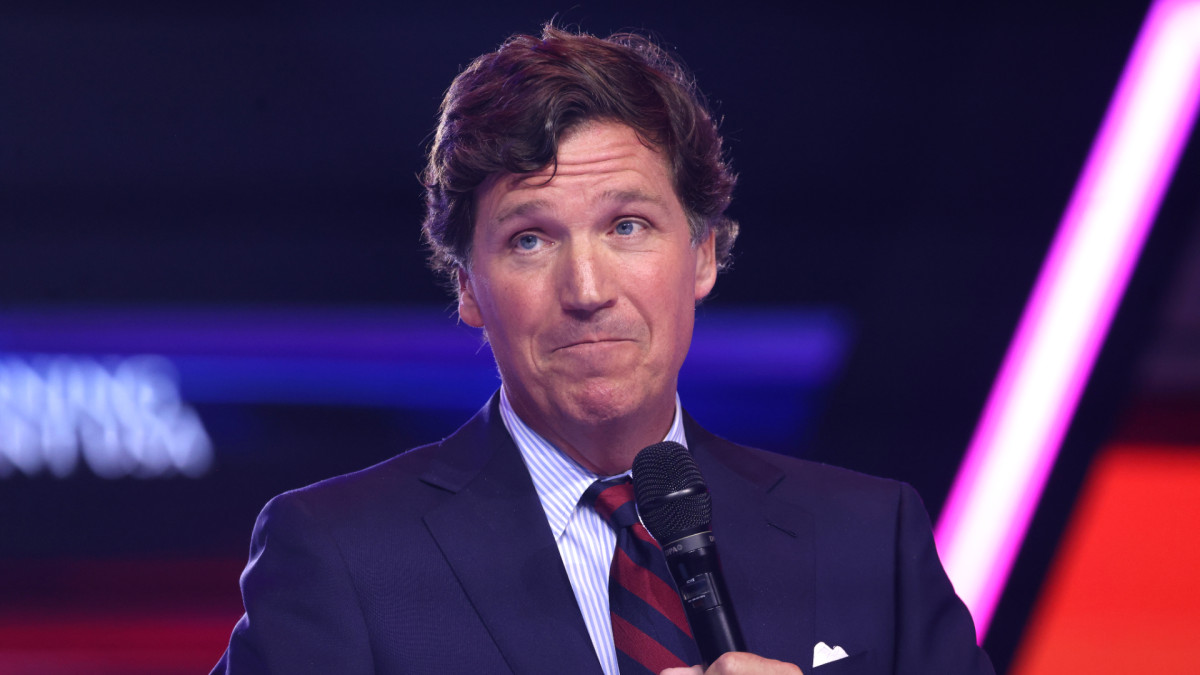
Let us imagine Tucker Carlson as a character from an American novel, or from any Netflix series: a man who began with a bow tie on CNN, aiming to establish himself as a benchmark of televised debate, but who ended up becoming the media preacher of the most populist right in the United States. His trajectory is the path of someone who learned that television does not reward subtleties nor conciliatory positions, but shrill certainty. In short, he became one of the champions of those who know that, in his country, politics is not won in Congress, but in the prime time.
If there is one thing the Make America Great Again movement has lived by (and has stirred the force of his bravado) is the idea that Americans feel betrayed by their elites . And, precisely, that is what voices like Tucker have learned to exploit in a country where the line between spectacle and politics is, on more than one occasion, indistinguishable. In the show Tucker Carlson Tonight, he offered a kind of sermon, a hybrid that mixed indignation with the show business, until Fox News let him go. And where did his furiously radical stance land? As is often the case, on social media: the place where the most controversial, uncomfortable, and extreme voices find a megaphone to be more free, more dangerous, less rigorous, and, of course, more influential.
“A journalist who left the practice of informing to become something of an oracle that delivers simple answers to the world’s great complexities”
He is the living image of that eternal paradox that underpins the US media empire: a journalist who left the practice of informing to become an agitator, a radical advocate, a kind of oracle that throws simple answers at the world’s great complexities. Ergo, in those talk-show hosts oropinion-makers who speak, not from information (and the standards of good journalism), but from the unjustifiable moral superiority that aims to sway votes.
Thus far, this would be the story, seen through the ultraconservative eyes of the United States, of “a great guy” (as Donald Trump described him, a month ago). But not anymore. Now Tucker Carlson has leaped without a parachute into the territory of controversy after questioning the Trump administration’s motives for striking Iran. Thanks to that, his figure is already in the public debate; he moved from being a spokesman for the MAGA movement to being the troublesome member. And, in light of that situation, the lash of Trumpism has not stood idly by: now the CIA accuses him of spying for Iran, and Carlson has stated the following: “They are preparing an indictment against me for talking to people in Iran”.
Then, this story—like everything that has happened recently in the United States—has become a triangle of tensions between a presenter with an ultraconservative activist vein, the CIA and the war in the country that could be the Achilles’ heel of the Trump administration, that is, Iran. We are talking, by the way, about a war that, as columnist Arwa Mahdawi notes in the British newspaperThe Guardian (and with Pentagon information), has already cost the American people $11.3 billion in just one week.
Un triángulo de tensiones que exhibe las grietas de la política trumpista
The relationship between Tucker Carlson, the CIA, and Iran seems straight out of a series whose plot is defined by intrigue: a journalist turned political actor, an intelligence agency that watches him warily and the new Trump-era enemy country that appears as the backdrop.
Since September 11, 2001, the security issue in the United States moved to the very top of both the national and international agenda. Since then, anyone can be suspected of anything. Carlson has not been an exception. Because this story began with the presenter’s controversial remarks; words that immediately put him on the ropes against the far-right wing of the Republican Party: “(The bombardments in Iran) are something absolutely abominable and evil.” Worse still—at least in the eyes of ultraconservatives—that stance is exactly the position of 59% of Americans who oppose the war, according to a CNN poll (it’s worth noting that another Reuters poll put the share at 43% opposed, 27% in favor and 30% undecided). That, of course, drew the CIA into the spotlight, in addition to the fact that he himself acknowledged having communications with people linked to Iran.
“Carlson played at being free (without ever having been), but that same freedom is what now, in theory, lands him on Trump’s blacklist”
In this way, his criticisms of military intervention and his alleged contacts with Iranian-linked figures turned him into an awkward figure for the current Government. However, what is curious here is that he is now the one being subjected to a game that he knew how to profit from for years: playing at being one thing and saying (or doing) another; selling himself as a professional of information and ending up as a political advocate. In short, Carlson played at being free (without having been), but that very freedom is what now, in theory, lands him on Trump’s blacklist.
Then, now he is the one who claims that the CIA is spying on him and that the Department of Justice is considering investigating him under a Foreign Agents Registration Act (FARA). That accusation, reported and developed in various outlets like The Guardian or POLITICO, reinforces the persecution narrative that he himself fuels: the journalist who challenges power and is punished for it.
But not everyone believes him. For example, journalist Michelle Goldberg, who published an article about it in The New York Times. In that piece, she argues that Carlson “acts in bad faith,” since he has no intention of informing or debating, but of generating paranoia and generalized distrust of U.S. democratic institutions.
Regarding this phenomenon, what Goldberg notes in the New York newspaper had already been warned by historian Timothy Snyder (for example, in his book On Tyranny: Twenty Lessons from the Twentieth Century—in Spanish, Sobre la tiranía: veinte lecciones sobre el siglo veintiuno). For him, these kinds of discourses depart from anything but innocence. That is, with that amplification of espionage ideas and the exaltation of a supposed victimhood, figures like Carlson (who manipulate the dirty game that politics often starts in show business) only seek destabilization and the delegitimization of democratic institutions so that external actors (Iran in this case) can profit from the distrust sown.
Because, at heart, the relationship between Carlson, the CIA, and Iran is not so much a direct link as a triangle (very tense) of perceptions: a communicator who plays with the idea of being pursued; an intelligence agency that fears the infiltration of hostile narratives and spies in times of extremely high military and political uncertainty; and a country (which has been affected by the United States, under supposed Israeli pressure,in the frame of the Epstein files’ disclosure) that is willing to seize any crack in the American system to raise its voice again. In short, as the aforementioned piece in The New York Times argues, “Carlson does not seek honest debate, but to provoke and delegitimize institutions”, and, it would seem, in that provocation, Iran appears as the perfect echo of a greater failure: that of an empire in distress, unable to control either its bombings or its dissents.
