
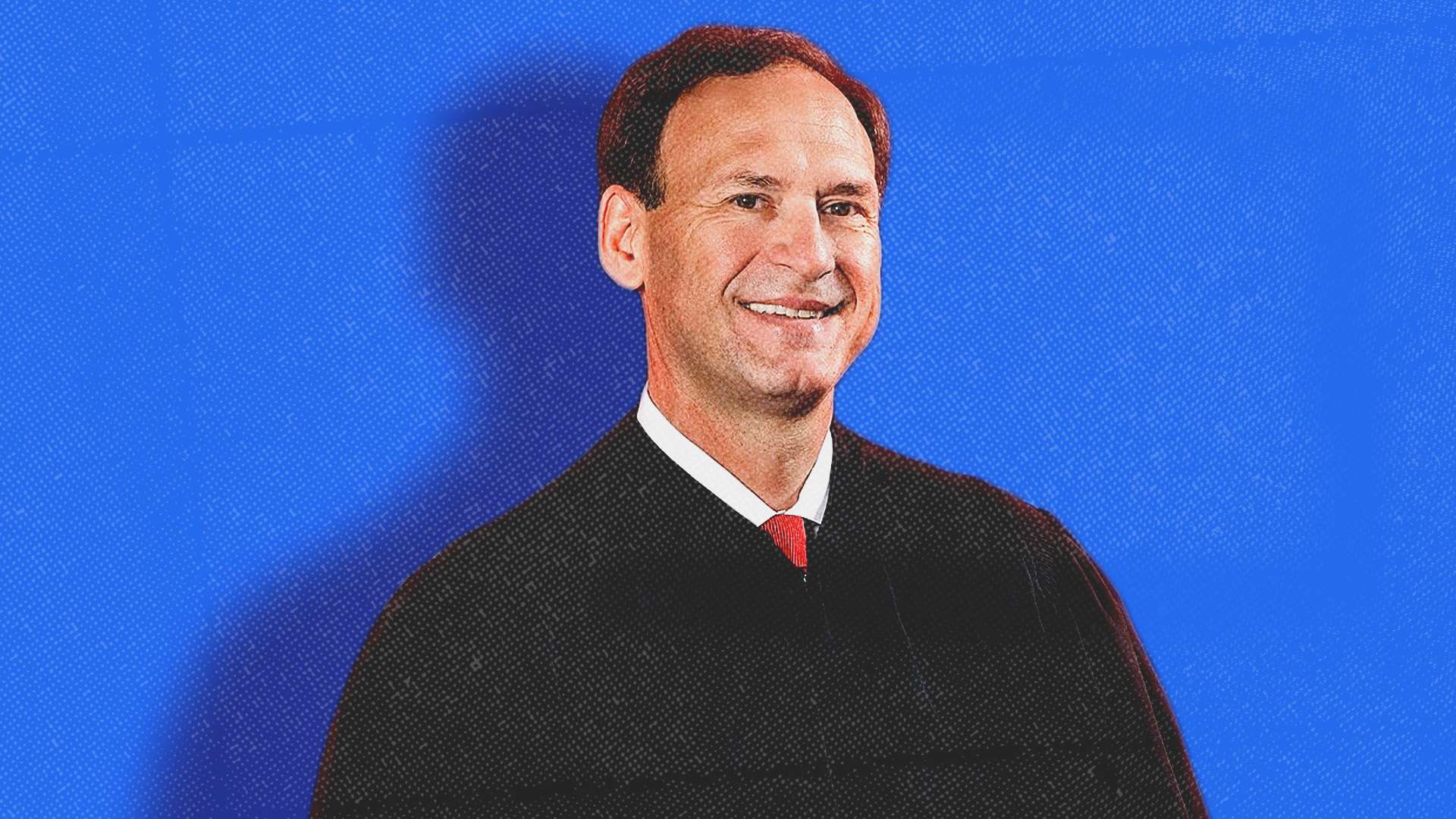
The Conservative Justice Remains on the Supreme Court. Will Conservatives Live to Regret It?
Do you recall the chatter that circulated earlier this year about an imminent retirement from the U.S. Supreme Court by Justice Samuel Alito? If you held out any lingering hopes or fears that those rumors might come true in 2026, Alito has now disabused you of them.
In conversations with The Wall Street Journal, the justice made clear that he intends to serve for another term. Ironically, the prospect of Alito staying on the bench a bit longer seems to be more welcome among progressives than among conservatives at the moment.
Conservatives were the ones who pressed for Alito to step down in the first place, hoping to head off a scenario in which a long-tenured justice could affect which party controls the White House or Senate and thus influence who would replace them. If the Republicans lose control of the Senate in this year’s midterm elections, those worries could become a reality.
The debate over whether a justice should retire has a long and turbulent history in modern American politics. Liberal scholars began publicly pressing for Ruth Bader Ginsburg’s retirement as early as 2011, when President Barack Obama’s re-election prospects were still uncertain. Randall Kennedy, writing in The New Republic, warned that Ginsburg’s failure to retire might contribute to a national political disaster if Obama were defeated. A few years later, as Democratic prospects in the Senate dimmed during Obama’s second term, Erwin Chemerinsky amplified a similar plea in the Los Angeles Times, arguing that only by resigning that summer could Ginsburg help ensure that a successor sharing her views would be chosen by a Democratic president.
Chemerinsky’s reasoning proved prescient in its own way. In 2016, when Obama attempted to nominate Merrick Garland to the Supreme Court after the sudden death of Justice Antonin Scalia, the Republican-controlled Senate effectively filibustered, stalling the nomination and leaving the seat open until Republicans captured the White House in the November election. That victory allowed President Donald Trump to appoint Neil Gorsuch to the Court in 2017.
Thus, Ginsburg’s opportunity to retire while a Democratic president could still install a like-minded successor slipped away. She remained on the bench until her death in 2020 at age 87, after which the seat was filled by a Trump appointee, Amy Coney Barrett.
Against this backdrop, Alito reflected on his own non-retirement plans in comments to The Wall Street Journal. He acknowledged that the topic is unpleasant because it underscores human mortality, but he framed life tenure as a natural aspect of the judiciary’s design. The image of vultures circling a long-tenured justice has, in effect, become a metaphor for the political pressure surrounding retirement—pressure that Alito says exists, but that he can endure.
In a broader sense, there is a striking parallel between Alito’s stance and the late Justice Ginsburg’s approach. Like her, he seems inclined to keep performing a job he finds meaningful for as long as his abilities allow, even as critics and allies alike weigh the strategic implications. He appears, at least publicly, content to continue serving in a role many would argue is among the most consequential in the nation, while disregarding the external din from those who would rather see him step aside for the sake of political calculation.
The question that lingers is not only whether Alito will remain for another term, but what his continued presence will mean for the court’s balance and for the political dynamics surrounding future appointments. If conservatives find themselves boxed in by a stalemate between the bench and the political branches, they may someday rue the stubborn persistence that keeps a longtime conservative voice on the court well into a generation of decision-making. Conversely, if the court’s trajectory continues to rely on a single voice kept in place by life tenure, opponents may worry that the balance of the court becomes less a product of timely political alignments and more a reflection of individual endurance.
As events unfold, both sides will watch closely how Alito’s continued service shapes jurisprudence, how it influences the timing of future vacancies, and how parties adapt their strategies around a court that remains anchored by a justice who shows no rush to depart. The saga raises a fundamental question about the governance of the judiciary: does enduring tenure strengthen the court’s stability, or does it risk entrenching a political status quo that no longer aligns with the electorate’s changing priorities? The answer, for the moment, rests with Justice Alito’s own decisions and with the evolving political landscape that frames every retirement conversation on the Supreme Court.
