
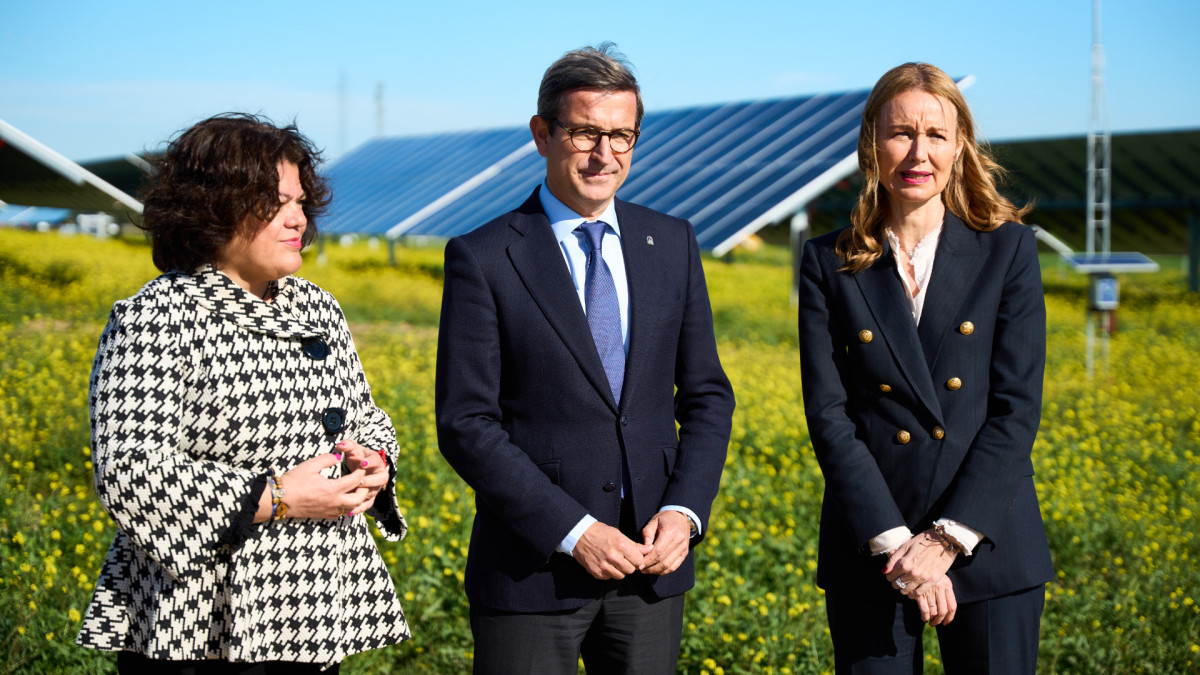
“Clean energy at competitive prices is one of the great economic opportunities for Andalusia. Today, we have more than 3,000 new industrial projects that have chosen this region thanks to the contribution of photovoltaics to our community.”
This sentence comes from Jorge Paradela, the Junta de Andalucía’s Minister of Industry, Energy and Mines, spoken two years ago at a photovoltaic sector conference. It was not a phrase designed for show; on the contrary, he has said it in many other forums. At the end of last year, for example, I read a similar declaration: “We want to reach 20 GW by the end of 2026 and be in the European top (…) we want this position for several reasons, among them is the importance of decarbonizing the economy, fighting climate change; but, above all, because it is a factor of investment localization, since clean energy in a territory attracts capital.”
“One of the first things that industrial investors ask is whether there is access in the region to competitive renewable energy”
Andalusia is one of the regions that has developed the most renewables in recent years. Its Government has understood that its solar potential, the largest in Europe, was its differential factor to attract industry in a region where the weight of industry has traditionally been low. Anyone with experience in administration in recent years knows that one of the first things potential industrial investors ask is whether there is access in the region to competitive renewable energy.
Moreover, one of the fundamental factors in the price competitiveness of Spanish electricity is that part of it can be obtained through solar self-consumption systems. Industrial self-consumption is one of the great competitiveness factors of our industries, often thanks to ground-mounted solar parks that connect directly to the factories themselves, so they must be close to them. For large consumers that operate around the clock, it can account for 30% of their electricity consumption, while for consumers who do not operate at night it can exceed 50%. This is a treasure that must be defended, despite the old-fashioned and shortsighted arguments that have resurfaced in some CNMC reports.
In fact, the expected success of Spanish projects in the European Industrial Decarbonisation Bank (IDB) auction for industrial heat decarbonisation comes precisely from those percentages of ultra-cheap solar energy, which reduce the average bill and place us among the most competitive electricity prices for industry in Europe. We are benefiting from European competitive processes thanks to this, let us not forget.
However, clouds are beginning to form on the horizon. The recent government agreements in Extremadura and Aragon have brought us a striking pact with identical wording in both cases: “The Government of (Extremadura/Aragón) commits to using all the legal and administrative means necessary to promote the non-installation of large photovoltaic and wind parks on productive soils, in lands of traditional use — including grazing routes — and on those soils where there would be an impact on natural heritage.”
What does this mean? Initially, we do not know. It could be empty rhetoric or an attempt at a generalized prohibition of renewable projects, in the purest Donald Trump style. In any case, this paragraph is a real threat to renewable development and, therefore, to the very industrial developments that seek this energy. Its drafters will probably think it won’t affect them at all, since perhaps they won’t apply these restrictions to strategic projects, but for strategic projects to come to your region, you must project commitment and guarantees with renewable development, precisely the opposite of what this pact projects.
“Demagoguery and a misunderstanding of what a model industrial requires, unfortunately, does not seem to be the exclusive heritage of a single political sector”
In the same vein, a few days ago the Por Andalucía candidate made some surprising statements indicating that he would not allow renewable developments on fertile lands, only on barren lands. “Not a single hectare,” he literally said. The declared intent was identical to what any radical-right politician could have said. Demagoguery and a misunderstanding of what a model industrial requires, unfortunately, do not seem to be the exclusive heritage of a single political sector.
Renewable developments have not always been well executed, but that does not justify such proposals. Agricultural land is land transformed, suitable for renewable development, and, in the overwhelming majority of cases (and in all cases in many autonomous communities), its change of use is done with the agreement of its owners. To treat productive agricultural land as sacrosanct is not only ridiculous in a country that is a major exporter of food, but also reveals the intent to maintain an agrarian and agrarianist society. Let us remember that Andalusia is the autonomous community with the smallest share of Spain’s industrial GDP, ranking only after the islands (focused on tourism) and Madrid (as administrative and economic capital).
“If you restrict renewable development, how on earth will you electrify the country? You will be helping to maintain dependence on fossil fuels”
And at this very moment there are opportunities on the horizon that argue for ambition. They are no longer just those large renewable parks directly connected to energy-intensive industries; after Royal Decree-Law 7/2026, collective self-consumption on rural land is now allowed as long as its size does not exceed five MW (a little under ten hectares). These parks could be near industrial parks and offer very cheap electricity to industrial SMEs that cannot afford their own self-consumption systems. If you prohibit productive soils from being used for these developments, you will not only hinder the attraction of industry, but you will harm your own SMEs. If you restrict renewable development, how on earth will you electrify the country? You will be helping to maintain dependence on fossil fuels sold to you by Trump, Putin, and those countries located in the powder keg of the Middle East.
Andalusia was the example that established the belief that renewable development had already become a broad political consensus in Spain and would not be conditioned by political changes. Now, in light of the precedents, this conviction is in doubt. We hope that the cultural battles of this era do not fracture this consensus. It would be bad for Spain, very bad for Andalusia, and it would push us down a very dark path, where something supported by around 80% of the Spanish population and objectively good for the country could end up sidelined by cultural battle dynamics, political demagoguery, and ideological intransigence.
