
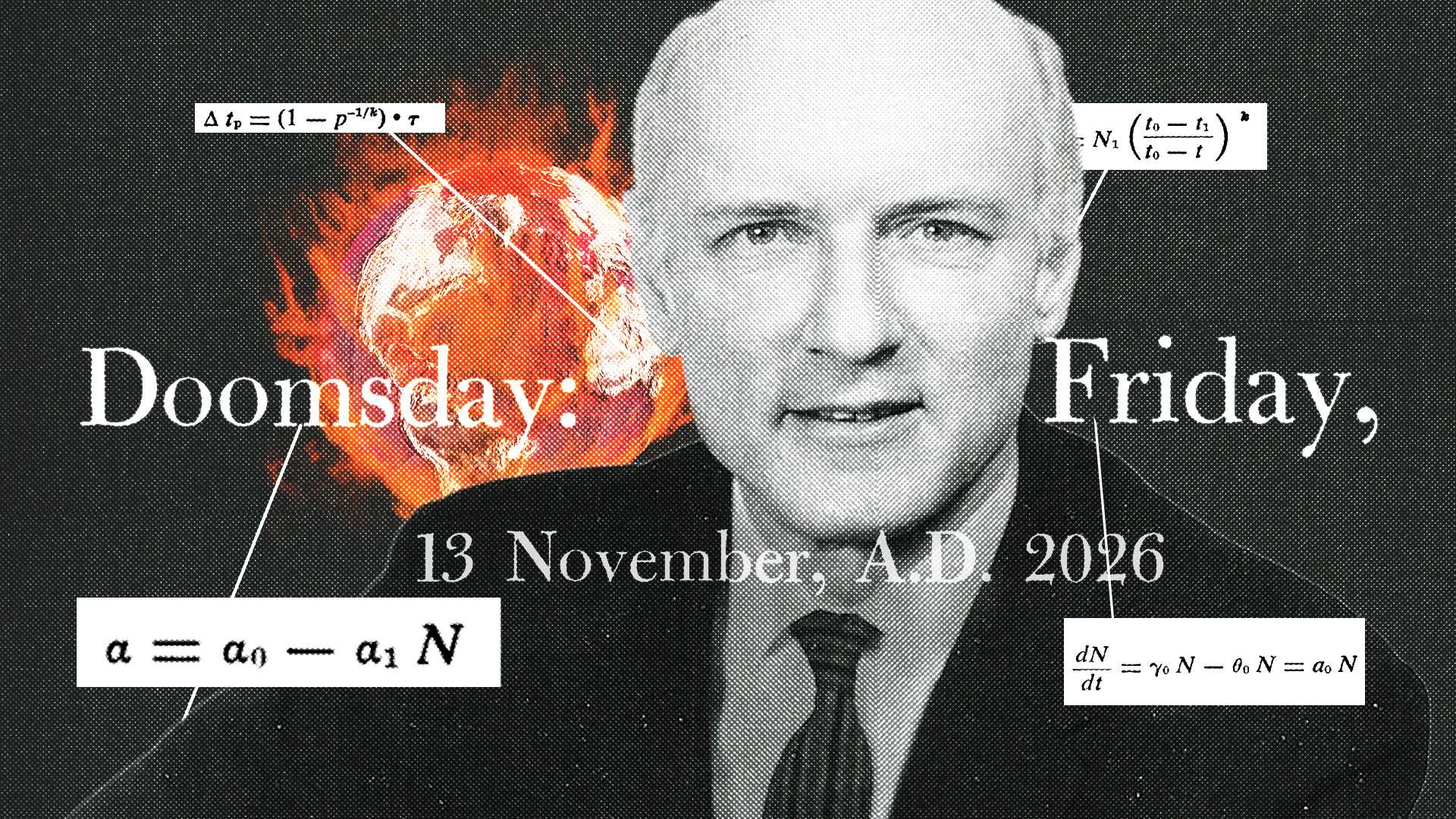
Back in 1960, a Science article forecast that humanity would vanish on November 13, 2026. Have you prepared?
Those who fear Friday the 13th can breathe a sigh of relief. The doom scenario has not materialized. Sixty-six years ago, physicist Heinz von Foerster and colleagues argued in their paper, “Doomsday: Friday, 13 November, A.D. 2026” that the human race would reach its end today. Why? Because, as The The New York Times reported, Foerster concluded that on this date “the human population will have expanded so far as to approach infinity and thus will automatically annihilate itself.” Unannihilated, we are still here.
To reach that apocalyptic conclusion, Foerster and his coauthors noted that the doubling time of global population growth had been shrinking, and they essentially projected that trend forward.

Foerster observed that “the optimists” hoped that, at some point, somehow, something would intervene to halt this ever-accelerating race toward self-destruction. Later in the decade, biologist Paul Ehrlich would reinforce Foerster’s doomsday forecasts in his book The Population Bomb. In 1968 Ehrlich famously proclaimed, “The battle to feed humanity is over. In the 1970s, the world will undergo famines–hundreds of millions of people are going to starve to death in spite of any crash programs embarked upon now.”
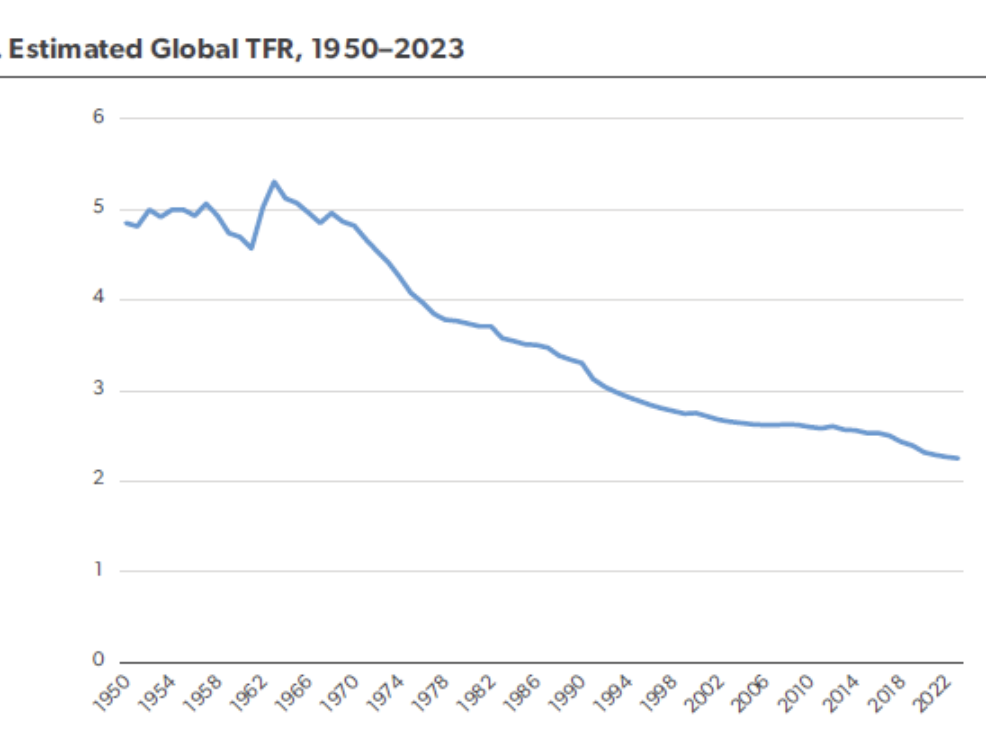
As it happened, both men were making their grim predictions at a time when global fertility was peaking and then began to fall. In the early 1960s, the worldwide total fertility rate stood at roughly five children per woman over her lifetime. Today, the global rate sits just above the replacement level of 2.1 children, and some demographers argue it has slipped below that threshold. Foerster and Ehrlich did not account for the demographic transition, in which wealthier, healthier populations opt for smaller families.
Unlike every other species, humans do not simply convert more food into more offspring by instinct.
In any case, these grim population forecasts helped justify coercive policies, including China’s one-child policy and compulsory sterilization in India. Rather than spiraling toward infinity, the United Nations most recently projects that the world’s population will rise from about 8.2 billion today to roughly 10.3 billion in the 2080s, before easing to around 10.2 billion by the century’s end. In other words, humanity will not double again. Indeed, some demographers now worry about the opposite trend: depopulation.
For instance, another physicist, Victor Yakovenko, regards the UN’s projections as far too optimistic. Unshaken by Foerster’s extrapolations, Yakovenko applies “social physics”—the use of mathematical methods from physics to analyze social phenomena—and predicts a population peak in 2030 at about 8.23 billion, followed by a decline. In fact, Yakovenko argues the world population could fall to around 5.82 billion as soon as 2062, a level it hovered around back in 1996.
In a recent Science article critiquing Foerster’s hyperbolic extrapolations, economist Javier Birchenall notes, “If we were to assume that Japan’s current annual natural decrease of 0.77 percent represented a universal and lasting trend, we would predict that the planet will be devoid of people on Tuesday, 5 May 3108.” A thousand eighty-two years from now, there would be no one left to toast Cinco de Mayo with tequila.
Epidemiologist Mark Woolhouse, writing in The Conversation, remarks, “The latest doomsday will pass without incident, but there’s always another looming on the horizon – it’s a recurring theme in human history.” For now, though, enjoy Friday the 13th, everyone.
